Most FIRE (Financial Independence, Retire Early) plans look good on a spreadsheet.
Savings rate optimized.
Expenses minimized.
Withdrawal rate calculated down to the decimal.
And yet, many people pursuing FIRE feel constantly tight, anxious, or one bad month away from derailment.
Not because the math is wrong—but because something essential is missing.
That missing variable is financial slack.
The Problem With “Tight” FIRE Plans
Traditional FIRE advice often rewards efficiency:
- Maximize savings rate
- Minimize expenses
- Cut everything non-essential
- Optimize the timeline
In theory, this gets you to financial independence faster.
In practice, it often creates a fragile system.
One that works only if:
- Income stays stable
- Health cooperates
- Motivation stays high
- Nothing unexpected happens
Real life rarely agrees.
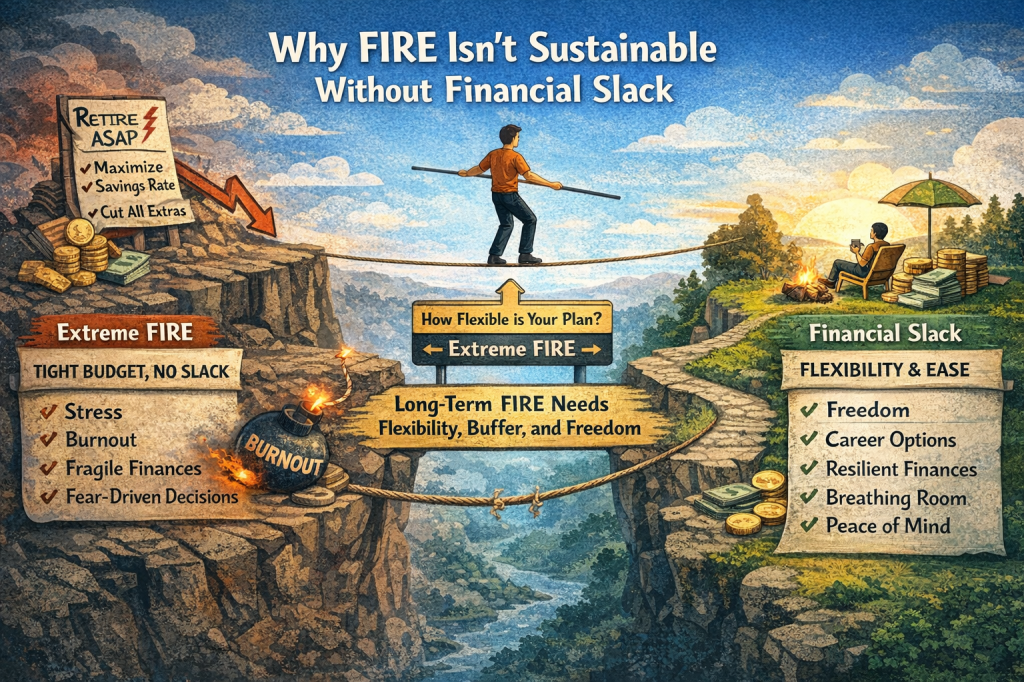
FIRE plans that run too tight don’t fail financially.
They fail psychologically and operationally.
What Is Financial Slack?
Financial slack is unused capacity in your financial system.
It’s the buffer that absorbs shocks, buys time, and preserves choice.
Examples:
- Spending below your comfort ceiling—not your tolerance floor
- Having margin in your savings rate
- Being able to say no to bad work
- Flexibility to increase spending without stress
- Room to make suboptimal decisions without damage
Slack is not laziness.
Slack is resilience.
Why Slack Matters More Than Optimization
Highly optimized systems break easily.
This is true in engineering, biology, and finance.
When every dollar is assigned a job, there’s no room for:
- Mistakes
- Learning
- Life transitions
- Health fluctuations
- Changing priorities
A FIRE plan without slack assumes a static world.
But the real world is dynamic.
The Hidden Cost of Zero Slack
When financial slack disappears, several things happen—quietly.
1. Decision Quality Declines
Tight finances force short-term thinking.
You choose:
- Higher-paying work over better work
- Familiar options over better ones
- Immediate relief over long-term benefit
Slack improves decisions by removing urgency.
2. Burnout Accelerates
Extreme saving often shifts from empowering to exhausting.
Every expense feels like a moral failure.
Every splurge feels dangerous.
Every setback feels catastrophic.
This isn’t discipline.
It’s chronic stress.
Burnout doesn’t just slow FIRE—it often ends it.
3. FIRE Becomes Brittle
Plans that depend on:
- Perfect market returns
- Continuous employment
- Minimal spending forever
…have no shock absorption.
The moment reality deviates, panic sets in.
Slack is what keeps FIRE functional when the model breaks.
Financial Slack vs. Emergency Funds
Emergency funds are static.
Financial slack is structural.
Emergency fund:
- One-time buffer
- Finite
- Used reactively
Financial slack:
- Built into daily life
- Renewable
- Used proactively
You can have an emergency fund and still live tightly.
Slack shows up in how relaxed your finances feel, not just your account balances.
Why Extreme FIRE Strategies Struggle Long-Term
Extreme FIRE works best for:
- Short time horizons
- Highly predictable lifestyles
- People willing to tolerate discomfort indefinitely
But most people don’t want:
- Permanent austerity
- Identity defined by frugality
- A life optimized for spreadsheets instead of satisfaction
Financial independence should expand life, not shrink it.
Slack is what allows that expansion.
Slack is what turns FIRE into a lifestyle
Without slack, FIRE is a finish line.
With slack, FIRE becomes a mode of living.
Slack allows:
- Coast FIRE
- Sabbaticals
- Career experimentation
- Geographic flexibility
- Gradual transitions instead of abrupt exits
This is why many people feel happier before hitting their FIRE number.
They’re experiencing slack—often unintentionally.
The Paradox: Slack often accelerates FIRE
This feels counterintuitive, but it’s real.
Financial slack can actually speed up progress by:
- Reducing burnout
- Improving career decisions
- Enabling higher-quality work
- Preventing costly mistakes
- Sustaining motivation longer
A plan you can maintain beats an aggressive plan you abandon.
How to Build Financial Slack (Without Derailing FIRE)
Slack doesn’t require spending irresponsibly.
It requires rebalancing priorities.
1. Build a “Comfort Budget,” Not a Minimum Budget
Most FIRE plans optimize for minimum viable spending.
Instead, identify:
- Your comfortable spending level
- The level where life feels easy, not constrained
Then:
- Live slightly below that
- Save the difference
Slack lives in the gap between comfort and actual spending.
2. Design Variable Expenses
Fixed expenses kill slack.
Variable expenses preserve it.
Examples:
- Flexible travel instead of fixed luxury
- Scalable hobbies
- Optional subscriptions
- Housing choices that allow downsizing or relocation
The more adjustable your spending, the more resilient your FIRE plan.
3. Maintain Optional Income
Financial independence isn’t binary.
Even small amounts of optional income:
- Extend runway
- Reduce withdrawal stress
- Improve psychological safety
Slack increases dramatically when income is optional rather than required.
4. Optimize for Recovery, not just Growth
Most FIRE plans obsess over accumulation.
Few plan for:
- Energy recovery
- Career plateaus
- Health fluctuations
- Motivation cycles
Slack accounts for the human system—not just the financial one.
Slack Changes How You Experience Money
With slack:
- Money feels quieter
- Decisions feel lighter
- Trade-offs feel intentional
- Setbacks feel manageable
Without slack:
- Every expense is loaded
- Every choice feels risky
- Every surprise feels like failure
The difference isn’t net worth.
It’s margin.
Financial Slack is anti-fragile
Systems with slack don’t just survive stress.
They improve under it.
- Market downturns become buying opportunities
- Career changes become experiments
- Time becomes a resource instead of a constraint
This is the real power of FIRE—not early retirement, but resilience.
Why this matters more after FIRE
Ironically, slack matters more after reaching FIRE.
Once you’re living off investments:
- Small errors matter more
- Stress compounds faster
- Flexibility becomes priceless
Lean FIRE without slack often leads to:
- Constant withdrawal anxiety
- Lifestyle rigidity
- Fear-driven decisions
Sustainable FIRE feels boring—in the best possible way.
A Better Mental Model for FIRE
Instead of asking:
“How fast can I reach my number?”
Ask:
“How much flexibility does my life have right now?”
Progress isn’t just distance to FIRE.
It’s how much pressure your life can absorb.
Final thought: Slack is the Point
FIRE without slack is just delayed stress.
FIRE with slack is freedom in motion.
Financial independence was never about hitting a number.
It was about creating a life that can bend without breaking.
If your FIRE plan doesn’t leave room to breathe, it isn’t done yet.
 VD
VD 
Leave a reply to How to Reduce Financial Stress Without Earning More (The Lifestyle Beta Approach) – VD Cancel reply