Most people associate meaningful travel with discomfort.
Cheap buses. Red-eye flights. Bad sleep. Heavy backpacks. Constant novelty. There’s an unspoken belief that real travel requires endurance—and that comfort somehow dilutes authenticity.
That belief works for short trips.
It quietly breaks long-term travel.
If you travel for weeks or months, comfort isn’t indulgence. It’s infrastructure. Done well, it becomes a force multiplier – extending your energy, attention, health, and curiosity. Done poorly, its absence turns travel into a slow drain that ends early, often without you realizing why.
This post is about why comfort prevents travel burnout, what comfort actually means (it’s not luxury), and how to design a travel system that lets you travel longer by trying less hard.
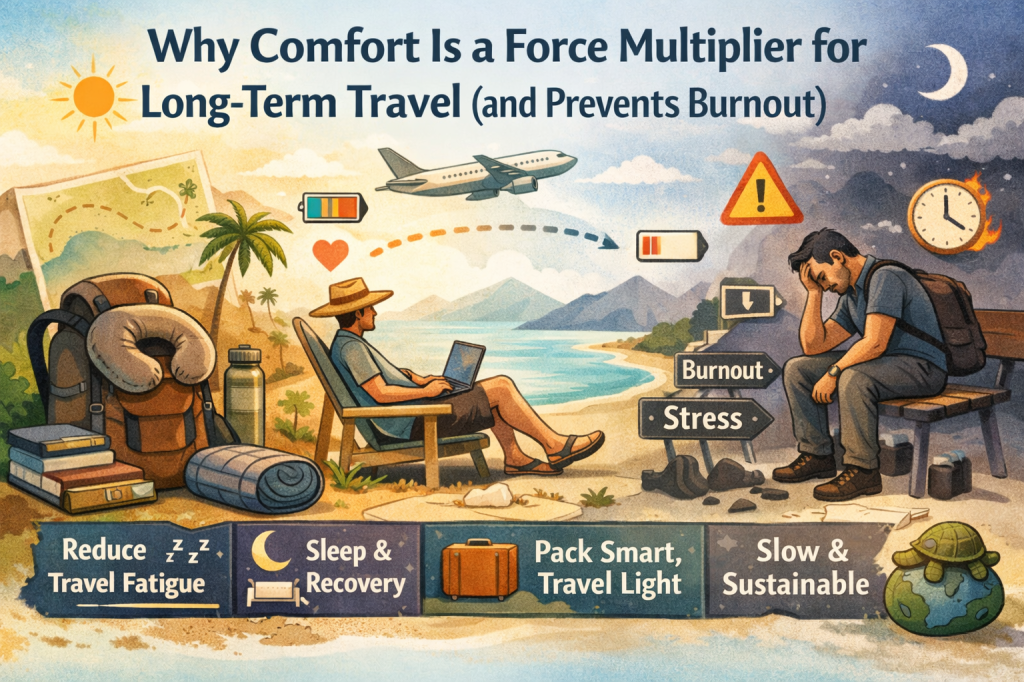
The burnout curve of long-term travel
Travel burnout rarely arrives dramatically.
It doesn’t announce itself as exhaustion. It shows up subtly:
- Shorter attention spans
- Irritability over small inconveniences
- Choosing cafés and screens over exploration
- A vague sense that “everywhere feels the same”
Most people assume burnout comes from too much travel.
More often, it comes from too much friction.
Each small discomfort—poor sleep, awkward logistics, constant noise, heavy bags—takes a tiny withdrawal from your energy budget. On a one-week trip, you barely notice. Over months, those withdrawals compound.
I’ve written before about this idea in The Energy Budget of Travel, where energy – not time or money – is the real limiting factor. Comfort slows the drain.
Not by eliminating challenge or novelty, but by removing unnecessary resistance so your limited energy can be spent on what actually matters: learning, connection, exploration, reflection.
Comfort is not luxury
When people hear “comfort,” they picture:
- Five-star hotels
- Business-class flights
- Expensive upgrades
That’s not what sustains long-term travel.
Comfort is about fit, not excess.
It’s the difference between:
- A chair that doesn’t hurt your back vs. an expensive one
- A quiet room vs. a stylish one
- A reliable routine vs. endless novelty
Comfort reduces background stress. Luxury often just adds cost.
In long-term travel, comfort means your body and mind can operate near baseline—even in unfamiliar places. This idea overlaps strongly with Comfort-Optimized Travel, where the goal isn’t indulgence but removing friction that quietly drains you.
Comfort as a force multiplier
A force multiplier doesn’t add effort. It amplifies the effort you already make.
Comfort multiplies three things that determine how long you can travel.
1. Energy
Good sleep, manageable walking distances, predictable meals—these don’t make travel exciting. They make everything else possible.
When energy is stable:
- You explore longer
- You say yes more often
- You recover faster from bad days
When it isn’t, even incredible destinations feel heavy.
This is why travelers who ignore recovery often burn out early. As I argued in Recovery Is a Skill, recovery doesn’t happen automatically just because you stop moving—it has to be designed.
2. Attention
Discomfort fragments attention.
If you’re constantly thinking about:
- Where to charge your devices
- Whether your bag is safe
- How long you can tolerate your seat or shoes
You’re not present.
Comfort frees cognitive bandwidth. You notice details. You remember conversations. You absorb a place instead of surviving it. This is one reason slow travel tends to feel richer than rapid movement, a theme I explored in Why Repeating Destinations Beats Chasing New Ones.
3. Emotional Regulation
Long-term travel stretches identity, routine, and belonging.
Layer chronic discomfort on top and small setbacks feel personal. Missed buses feel like failures. Minor hassles feel unfair. Comfort provides emotional margin—the ability to respond rather than react.
This is why comfortable travelers often appear calmer, not softer.
Why discomfort causes travel burnout
Discomfort accelerates burnout through three mechanisms.
Accumulation
Most discomforts are minor. Their damage comes from repetition.
A bad pillow once is annoying. A bad pillow for 30 nights reshapes mood, patience, posture, and health. The same applies to noise, poor seating, heavy loads, and constant temperature stress.
Decision fatigue
Constantly solving basic problems—where to eat, how to sleep, how to move—consumes decision energy.
Comfort automates the basics.
This is similar to why systems outperform motivation, a broader idea I explored in Why Systems Beat Motivation. When the basics are handled, your mind is free for curiosity instead of logistics.
Identity drift
When travel feels like constant struggle, your identity narrows to logistics manager.
You stop being a learner, observer, or participant. You become someone who is always catching up. Comfort gives you your role back.
Designing comfort without killing adventure
The common fear is that comfort makes travel dull.
In practice, the opposite happens.
Comfort allows you to choose discomfort deliberately – for hikes, long walks, language challenges, or cultural stretch – rather than being surrounded by it all day.
You don’t want your entire day to be hard. You want specific parts of it to be challenging.
The four pillars of sustainable travel comfort
1. Sleep is non-negotiable
Sleep quality determines everything downstream.
Design for:
- Quiet over perfect location
- Consistency over novelty
- Darkness and temperature control
A slightly worse view with better sleep beats a perfect location that drains you. This aligns closely with the principles in The Sleep Efficiency Blueprint – more rest from the same hours.
2. Movement with less friction
Long-term travel increases walking. The problem isn’t distance – it’s how you move.
Comfortable shoes, lighter bags, shorter daily distances reduce joint and nervous system fatigue. Over months, this matters more than any single workout or hike.
Your body is the vehicle. Treat it accordingly, a theme echoed in Training for Longevity and Movement Snacks.
3. Familiar anchors
Familiarity reduces cognitive load.
Anchors might include:
- Returning to the same neighborhood
- Repeating cafés or walking routes
- Keeping a morning routine
Anchors don’t limit exploration. They stabilize it. This is why slow travel often creates deeper experiences than constant novelty, as discussed in Slow Travel: Why Staying Longer Saves Money and Creates Richer Experiences.
4. Pack for recovery, not just mobility
Most packing lists optimize for movement.
Long-term travel requires recovery tools:
- Sleep aids
- Simple mobility or stretching tools
- Clothing that works indoors and out
This overlaps with ideas from Minimalist Packing List – not packing less for its own sake, but packing better.
The comfort threshold
Every traveler has a comfort threshold – the minimum conditions required to stay curious rather than depleted.
Travel below it and you last weeks.
Travel above it and you last months or years.
The threshold changes with:
- Age
- Health
- Season
- Stress outside travel
Ignoring it isn’t toughness. It’s poor system design.
Why comfortable travelers go farther
The travelers who last longest aren’t the most hardcore.
They are the ones who:
- Eliminate avoidable friction
- Spend money where it buys energy
- Repeat what works
- Recover early, not late
This is the same principle behind sustainable FIRE (Financial Independence, Retire Early) and long-term health: endurance beats intensity when the timeline is long.
Comfort doesn’t make travel less meaningful.
It makes meaning sustainable.
The Deeper Lesson
This applies beyond travel.
Any long-term pursuit – health, learning, financial independence – fails when it relies on constant endurance. I’ve written about this pattern repeatedly, whether in Why FIRE Isn’t Sustainable Without Financial Slack or Designing a life that travels well.
Comfort is not weakness.
It’s slack.
And slack is what allows systems to survive contact with real life.
Design travel that your future self can maintain.
You won’t see less of the world.
You’ll see it more clearly.
 VD
VD 
Leave a comment