Most performance advice is complicated.
Optimize your diet. Periodize your strength training. Time-block deep work. Engineer your sleep environment. Track your HRV.
All useful.
But there’s one lever that is simpler, faster, and more immediate than any of them:
Your breath.
Breathing is not just automatic. It’s trainable. And once you treat it as a skill — not a background process — it becomes the simplest upgrade you can make to your nervous system.
If you care about stress resilience, focus, longevity, or sustainable performance, learning to breathe properly is foundational.
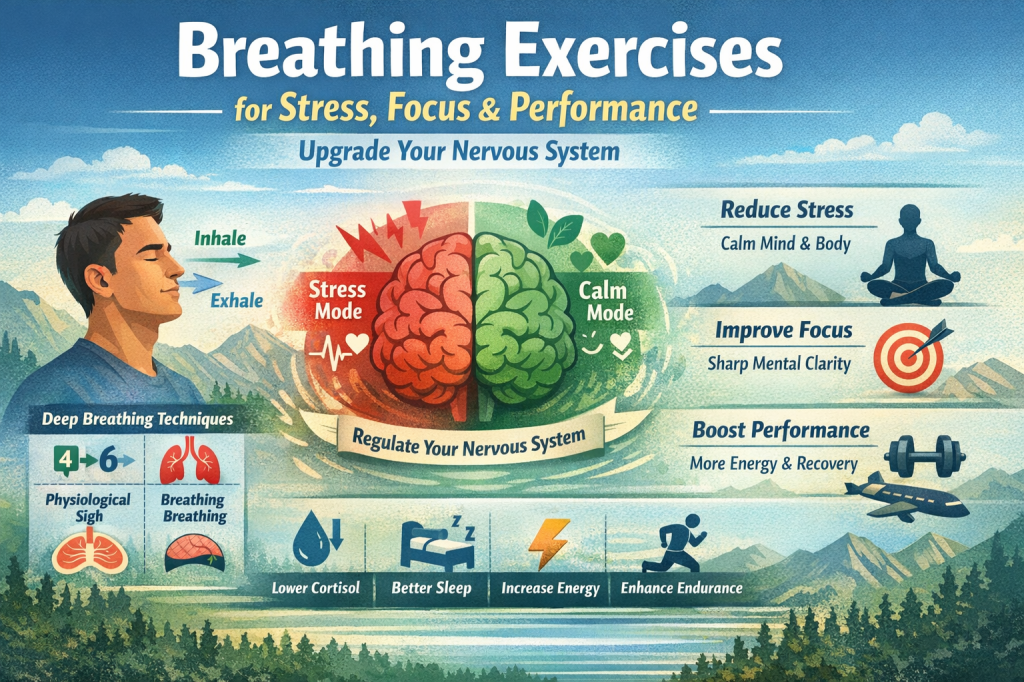
The Nervous System Is the Real Performance Engine
Stress, burnout, brain fog, poor sleep, tension headaches, shallow focus — these are rarely discipline problems.
They’re nervous system problems.
In How Desk Work Affects Your Nervous System: The Physical Cost of Focus, I wrote about how modern cognitive work pushes us into chronic low-grade fight-or-flight. Screens, deadlines, constant context switching — they keep the sympathetic nervous system slightly elevated all day.
When this becomes your baseline, everything suffers:
- Focus becomes fragile
- Recovery slows
- Sleep quality declines
- Muscle tension accumulates
- Emotional reactivity increases
You can’t out-productivity a dysregulated nervous system.
But you can regulate it — directly — through breathing.
Because breathing is the only autonomic function you can consciously control.
And that makes it a master switch.
Why Breathing Works (Physiologically, Not Mystically)
Breathing influences:
- Heart rate
- Blood pressure
- Carbon dioxide levels
- Vagal tone
- Muscle tension
- Mental state
When you breathe quickly and shallowly through your chest, your body interprets that as a stress signal.
When you breathe slowly, deeply, and with long exhales, you activate the parasympathetic nervous system — the “rest and digest” side.
This is not wellness folklore. It’s biology.
Slow breathing:
- Lowers heart rate
- Improves heart rate variability
- Reduces cortisol
- Increases emotional regulation
- Improves attentional control
If you’ve read Energy Management vs Time Management, you know energy precedes productivity.
Breathing is energy regulation at the source.
The Modern Breathing Problem
Most adults don’t breathe well.
Common patterns:
- Mouth breathing
- Shallow chest breathing
- Rapid, unconscious breathing
- Constant low-level breath-holding while focusing
That last one is especially common in developers, writers, and readers.
You lean toward the screen.
You concentrate.
You subtly hold your breath.
Over hours, this creates:
- Neck tension
- Tight hip flexors
- Fatigue
- Reduced oxygen efficiency
- Chronic sympathetic activation
It’s part of what I described in Digital Posture: How Screens Reshape Your Body (and How to Fix It Fast) and The Hidden Injuries of Sitting All Day (and How to Fix Them Early).
Posture and breathing are inseparable.
Fix one, and you influence the other.
Breathing as a Skill (Not a Relaxation Trick)
Most people use breathing exercises only when stressed.
That’s reactive.
Instead, think of breathing like strength training:
You don’t train only when weak.
You train to build capacity.
In Training for Longevity: How to Exercise for Long-Term Health, Not Just Looks, I argued that we should train for decades, not aesthetics.
The same applies to breathing.
You are training:
- CO₂ tolerance
- Nervous system flexibility
- Emotional regulation
- Recovery speed
Breathing practice builds what I’d call autonomic optionality — the ability to shift states on demand.
That’s performance.
Three Simple Breathing Exercises (That Actually Work)
You don’t need 20 techniques.
You need 2–3 reliable tools.
1. Physiological Sigh (Fast Stress Reset)
Best for: acute stress, pre-meeting nerves, emotional spikes.
How:
- Inhale through nose
- Take a second short sip inhale
- Long slow exhale through mouth
- Repeat 3–5 times
This quickly reduces stress by increasing carbon dioxide release and activating parasympathetic pathways.
Use it:
- Before a difficult conversation
- After a stressful email
- When you feel tension building
Think of it as a nervous system reset button.
2. 4–6 Breathing (Daily Regulation Practice)
Best for: baseline stress reduction and focus.
How:
- Inhale through nose for 4 seconds
- Exhale through nose for 6 seconds
- Continue for 5 minutes
Longer exhales bias the parasympathetic system.
Do this:
- Before deep work
- After work to transition out of “task mode”
- Before sleep
In How to Improve Focus Before Deep Work: Simple Mental Warm-Up Rituals, I emphasized the importance of pre-focus rituals.
Breathing is the most efficient warm-up available.
Five minutes of 4–6 breathing before a work block can dramatically improve attentional stability.
3. Diaphragmatic (Belly) Breathing
Best for: posture correction and chronic tension.
How:
- One hand on chest, one on belly
- Breathe so the belly rises first
- Keep chest relatively still
- Slow, nasal breathing
This retrains the diaphragm to do its job.
Benefits:
- Reduces neck tension
- Improves oxygen efficiency
- Stabilizes the spine
- Enhances endurance
If you’ve read Posture, Breath, and Walking: Three Simple Habits That Improve Health and Longevity, you know walking and posture amplify breathing mechanics.
They are a system.
Breathing and Cognitive Performance
Breathing doesn’t just calm you down.
It improves thinking.
Slow nasal breathing increases prefrontal cortex activity — the part responsible for executive function, impulse control, and complex reasoning.
In Learning Like an Investor: How to Allocate Attention for Long-Term Growth, I discussed attention as a finite capital allocation problem.
Stress consumes attention bandwidth.
Regulated breathing expands it.
You’ll notice:
- Fewer intrusive thoughts
- Less urgency bias
- Better working memory
- Reduced mental fatigue
It’s not that breathing makes you smarter.
It reduces interference.
And removing interference often matters more.
Breathing and Physical Performance
Breathing affects:
- Strength output
- Endurance
- Recovery speed
Poor breathing = energy leak.
Efficient breathing = energy conservation.
In Recovery is a Skill: Why It Doesn’t Happen Automatically (and How to Improve It), I wrote about how recovery must be trained intentionally.
Breathing is recovery training.
After strength sessions.
After long travel days.
After mentally demanding work.
Five to ten minutes of slow breathing accelerates state transition from stress to repair.
That compounds over years.
The Travel Connection
Travel dysregulates breathing.
Flights.
Unfamiliar beds.
Noise.
Disrupted routines.
In The Energy Budget of Travel and Travel Warm-Ups: Simple Routines to Help You Arrive Energized and Avoid Travel Fatigue, I emphasized arrival rituals.
Add breathing to that ritual.
After landing:
- Walk 10–20 minutes
- Hydrate
- 5 minutes of slow nasal breathing
It helps recalibrate circadian rhythm and reduces travel fatigue.
Breathing is portable.
No equipment.
No gym.
No time zone dependency.
The Minimum Effective Dose
You don’t need an hour.
Start with:
- 5 minutes in the morning
- 5 minutes before deep work
- 3 physiological sighs when stressed
That’s it.
In The Minimum Effective Longevity Habits, I argued that small, consistent inputs beat ambitious bursts.
Breathing fits that philosophy perfectly.
Tiny habit.
Huge leverage.
The Compounding Effect
Most benefits of breathing are subtle at first.
Better sleep latency.
Less jaw tension.
Fewer stress spikes.
Smoother focus transitions.
But over years?
- Lower baseline stress
- Fewer burnout cycles
- Better emotional control
- Improved cardiovascular resilience
- Higher cognitive clarity
Breathing becomes a quiet force multiplier.
Like strength training.
Like reading daily.
Like financial slack.
Small inputs.
Large outcomes.
A Simple 7-Day Experiment
If you like frameworks and experiments, try this:
For 7 days:
- 5 minutes 4–6 breathing every morning
- 3 physiological sighs before stressful tasks
- Nasal breathing only during walks
Track:
- Focus quality
- Sleep ease
- Perceived stress
- Muscle tension
No app required.
Just observation.
You may find that breathing changes your day more than any productivity tool.
Capacity Is the Goal
Breathing increases usable capacity.
It doesn’t replace strength training.
It doesn’t replace sleep.
It doesn’t replace financial discipline.
But it amplifies all of them.
Because when your nervous system is regulated:
- You think clearer.
- You train better.
- You recover faster.
- You decide more rationally.
- You experience less friction.
Breathing is not glamorous.
It’s foundational.
Final Thought: The Simplest Upgrade
We search for complex optimizations.
New supplements.
New tools.
New frameworks.
But the simplest upgrade is already happening 20,000 times per day.
The question is whether you’re doing it well.
Treat breathing as a skill.
Train it like strength.
Use it like a lever.
Refine it like a craft.
Because the highest performers aren’t just managing time.
They’re managing state.
And state begins with breath.
 VD
VD 
Leave a reply to Daily Reflection for Mental Clarity and Growth: The Compounding Effect on Your Thinking – VD Cancel reply