Moving to a new city is one of the highest-leverage life decisions you can make.
It affects:
- Your cost of living
- Your social circle
- Your career trajectory
- Your daily energy
- Your health habits
- Your savings rate
In Geographic Flexibility as Wealth, I argued that location is not just lifestyle — it’s economics. Where you live influences both your expenses and your earning potential.
But here’s the problem:
Most people relocate based on short visits, Instagram aesthetics, or vague dissatisfaction.
That’s not experimentation.
That’s gambling.
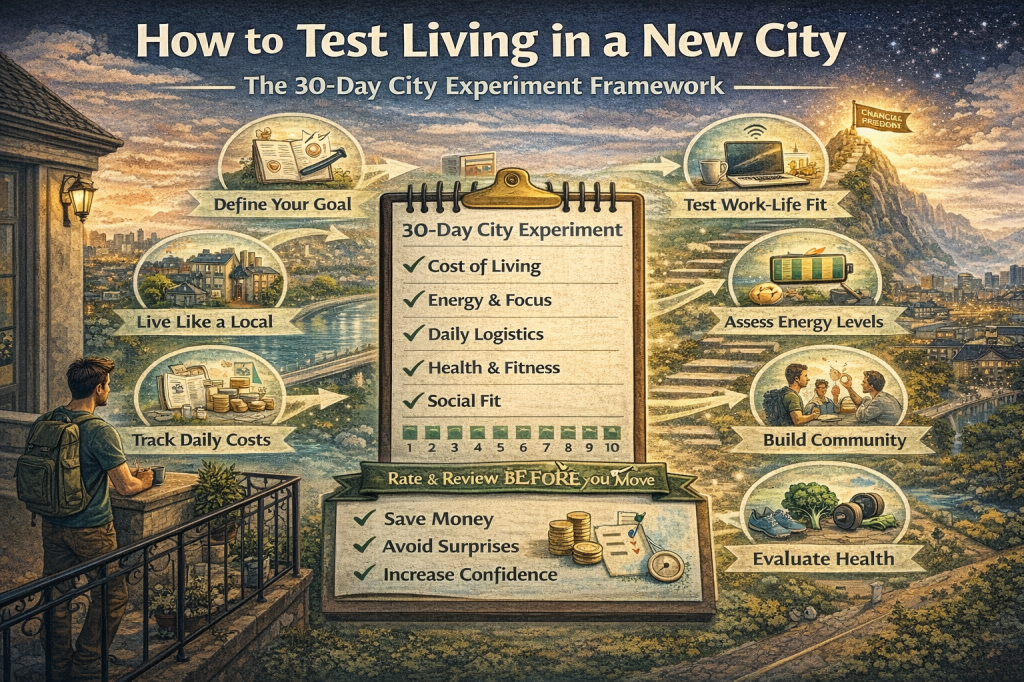
Instead, use a 30-Day City Experiment — a structured way to test living somewhere before committing.
Not as a tourist.
But as a temporary local.
Why 30 Days?
A weekend trip tells you nothing about daily life.
A week is still novelty.
But 30 days?
- The excitement fades.
- Frictions emerge.
- Logistics become real.
- Habits stabilize.
- Energy patterns reveal themselves.
Thirty days is long enough to simulate real life — without locking yourself into a lease, social commitments, or sunk costs.
It’s lifestyle prototyping in action (as discussed in Lifestyle Prototyping: How to Test-Drive a New Life Before You Commit).
Step 1: Define the Purpose of the Move
Before booking anything, clarify:
Why are you testing this city?
Common reasons:
- Lower cost of living (geoarbitrage)
- Better weather
- Career opportunity
- Community
- Slower pace
- Health reset
- Creative focus
If you don’t define the objective, you’ll evaluate the city emotionally instead of strategically.
For example:
If your goal is cost reduction, measure:
- Rent
- Food
- Transportation
- Taxes
If your goal is energy and focus, measure:
- Sleep quality
- Distraction levels
- Walkability
- Noise
The experiment must match the hypothesis.
Step 2: Live Like a Local (Not a Tourist)
Tourists optimize for novelty.
Residents optimize for sustainability.
During your 30 days:
- Rent in a residential neighborhood, not the entertainment district.
- Use public transportation.
- Shop at local grocery stores.
- Cook most meals.
- Establish a daily routine.
- Use a coworking space if you work remotely.
In Slow Travel: Why Staying Longer Saves Money and Creates Richer Experiences, I wrote about depth over novelty.
The same applies here.
You’re not sampling highlights.
You’re testing repeatability.
Step 3: Simulate Your Real Workload
If you plan to work there, you must test productivity there.
During the 30 days:
- Maintain your normal workload.
- Schedule deep work blocks.
- Attend meetings.
- Test Wi-Fi reliability.
- Evaluate time zone alignment.
In Energy Management vs Time Management, I emphasized that productivity depends on environment.
Ask:
- Do you feel focused?
- Are you more distracted?
- Does the city energize or drain you?
Some places feel exciting for five days — and exhausting by week three.
Thirty days reveals that truth.
Step 4: Measure Cost in Detail
Don’t guess affordability.
Track it.
Create a simple cost sheet:
- Rent (short-term)
- Estimated long-term rent
- Utilities
- Groceries
- Dining
- Transportation
- Gym
- Healthcare
- Taxes (if applicable)
Compare it to your current city.
In Future-Proofing Your Lifestyle, I discussed designing life so costs shrink relative to income over time.
A city shift can accelerate FIRE (Financial Independence, Retire Early) dramatically — or quietly sabotage it.
Numbers remove illusions.
Step 5: Track Energy, Not Just Money
Some cities are financially efficient but energetically draining.
Others are expensive but highly energizing.
Energy influences:
- Career performance
- Creativity
- Health consistency
- Social engagement
During the experiment, journal briefly each night:
- Energy level (1–10)
- Mood (1–10)
- Focus quality (1–10)
- Social fulfillment (1–10)
Patterns will emerge.
In The Energy Budget of Travel, I discussed how location affects fatigue.
Cities have energy signatures.
Your body knows before your spreadsheet does.
Step 6: Test Daily Logistics
Friction compounds.
Ask:
- Is the city walkable?
- How long does grocery shopping take?
- How easy is public transport?
- Is healthcare accessible?
- Is it easy to exercise?
In Designing a Life That Travels Well, I emphasized minimizing friction.
High-friction environments drain willpower.
You want sustainable ease, not heroic discipline.
If every errand feels complicated, that friction will compound over years.
Step 7: Build Temporary Community
A city without people is just architecture.
During your 30 days:
- Attend meetups.
- Join a fitness class.
- Visit coworking events.
- Use hobby groups.
- Reach out to friends-of-friends.
Evaluate:
- Are people open?
- Do you resonate culturally?
- Is community accessible or insular?
In How to Make Friends While Traveling Solo, I explained that community is built through repeated proximity.
Thirty days allows enough repetition to test social fit.
Step 8: Evaluate Health Environment
Cities influence health silently.
Consider:
- Walkability
- Access to nature
- Air quality
- Food quality
- Noise levels
- Sleep quality
In Training for Longevity and Daily Mobility for Joint Health, I wrote about designing environments that support consistency.
Ask:
- Do you walk more?
- Do you train more consistently?
- Do you sleep better?
A city that improves health automatically is a force multiplier.
Step 9: Test a Worst-Case Week
Midway through the experiment, simulate stress.
- Work long hours.
- Deal with errands.
- Handle unexpected tasks.
See how the city feels under pressure.
Some places feel magical in low-stress conditions but collapse under real workload.
You’re not testing vacation mode.
You’re testing life.
Step 10: The End-of-Month Scorecard
At the end of 30 days, evaluate across five categories:
1. Financial Efficiency
Does it accelerate or slow your FIRE trajectory?
2. Energy & Focus
Do you feel sharper or more scattered?
3. Health Support
Does the environment support your habits?
4. Social Alignment
Do you feel belonging potential?
5. Optionality
Does this location expand career or lifestyle options?
Score each 1–10.
Then ask:
Would I repeat this month 12 times?
If the answer isn’t a strong yes, don’t commit.
Why This Framework Works
Most relocation decisions are emotional.
The 30-Day City Experiment is structured.
Structure prevents:
- Romanticizing
- Impulse moves
- Sunk-cost bias
- Social comparison
It converts uncertainty into data.
And data reduces regret.
The Financial Multiplier Effect
Location arbitrage can dramatically alter:
- Savings rate
- Tax exposure
- Housing costs
- Career leverage
In Geoarbitrage 101, I explained how living well for less accelerates financial independence.
A $1,000 monthly cost reduction invested at 7% annually compounds into six figures over time.
City choice is not cosmetic.
It’s compounding infrastructure.
The Psychological Shift
Testing a city changes your identity.
You become:
- Someone who experiments.
- Someone who designs intentionally.
- Someone who moves toward opportunity.
Even if you return home, you gain clarity.
Clarity reduces restlessness.
You no longer wonder “what if.”
You know.
And knowing stabilizes decision-making.
When 30 Days Isn’t Enough
Sometimes you’ll need:
- Seasonal testing (winter vs summer)
- Longer visa exploration
- Job-specific testing
- Family considerations
But 30 days is a powerful filter.
It eliminates poor fits quickly.
And accelerates good ones confidently.
The Freedom Angle
Financial independence isn’t just about retiring early.
It’s about choosing your environment.
Location is one of the highest-leverage variables in your life.
The 30-Day City Experiment gives you:
- Data instead of fantasy
- Experience instead of speculation
- Structure instead of impulse
It transforms relocation from a leap into a calculated move.
Final Thought: Test Before You Transplant
Before uprooting your life:
Run the experiment.
Thirty days.
Full immersion.
Structured evaluation.
Treat location like an investment decision.
Because it is.
A good city multiplies health, wealth, and energy.
A bad one compounds friction.
Choose deliberately.
And let experimentation replace guesswork.
 VD
VD 
Leave a reply to Why Some Cities Recharge You (and Others Drain You): The Hidden Energy Cost of Urban Living – VD Cancel reply