Modern work doesn’t look dangerous.
You sit at a desk. You answer messages. You attend meetings. You think.
Yet many people end the day exhausted in a way that sleep alone doesn’t fix. Not physically tired, exactly—more like mentally brittle, emotionally flat, and oddly restless at the same time.
This isn’t a motivation problem or a discipline issue.
It’s nervous system overload—the hidden cost of being cognitively “on” all day.
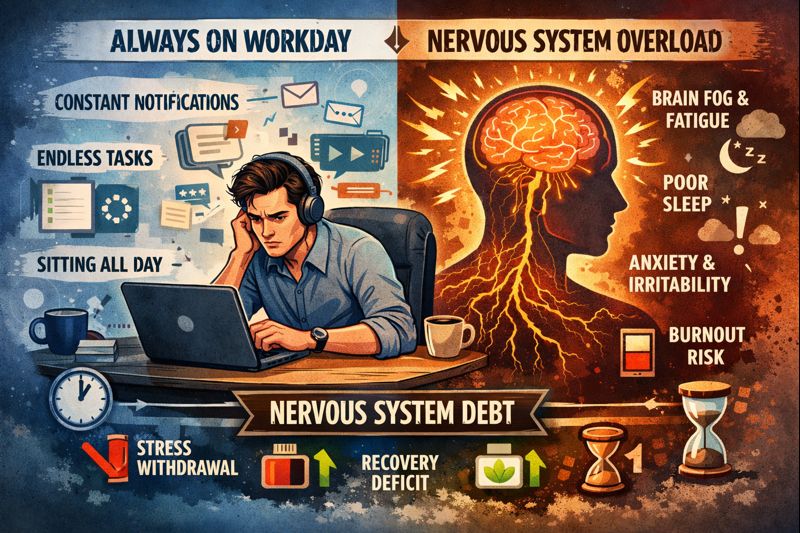
The Always-On Workday
A typical knowledge worker’s day includes:
- Rapid task switching
- Continuous low-level notifications
- Social vigilance in meetings and calls
- Artificial urgency created by digital tools
- Long periods of stillness paired with high mental demand
None of these are extreme in isolation. Together, they create a state where your nervous system never fully disengages.
You’re not sprinting—but you’re also never resting.
This is the defining feature of modern work:
sustained activation without resolution.
Your Nervous System Was Built for Rhythms, Not Plateaus
Your nervous system evolved around clear cycles:
- Activation → recovery
- Effort → rest
- Threat → safety
Modern work collapses these cycles into a flat line of alertness.
You remain mentally engaged for 8–12 hours while your body stays physically inactive. There’s little movement, minimal sensory variation, and few signals that say, “This task is done. You’re safe now.”
From a biological perspective, this looks like continuous low-grade threat, even if you consciously feel “fine.”
This same mismatch shows up in desk-bound health issues I’ve written about in How Desk Work Affects Your Nervous System and The Hidden Injuries of Sitting All Day. The body and brain are tightly linked—and modern work stresses both in subtle but persistent ways.
Nervous System Debt: A Useful Mental Model
Think of your nervous system like a financial account.
- Stress is a withdrawal
- Recovery is a deposit
When withdrawals exceed deposits, you accumulate nervous system debt.
Like financial debt, it doesn’t feel dangerous at first. You can run a deficit for a while. But over time, interest compounds.
Nervous system debt shows up as:
- Brain fog and reduced focus
- Lower emotional tolerance
- Poor sleep quality
- Irritability and impatience
- Loss of curiosity and creativity
- A feeling of being “tired but wired”
You’re still productive—but at a higher biological cost.
This mirrors what happens financially when people optimize aggressively without slack, a theme I explored in Why Financial Independence Is Really About Slack (Not Early Retirement) and Why FIRE Isn’t Sustainable Without Financial Slack. Systems without buffers eventually break.
Why Mental Work Feels More Draining Than Physical Work
Physical labor usually includes built-in recovery mechanisms:
- Movement and posture changes
- Clear effort–rest cycles
- Sensory feedback
- Visible completion points
Desk work includes almost none of these.
Instead, it involves:
- Open-ended problems
- Abstract goals with no finish line
- Social performance without closure
- Mental effort without physical discharge
Your nervous system interprets this as unfinished stress.
You worked all day—but nothing told your body it was allowed to stand down.
This is why people can feel more exhausted after a day of emails than a long hike, something that also shows up during travel. In The Energy Budget of Travel, I explored how mental load, not movement, is often the real limiter.
The Problem Isn’t Stress—It’s Lack of Resolution
Stress itself isn’t harmful.
Unresolved stress is.
In healthy systems, the loop looks like:
Stress → action → completion → recovery
In modern work, it often looks like:
Stress → attention → interruption → more stress → sleep (maybe)
There’s no clear resolution signal.
This is why even people who enjoy their work feel drained. Liking the task doesn’t eliminate the biological need for closure.
Why “Relaxing More” Doesn’t Fix It
When people feel fried, they often try to relax harder:
- Scrolling
- Watching shows
- Passive downtime
But relaxation without regulation doesn’t repay nervous system debt.
Your nervous system doesn’t respond to intentions.
It responds to signals.
Passive consumption often keeps the brain stimulated while providing no physical or sensory cues of safety. That’s why you can spend hours “relaxing” and still feel unrested.
This is closely related to what I described in Recovery Is a Skill: Why It Doesn’t Happen Automatically and Energy Management vs Time Management. Recovery requires design, not just free time.
Regulation Beats Relaxation
What actually restores the nervous system are signals that say:
- The task is complete
- The environment is safe
- Effort has ended
These signals come from:
- Movement that changes posture and breathing
- Rhythmic activity (walking, mobility, light strength work)
- Environmental shifts (light, sound, temperature)
- Clear transitions between modes of attention
In other words, regulation, not just relaxation.
This is why simple practices—walking after work, short mobility sessions, breath-focused cooldowns—are disproportionately effective. They give your nervous system evidence, not advice.
The Accumulation Problem
The most dangerous part of nervous system overload is how quietly it accumulates.
You don’t crash all at once.
You slowly lose margin.
- Focus becomes harder to sustain
- Emotional reactions get sharper
- Learning feels effortful instead of energizing
- Health habits require more discipline
Eventually, people compensate by adding more systems: productivity tools, stricter routines, stronger stimulants.
But adding structure without adding recovery just increases withdrawals.
This mirrors what happens in learning when people consume more information without integration—a problem I explored in Cognitive Nutrition and Idea Carrying Capacity. Capacity is finite. Ignoring that reality creates friction everywhere.
Small Ways to Lower the Daily Cost
You don’t need a radical lifestyle change.
You need better daily accounting.
Here are a few high-leverage adjustments:
1. Add Physical Punctuation
Short movement breaks that change posture, breathing, and visual distance help close stress loops.
Ask: “What tells my body this task is finished?”
This aligns with ideas from Movement Snacks and Daily Mobility for Joint Health—small inputs, long-term payoff.
2. Reduce Cognitive Fragmentation
Batch communication where possible. Fewer context switches mean fewer nervous system withdrawals.
This echoes the logic behind Why Systems Beat Motivation—good systems reduce load instead of relying on willpower.
3. End the Workday Deliberately
A short walk, light mobility, or breath work creates a shutdown ritual your nervous system can recognize.
Without this, work bleeds into recovery time, which is a common theme in burnout I’ve seen among remote and flexible workers.
4. Recover During the Day, Not Just After
Waiting until night to recover is like paying your credit card after it’s maxed out.
Micro-recovery throughout the day keeps debt from compounding.
The Long-Term Cost of Ignoring This
Unchecked nervous system overload doesn’t just lead to burnout.
It erodes:
- Learning capacity (The Learning Bottleneck)
- Emotional regulation
- Health behaviors
- Creativity and long-term motivation
Over time, this limits optionality—the very thing many people are working toward financially and lifestyle-wise.
You can see this tension clearly in FIRE (Financial Independence, Retire Early) discussions: people reach financial independence but lack the energy or health to enjoy it. That’s why I often frame FIRE as a lifestyle upgrade, not a finish line.
Designing Workdays You Can Sustain for Decades
The goal isn’t to escape modern work or eliminate stress.
It’s to design workdays your nervous system can tolerate indefinitely.
That means:
- Treating energy as a primary resource
- Building recovery into daily systems
- Respecting biological limits instead of overriding them
Just as financial independence is about margin, buffer, and flexibility, nervous system health is about the same principles applied biologically.
The true cost of being “on” all day isn’t measured in hours worked.
It’s paid later—in health, clarity, learning, and choice.
And like financial debt, nervous system debt compounds quietly—until you change the system.
 VD
VD 
Leave a reply to How to Declutter Your Mind for Better Decision Making and Mental Clarity – VD Cancel reply