Money is easy to measure.
Time is not.
We track income, savings rates, net worth, and investment returns with precision. We build spreadsheets, projections, and FIRE (Financial Independence, Retire Early) calculators to estimate when money will “set us free.”
Time, meanwhile, is treated as a constant—something fixed and scarce that simply ticks away in the background.
But anyone who has pursued financial independence long enough eventually realizes something counterintuitive:
Money compounds on paper. Freedom compounds in time.
The real question isn’t whether money matters. It does. The question is which one compounds faster toward a life with real flexibility, resilience, and choice.
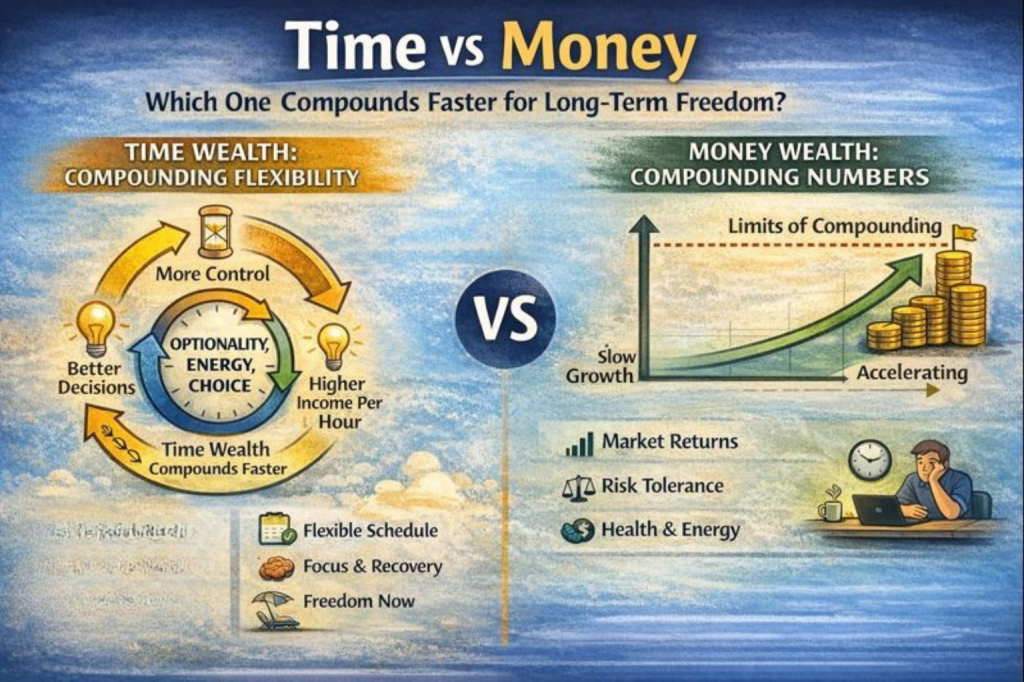
The Two Forms of Wealth Most People Confuse
Most people grow up learning about only one kind of wealth.
Money Wealth
Money wealth is familiar and legible:
- income
- savings rate
- investments
- net worth
It compounds mathematically. You add capital, reinvest returns, and let time and markets do their work. This is the traditional FIRE playbook—and it works.
But money wealth has a blind spot: it primarily improves future freedom, often at the expense of the present.
You can be financially “on track” while feeling chronically rushed, exhausted, and constrained for decades.
Time Wealth
Time wealth is quieter and harder to measure:
- control over your schedule
- flexibility in how and when you work
- the ability to say no
- recovery time
- slack between obligations
Time wealth isn’t about doing nothing. It’s about choice. It’s about having enough control to decide how your energy is spent.
And unlike money, time wealth starts paying dividends immediately.
Why Money Compounding Feels Powerful—but Is Limited
Money compounding is real, but it’s constrained.
Early on, progress is slow. The first $100K takes time because:
- contributions are small
- investment returns are modest
- expenses dominate cash flow
As capital grows, compounding accelerates. But even then, money wealth remains bounded by:
- market returns
- income ceilings
- health and energy
- risk tolerance
More importantly, money compounding often requires delaying freedom. Long hours, high stress, and deferred recovery are treated as temporary sacrifices—sometimes lasting decades.
Money grows. Time shrinks.
Why Time Compounding Is Non-Linear
Time compounds differently.
Small increases in time control create second-order effects that money alone cannot.
When you gain even a modest amount of schedule flexibility:
- sleep improves
- recovery improves
- stress decreases
- thinking becomes clearer
- decisions improve
Each of these feeds back into the system.
Better decisions lead to:
- higher leverage work
- better income per hour
- fewer costly mistakes
- greater career longevity
Time doesn’t just compound. It self-reinforces.
The Time Wealth Flywheel
Time wealth creates a flywheel that money alone can’t start.
More time → better energy
Better energy → higher quality work
Higher quality work → better income efficiency
Better income efficiency → more time
This flywheel explains why some people appear to “get ahead” with less effort. They aren’t lazy. They’re operating under better conditions.
Money can buy time.
But time also improves the return on money.
Why FIRE Without Time Wealth Feels Empty
Many FIRE paths obsess over financial metrics:
- savings rate
- withdrawal rate
- net worth milestones
But when time freedom is postponed entirely, hidden costs accumulate:
- chronic stress
- health degradation
- burnout
- decision fatigue
These costs quietly erode the very thing FIRE is supposed to enhance: quality of life.
This is why some people reach impressive financial milestones and still feel trapped. They optimized numbers without building slack.
Financial independence without time wealth is technically successful—but experientially hollow.
Time Wealth as Risk Reduction
Time wealth isn’t just about enjoyment. It’s a resilience strategy.
When you have time:
- you can recover from mistakes
- you can wait for better opportunities
- you can learn new skills
- you can pivot when circumstances change
People without time are forced into reactive decisions. People with time can play offense.
From this perspective, time wealth is one of the most underappreciated forms of risk management.
The Hidden Cost of Trading Time for Money
Early in a career, trading time for money makes sense. The returns are high and skills compound.
But past a point, the trade flips.
Additional money often comes at the cost of:
- longer hours
- higher cognitive load
- constant availability
- reduced recovery
These costs reduce future earning capacity and make freedom harder to enjoy later.
At some point, preserving time compounds faster than maximizing income.
Time Arbitrage: Where Money and Time Meet
The most effective strategies don’t choose time or money. They convert one into the other efficiently.
Examples include:
- reducing expenses to buy flexibility
- choosing roles with lower stress and longer longevity
- increasing income per hour instead of total hours
- designing work that scales with judgment, not effort
This is time arbitrage: using money decisions to reclaim time, and using time to improve money decisions.
Why Time Wealth Starts Earlier Than You Think
You don’t need financial independence to build time wealth.
Early signals include:
- negotiating flexible work arrangements
- compressing workdays
- eliminating low-value commitments
- designing routines that protect recovery
These small wins compound psychologically. Once you experience time control, your priorities permanently shift.
Time wealth changes how you think about money, not the other way around.
Which One Actually Compounds Faster?
In isolation, money compounds predictably.
But toward long-term freedom, time often compounds faster because it:
- improves decision quality immediately
- increases earning efficiency
- protects health and energy
- expands optionality
Money without time delays freedom.
Time without money limits scale.
The most durable path builds both—but prioritizes time earlier than most people are taught to.
The Real Goal: Compounding Optionality
Financial independence isn’t about a number. It’s about choice.
Money buys options.
Time activates them.
When you combine moderate money wealth with growing time wealth, freedom compounds faster than either alone.
The most successful FIRE paths don’t maximize net worth at all costs. They design lives where time, money, and energy reinforce each other.
A Simple Decision Filter
When faced with a tradeoff, ask:
- Does this increase my future time options?
- Does it improve income per hour, not just income?
- Does it protect my health and energy?
- Does it reduce fragility?
If the answer is yes, it likely compounds freedom—even if it looks suboptimal on a spreadsheet.
Final Thought
Money is a tool.
Time is the environment.
Tools compound only when the environment supports them.
If you want long-term freedom, don’t ask only how fast your money is growing. Ask how fast your control over time is expanding.
That’s the compounding that actually matters.
Related Reading
If this article resonated, you may enjoy these related posts:
FIRE, Optionality, and Financial Slack
- The Optionality Playbook: Why Financial Independence Is About Better Choices, Not Early Retirement
- Why FIRE Isn’t Sustainable Without Financial Slack
- Financial Independence Is a Skill, Not a Number
- The 80/20 of FIRE: Tiny Financial Tweaks That Create Outsized Results
- Time Arbitrage: How Flexible Schedules Help You Save More, Spend Less, and Build Wealth
Lifestyle Design & Sustainability
- Designing a Life That Travels Well: A Framework for Sustainable, Location-Flexible Living
- Future-Proofing Your Lifestyle: How to Spend Less Every Year (While Improving Your Quality of Life)
- Lifestyle Prototyping: How to Test-Drive a New Life Before You Commit
 VD
VD 
Leave a reply to Life After Financial Independence: How to Navigate the Identity Crisis When Work No Longer Defines You – VD Cancel reply