Modern work doesn’t look dangerous.
There are no predators, no famine, no freezing nights. Most of us sit in climate‑controlled rooms, stare at glowing rectangles, and earn a living with our thoughts.
And yet many people feel constantly exhausted, wired‑but‑tired, anxious, irritable, and unable to fully recover — even when they sleep enough, take time off, or reduce their workload.
This isn’t because you’re weak, undisciplined, or doing work “wrong.”
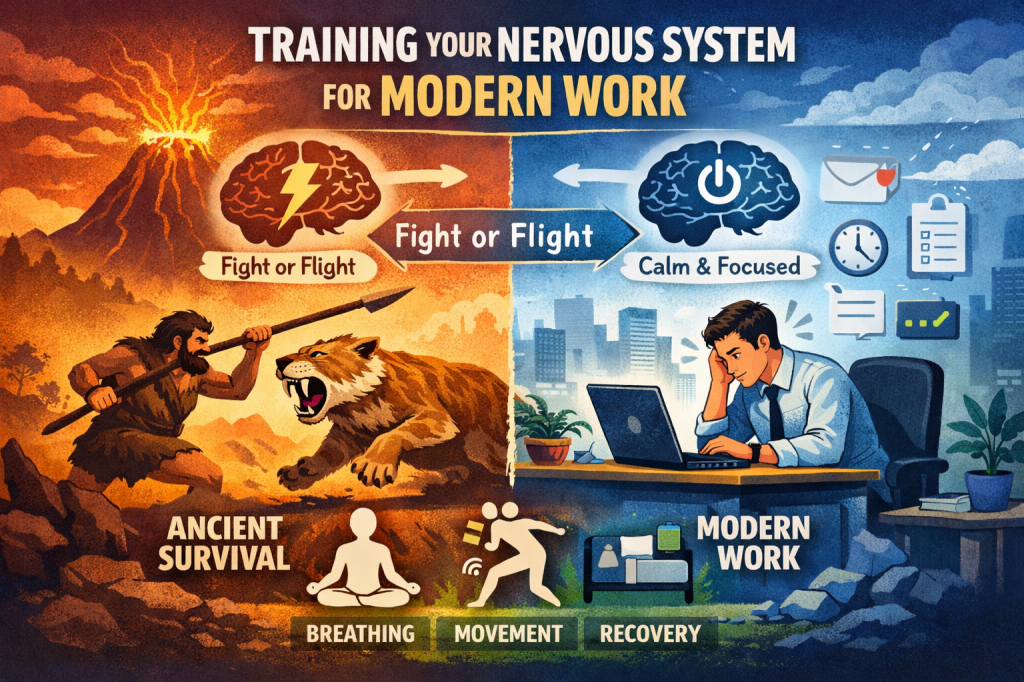
It’s because your nervous system is still optimized for ancient survival, while your daily environment delivers continuous, low‑grade threat signals it was never designed to process.
Modern work asks your brain to be alert all day without ever resolving that alertness.
This blog is about how to train your nervous system for modern work — desk jobs, screens, cognitive load, constant communication — so stress stops accumulating and burnout stops feeling inevitable.
Why Modern Work Quietly Overloads the Nervous System
Your nervous system evolved to handle short, intense challenges:
- Detect danger
- Mobilize quickly
- Resolve the threat
- Recover deeply
Stress used to be acute and episodic.
Modern work reverses this pattern.
Today’s stressors are:
- Ambiguous (emails, performance reviews, open‑ended projects)
- Cognitive (decision‑making, planning, problem‑solving)
- Social (visibility, evaluation, comparison)
- Continuous (notifications, background urgency, always‑on tools)
There is rarely a clear beginning or end.
Instead, your nervous system stays partially activated all day — not enough to fight or flee, but too much to fully relax.
Physiologically, this looks like:
- Shallow breathing
- Elevated baseline tension
- Difficulty focusing deeply
- Trouble “turning off” after work
- Sleep that doesn’t fully restore
Burnout isn’t a personal failure.
It’s a predictable response to the wrong inputs applied for too long.
Ancient Hardware, Modern Software
Your body doesn’t know what an inbox is.
It doesn’t understand deadlines, Zoom calls, or Slack messages. It only understands signals.
Uncertainty, social evaluation, and lack of control all register as threat, even if you intellectually know you’re safe.
Some common examples:
- A Slack notification feels minor, but your nervous system reads it as unpredictability
- A long to‑do list signals unfinished danger
- Sitting still while thinking hard creates mobilization without movement
In ancestral environments, stress almost always led to movement.
In modern work, stress leads to stillness.
That mismatch — activation without resolution — is one of the core drivers of nervous system overload.
Stress is not the Enemy — Accumulation is
A common mistake is trying to eliminate stress.
Stress isn’t optional.
Challenge, effort, and focus are necessary for growth and meaningful work.
The real problem is stress without discharge.
When activation isn’t followed by:
- movement
- breath changes
- completion signals
- recovery cues
…it lingers in the system.
Think of your nervous system like a browser.
Each unresolved task, notification, or worry is a tab running in the background. One or two is fine. Fifty isn’t.
Eventually performance degrades — not because the computer is broken, but because it was never designed to run that many processes at once.
Coping vs Training: A Critical Distinction
Most advice focuses on coping:
- meditate more
- take breaks
- go on vacation
Helpful — but incomplete.
Coping manages spikes.
Training changes baseline capacity.
You don’t just want to calm down after work.
You want a nervous system that:
- returns to baseline faster
- tolerates cognitive load better
- distinguishes real threats from informational noise
This requires regular, low‑level inputs over time — not heroic interventions when you’re already depleted.
Principle 1: Reintroduce Movement as Stress Resolution
Modern work creates stress without movement.
So movement must be reintroduced deliberately.
This doesn’t mean more intense workouts (which can add stress if recovery is poor).
It means frequent, low‑intensity movement:
- short walks
- posture changes
- mobility breaks
- light strength work
Movement tells the nervous system:
“The stress cycle is complete.”
Even a few minutes can meaningfully reduce background tension.
Consistency matters more than volume.
Principle 2: Train the Breath You Actually Use at Work
Breathing patterns strongly influence nervous system state.
Most desk workers unconsciously breathe:
- shallow
- high in the chest
- irregular
This reinforces vigilance and sympathetic activation.
Instead of relying only on dedicated breathwork sessions, focus on default breathing:
- nasal breathing during work
- slower breathing under load
- longer exhales than inhales
- occasional physiological sighs
The goal isn’t constant relaxation.
It’s regulation — the ability to shift states when needed.
Principle 3: Reduce Cognitive Threat Signals
Your nervous system reacts more to uncertainty than workload.
Common cognitive stressors include:
- unclear priorities
- constant task switching
- open‑ended goals
- lack of completion
Simple interventions with outsized impact:
- define what “done” means before starting
- batch communication
- limit active projects
- create clear shutdown rituals
Completion cues matter.
They tell your nervous system it’s safe to stand down.
Principle 4: Build Micro‑Recovery Into the Day
Recovery doesn’t only happen at night.
Your nervous system recalibrates through small state shifts:
- standing up
- looking far away
- slow walking
- brief solitude
- silence
Think in minutes, not hours.
Five minutes of true downshift, repeated throughout the day, beats one exhausted vacation.
Principle 5: Increase Recovery Capacity Over Time
Two people can have the same job.
One burns out.
The other doesn’t.
The difference is often recovery capacity:
- sleep quality
- physical robustness
- emotional bandwidth
- movement tolerance
Strength training, mobility, sunlight exposure, and consistent routines all expand how much stress you can process before tipping into overload.
This is long‑term nervous system training.
What a Trained Nervous System Feels Like
Not euphoric.
Not permanently calm.
Just:
- faster recovery
- fewer stress spirals
- clearer thinking under pressure
- less exhaustion from normal days
Stress still happens.
It just doesn’t accumulate.
Burnout is a Signal, Not a Personal Failure
If modern work feels harder than it should, you’re not broken.
Your nervous system is responding exactly as designed — just in an environment it never evolved for.
The solution isn’t more willpower.
It’s better inputs.
Train the system, not just the schedule.
And modern work becomes sustainable again.
Related Reading
If this topic resonates, you may find these blogs helpful:
- The Cost of Being “On” All Day: How Modern Work Overloads Your Nervous System
- Energy Management vs Time Management: How to Increase Focus, Productivity, and Avoid Burnout
- How Desk Work Affects Your Nervous System: The Physical Cost of Focus
- Your Body’s Dashboard: Early Physical Signs of Burnout You Shouldn’t Ignore
- Recovery is a skill: Why It Doesn’t Happen Automatically (and How to Improve It)
- Posture, Breath, and Walking: Three Simple Habits That Improve Health and Longevity
- Designing a Body That Tolerates Modern Life
- The Sleep Efficiency Blueprint: How to Improve Sleep Quality and Wake Up Rested
Each explores a different angle of the same core idea: sustainable performance starts with nervous system health.
 VD
VD 
Leave a reply to How to Recover from Burnout and Rebuild Your Energy After a Long Stint at Work – VD Cancel reply