Mobility is seductive.
The ability to pack up, change cities, or cross borders at will feels like freedom in its purest form. No long-term leases. No fixed routines. No single place dictating how you live.
For many people, location independence begins as a lifestyle upgrade.
But over time, constant movement can quietly erode something just as important as freedom: grounding.
This blog explores how to design travel optionality — the ability to move when you want — without drifting into rootlessness, fatigue, or a life that feels perpetually provisional.
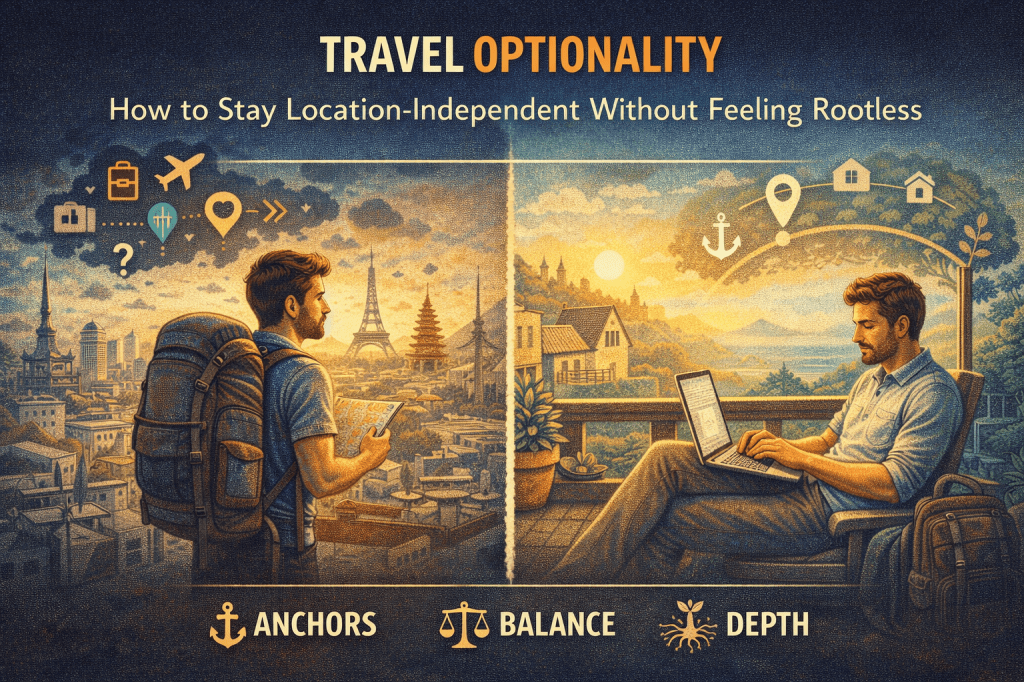
Mobility vs Optionality
Mobility is movement.
Optionality is choice.
They are not the same thing.
Many people who describe themselves as location-independent are actually locked into motion. They move not because they want to, but because stopping feels uncomfortable — or because their identity depends on staying mobile.
True travel optionality means:
- You can stay longer when something works
- You can leave without friction when it doesn’t
- Your life functions whether you move or not
The goal isn’t constant travel.
It’s low-friction choice.
Why Constant Movement Creates Subtle Stress
Humans adapt quickly — but not endlessly.
Every relocation resets:
- social context
- routines
- physical environment
- mental maps
In the short term, novelty energizes. In the long term, repeated resets tax the nervous system.
This stress rarely shows up dramatically. It accumulates quietly, revealing itself as:
- decision fatigue
- shallow social ties
- difficulty focusing
- a lingering sense of impermanence
When nothing is meant to last, it’s hard for anything to deepen.
Rootlessness isn’t Freedom
Rootlessness often masquerades as flexibility.
But a life with no anchors doesn’t feel expansive — it feels uncontained.
Without stable reference points, identity becomes fragile. You end up constantly recalibrating who you are based on where you are.
Freedom without grounding turns into drift.
The solution isn’t giving up mobility.
It’s adding structure.
Anchors Make Freedom Usable
Anchors are not the opposite of freedom.
They make freedom functional.
Anchors reduce cognitive load and stabilize identity across locations. They allow your nervous system to relax even when geography changes.
Anchors can be:
- daily routines
- physical training practices
- work rhythms
- recurring destinations
- personal rules that travel with you
Without anchors, every place feels temporary — including your own life.
The Cost of Living in Perpetual Transition
Living in transition feels light.
It also prevents accumulation.
When everything is provisional, it’s harder to:
- invest socially
- build skills patiently
- maintain health practices
- experience compounding progress
Optionality without commitment creates motion without depth.
Depth is what turns freedom into satisfaction.
Design a Base, Not a Prison
A base doesn’t mean permanence.
It means having a default.
A base might be:
- a home city
- a region you return to seasonally
- a few trusted neighborhoods around the world
- even just a familiar gym chain, grocery setup, and storage system
The purpose of a base is psychological safety, not ownership.
You don’t need roots everywhere.
You need somewhere that restores orientation.
Travel in Chapters, Not Checklists
Checklist travel maximizes novelty.
Chapter-based travel creates meaning.
Instead of asking, “What should I see next?” ask:
“What am I here to practice?”
A chapter might center on:
- physical training
- writing or deep work
- recovery from burnout
- language immersion
- creative exploration
Purpose gives travel coherence.
Coherence is what prevents rootlessness.
Stay Long Enough for Boredom
Places don’t reveal themselves immediately.
They reveal themselves through repetition:
- the second grocery store visit
- the fifth walk through the same streets
- the tenth morning at the same café
When excitement fades, livability appears.
Staying long enough for boredom allows places to become inhabitable rather than consumable.
Portable Identity Reduces Friction
When everything changes, identity can blur.
Some travelers unconsciously reinvent themselves in each location — new routines, new standards, new ambitions.
This constant reinvention is exhausting.
Portable identity reduces that cost.
Ask yourself:
- Who am I regardless of location?
- What habits are non-negotiable?
- What standards don’t change when scenery does?
Consistency creates internal grounding even when geography shifts.
Optionality Requires Financial Slack
Mobility without financial margin is stressful.
True travel optionality depends on slack:
- low fixed costs
- flexible commitments
- emergency buffers
Without margin, movement becomes reactive rather than intentional.
Slack turns travel into a choice instead of a necessity.
Knowing When to Stay Put
Optionality includes the option to remain.
Signs it’s worth staying longer:
- routines are working
- energy feels stable
- relationships are deepening
- progress is compounding
Leaving too early often resets momentum.
Depth requires time.
A Sustainable Definition of Location Independence
Location independence doesn’t mean nowhere matters.
It means no single place controls your life.
You’re free to move — and free to stay.
Rooted enough to function.
Mobile enough to adapt.
That balance is what turns travel from an escape into a durable lifestyle.
Final Thought: Freedom Needs Structure
Travel optionality isn’t about endless motion.
It’s about designing a life that works across places.
With anchors that ground you.
With slack that protects you.
With enough structure that freedom feels expansive rather than empty.
When movement becomes a choice — not an identity — rootlessness fades and mobility becomes what it was always meant to be: a tool, not a trap.
Related Reading
If this blog resonated, you may enjoy these pieces exploring sustainable travel, location flexibility, and lifestyle design:
- Designing a Life That Travels Well: A Framework for Sustainable, Location-Flexible Living
- Living Out of a Backpack: How to Travel Long-Term Without Feeling Temporary
- Why Repeating Destinations Beats Chasing New Ones: The Case for Slow Travel
- Slow Travel: Why Staying Longer Saves Money and Creates Richer Experiences
- Why Comfort Is a Force Multiplier for Long-Term Travel (and Prevents Burnout)
- The Energy Budget of Travel: How to Avoid Travel Fatigue and Explore Without Exhaustion
- Lifestyle Prototyping: How to Test-Drive a New Life Before You Commit
- Geographic Flexibility as Wealth: How Location Independence Multiplies Your Income
- Mental Carry-On: How to Learn From Travel (Not Just Visit Places)
- Travel That Pays You Back: How Travel Builds Skills, Perspective, and Long-Term Value


Leave a Reply