Smart people read a lot.
They highlight passages, collect notes, save quotes, and build impressive libraries. They listen to podcasts, follow smart thinkers, and genuinely enjoy learning.
And yet, months or even years later, their thinking, behavior, and decisions often look… mostly the same.
This isn’t because reading is useless.
It’s because information doesn’t automatically become transformation.
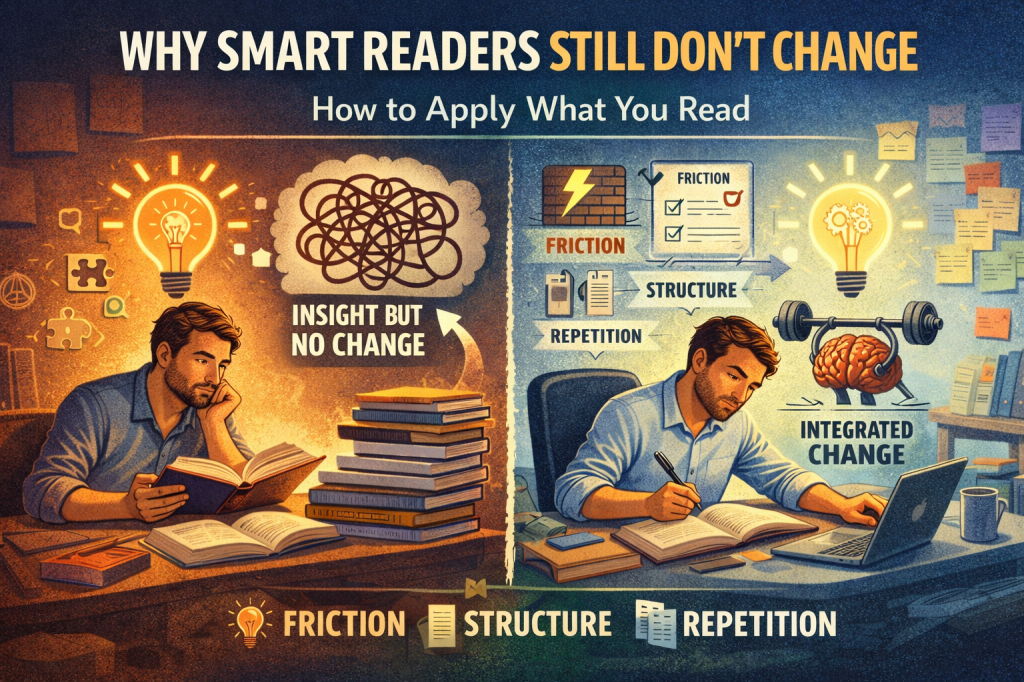
Reading creates insight. Change requires something more.
This blog explores why even thoughtful, disciplined readers struggle to change — and how to actually apply what you read so books don’t just inform you, but reshape how you think and live.
The Comfortable Illusion of Progress
Reading feels productive.
You’re exposed to better arguments. You encounter ideas that challenge your assumptions. Compared to endless scrolling or shallow entertainment, reading is clearly higher-quality input.
The problem is that feeling informed is not the same as being changed.
Reading often produces a simulation of progress:
- You understand the idea
- You agree with the idea
- You can explain the idea to someone else
But nothing in your daily behavior actually shifts.
The mind gets credit without doing the work.
This illusion is especially strong for smart readers, because comprehension comes easily. You move on feeling upgraded — even though your defaults remain untouched.
Why Intelligence Makes This Problem Worse
Paradoxically, intelligence often makes readers less likely to change.
Why?
Because intelligence makes it easier to:
- grasp ideas quickly
- articulate insights clearly
- rationalize why change can wait
When understanding is effortless, friction disappears.
And friction is the catalyst for change.
If an idea doesn’t challenge your habits, threaten your identity, or force a tradeoff, it remains intellectually interesting — but behaviorally inert.
Smart readers are especially good at mistaking clarity for commitment.
Insight is Not the Bottleneck
Most readers assume the problem is a lack of insight.
So they read more.
But insight accumulates far faster than integration.
You can only apply a small number of ideas at any given time.
This creates what might be called idea overload:
- too many frameworks
- too many methods
- too many mental models
Instead of better decisions, you get hesitation.
Instead of action, you get comparison.
The bottleneck isn’t information. It’s capacity for change.
Reading Without Friction Produces No Change
Books are safe.
They don’t demand action.
They don’t test you.
They don’t push back when you misunderstand or half-apply an idea.
Most reading happens in a calm, comfortable state — exactly the opposite conditions under which habits are formed.
Change requires:
- effort
- repetition
- exposure to failure
- feedback from reality
Without friction, ideas slide through your mind without leaving a mark.
The Real Job of Reading: Constraint, Not Accumulation
The purpose of reading isn’t to collect ideas.
It’s to narrow your thinking.
Good books should:
- eliminate options
- sharpen priorities
- force tradeoffs
If every book adds something new without removing anything old, your thinking becomes bloated rather than precise.
Change happens when an idea replaces an old default.
Until something is removed, nothing really changes.
Why Most Note-Taking Systems Fail
Notes feel like work.
They give the impression of seriousness and follow-through.
But most note-taking systems optimize for storage, not behavior.
Common failure modes include:
- capturing too much
- revisiting too little
- separating notes from real decisions
A highlight you never see again cannot change you.
Neither can a summary that never intersects with how you spend your time, money, or energy.
If your notes don’t show up where decisions happen, they’re just archives.
Application Requires Time, Not More Books
Ideas don’t need novelty.
They need exposure.
Re-reading one meaningful book at the right moment is often more transformative than reading ten new ones back-to-back.
Application happens through:
- revisiting
- testing
- reflecting
- adjusting
This is slower.
And because it’s slower, it’s rare.
But it’s also where learning turns into lived experience.
A Practical Framework for Applying What You Read
If you want reading to change you, try this approach.
1. Read With a Question, Not Curiosity
Instead of asking, “Is this interesting?” ask:
“What problem in my life could this solve right now?”
If there’s no clear answer, enjoy the book — but don’t expect transformation.
2. Extract One Dominant Idea
Not ten.
One.
The idea that feels slightly uncomfortable, relevant, and actionable.
3. Create Artificial Friction
Ideas need resistance.
Turn the idea into:
- a rule
- a constraint
- a temporary experiment
Something that forces behavior to change, even imperfectly.
4. Test It Where Failure Is Visible
Apply the idea in real life:
- your schedule
- your finances
- your health routines
- your relationships
If nothing in your day looks different, the idea hasn’t been applied.
5. Reflect After Action, Not After Reading
Understanding deepens after use.
Reflection closes the loop and reveals what actually works.
Why Repetition Beats Novelty
Most meaningful change comes from encountering the same idea repeatedly, in different contexts, over long periods of time.
That’s why:
- rereading works
- returning to a small personal canon works
- seasonal reading works
The mind needs time to reorganize around new principles.
Novelty excites.
Repetition transforms.
What Changed Readers Do Differently
Readers who change don’t read more.
They:
- reread selectively
- discard ideas aggressively
- apply slowly
- revisit often
Their libraries are smaller.
Their thinking is sharper.
They trade breadth for depth — and get better results.
Reading is Leverage, Not a Shortcut
Books don’t change lives.
People do.
Reading is leverage — but only when paired with friction, time, and application.
If you want reading to matter, stop asking what to read next.
Start asking:
“What am I willing to let this idea change?”
That question — uncomfortable and practical — is where transformation begins.
Related Reading
If this blog resonated, you may find these pieces helpful:
- Why Reading Alone Isn’t Enough
- The Reading Afterlife: What to Do After You Finish a Book to Remember and Apply It
- Cognitive Friction: Why Some Books Change Your Thinking (and Others Don’t)
- The Reading Flywheel: How to Remember, Apply, and Learn More From Books
- Learning Like an Investor: How to Allocate Attention for Long-Term Growth
- Idea Carrying Capacity: How Many Concepts Can You Actually Use at Once?
- How to Learn More From Books: Why Owning Fewer Books Can Make You Smarter
- The Literature Gym: Daily Reading Exercises to Improve Your Thinking
- Just-in-Time Learning: Why Timing Matters More Than Volume
Together, they explore the same core idea from different angles: learning compounds only when ideas are applied, tested, and allowed to change how you live.


Leave a Reply