I used to finish books and feel accomplished. Year after year, I read 60–80 books annually but my actual life — my habits, decisions, and results — barely changed.
The painful realization hit me around a few years ago: I was consuming information, not transforming.
If you’re someone who loves reading but feels frustrated that your behavior rarely matches the wisdom you consume, this article is for you. The gap between reading and real change is incredibly common, but it’s also fixable.
Here’s exactly how to turn your reading habit into genuine, lasting behavior change.
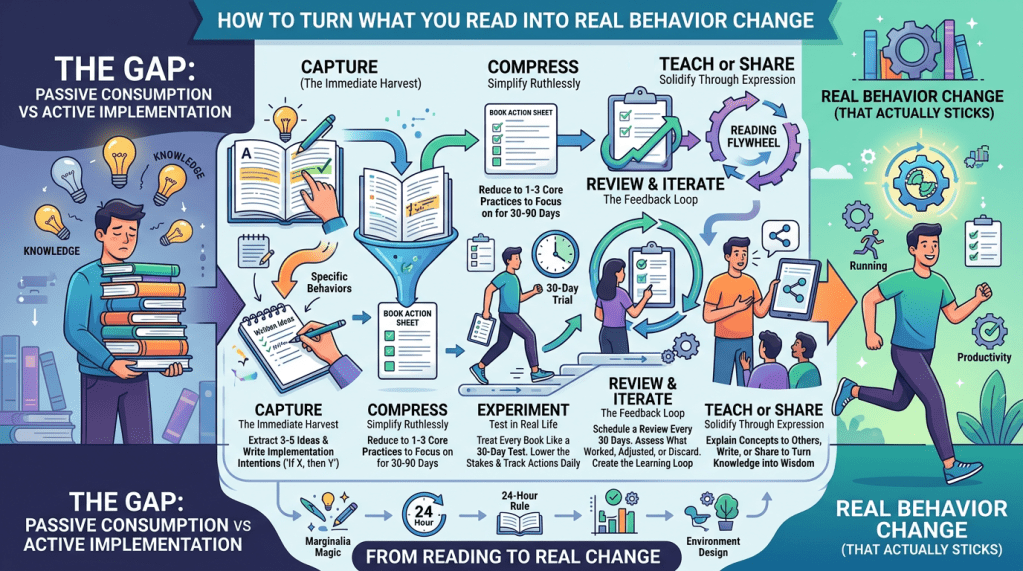
Why Reading Alone Almost Never Creates Change
The problem isn’t lack of intelligence or discipline. It’s a fundamental misunderstanding of how behavior actually changes.
Reading gives you knowledge. Behavior change requires implementation. These are two completely different processes.
When you finish a book, your brain often tricks you into thinking you’ve already changed. Psychologists call this the illusion of explanatory depth — you understand the concept intellectually, so you assume you’ve integrated it. In reality, you’ve only added information to your mental library.
Most people stop at this stage. They move on to the next book, chasing the next dopamine hit of new ideas, while their daily actions remain the same.
Real behavior change is slow, messy, and requires deliberate systems. It demands moving from passive consumption to active experimentation.
The Reading-to-Behavior Framework
After years of trial and error, I developed a practical framework that consistently turns reading into measurable change. It has five stages:
1. Capture (The Immediate Harvest)
Never finish a book without extracting the ideas you want to implement. While reading, mark sentences that trigger a reaction. After finishing, spend 15–30 minutes doing a “Capture Session”:
- Write down the 3–5 biggest ideas or lessons
- Note which specific behaviors you want to change
- Create one-sentence implementation intentions
Example: Instead of “I want to be more disciplined,” write “When I finish work at 5pm, I will immediately put on my running shoes and go for a 20-minute walk.”
2. Compress (Simplify Ruthlessly)
Take your notes and compress them into something you can actually use. The goal is to reduce an entire book into 1–3 core practices you can focus on for the next 30–90 days.
I often create a one-page “Book Action Sheet” with:
- Core idea in one sentence
- New behavior I’m adopting
- Trigger + Action + Reward formula
3. Experiment (Test in Real Life)
This is where most readers fail. They admire ideas but never test them.
Treat every book like a 30-day experiment. Pick one behavior and run it as a test. Track it daily. Some experiments will fail. That’s expected — and valuable.
The key is to lower the stakes. You’re not adopting a permanent identity change. You’re running a small, low-risk experiment.
4. Review & Iterate (The Feedback Loop)
Schedule a review every 30 days. Ask yourself:
- What worked?
- What didn’t?
- What should I keep, adjust, or discard?
This review process is where the real learning happens. Most people never review, which is why they repeat the same patterns year after year.
5. Teach or Share (Solidify Through Expression)
One of the fastest ways to internalize an idea is to teach it. Explain the concept to a friend, write about it, or even record a voice note for yourself.
Teaching forces you to simplify and confront gaps in your understanding. It turns passive knowledge into active wisdom.
Advanced Techniques That Accelerate Behavior Change
Once you have the basic framework, these practices dramatically increase your results:
- Marginalia Magic: Write in your books aggressively. Argue with the author. Write questions in the margins. This turns reading into a conversation.
- The 24-Hour Rule: You must take at least one small action within 24 hours of finishing a book, or the momentum dies.
- Implementation Intentions: Use the “If X, then Y” formula. It’s one of the most research-backed ways to bridge the gap between intention and action.
- Spaced Application: Revisit your notes from a book after 2 weeks, 1 month, 3 months, and 6 months. This fights the forgetting curve.
- Environment Design: Change your surroundings to support the new behavior. Want to read more critically? Keep a pen and notebook next to every chair.
Common Traps That Keep Smart Readers Stuck
- Reading for entertainment disguised as growth
- Collecting books instead of implementing them
- Perfectionism (trying to apply everything at once)
- Shallow reading (highlighting everything, retaining nothing)
- No accountability system
The biggest trap? Reading books that make you feel good about yourself without requiring hard change.
Building a Reading System That Actually Changes You
The ultimate goal is to create a “Reading Flywheel” — a self-reinforcing system where reading naturally leads to action, which leads to better results, which leads to more motivated reading.
My current system looks like this:
- Read with intention (I choose books based on current life challenges)
- Immediate capture session after finishing
- Choose maximum 2 behaviors to test for the next 30 days
- Monthly review session
- Teach or write about the key lessons publicly
The Deeper Truth
Reading to change your behavior isn’t about becoming a productivity machine. It’s about becoming more of who you actually want to be — more calm, more courageous, more generous, more disciplined, more alive.
The books are just mirrors and maps. The real work is walking the path.
If you’re tired of feeling like your bookshelf represents potential rather than progress, start small. Pick one book you’ve recently finished. Go through the framework above this week.
The gap between who you are and who you could become is closed one implemented idea at a time.
Related Reading
If this resonated with you, you may also enjoy these articles from the archive:
- Why Smart Readers Still Don’t Change: How to Apply What You Read
- The Reading Afterlife: What to Do After You Finish a Book to Remember and Apply It
- The Reading Flywheel: How to Remember, Apply, and Learn More From Books
- How to Read Books That Change You — Not Just Inform You
- Marginalia Magic: How Writing in Books Improves Comprehension and Critical Thinking
- How to Learn More From Books: Why Owning Fewer Books Can Make You Smarter
- How to Build a Second Brain with What You Read (No Apps Needed)
- The Compound Effect of Reading: How 20 Minutes a Day Changes a Life


Leave a Reply