For most of my adult life, I believed that progress only came from pushing harder. More weight. More reps. More intensity. Rest days felt like weakness — something for beginners or people who lacked discipline.
Then I crossed 40.
Suddenly, the same approach that built my body in my 30s started breaking it down. Lingering shoulder tightness became chronic. Sleep worsened even when I trained “well.” Progress slowed dramatically despite putting in more effort. I was doing everything the fitness industry told me to do — and I was getting worse results.
After experimenting, tracking, and studying the science, I made a surprising discovery: After 40, more rest days are usually the missing ingredient for better results, not more intensity.
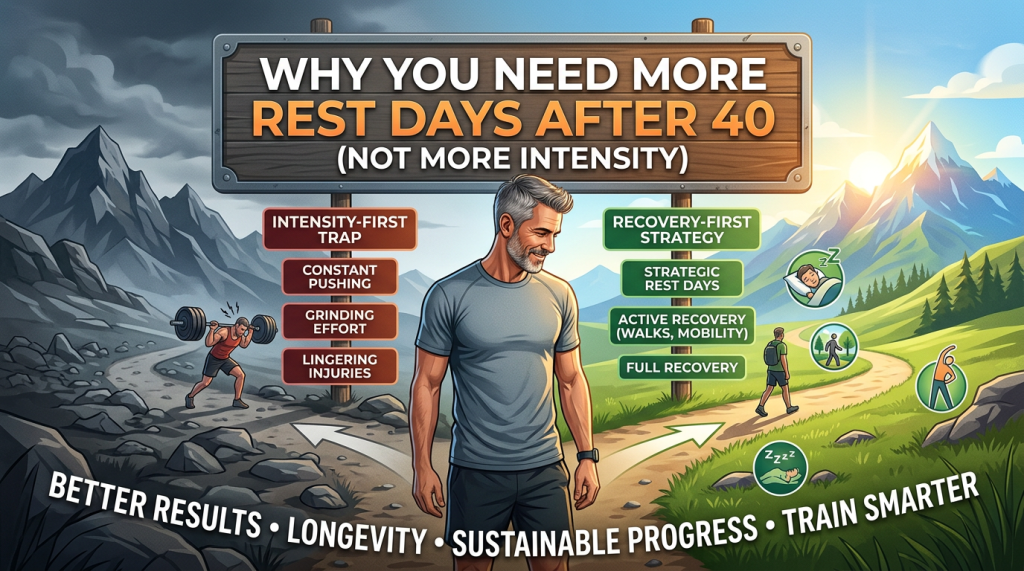
This isn’t about getting lazy. It’s about training smarter in a body that no longer recovers like it did at 25. The shift from intensity-first to recovery-first training might be the most important change you can make for long-term strength, health, and longevity.
The Biological Reality Check After 40
Around age 40, your body begins a gradual but noticeable shift in how it handles training stress. These changes are normal, but they fundamentally alter the rules of the game.
Testosterone and growth hormone production decline by roughly 1% per year after 30. Recovery hormones drop while cortisol (the stress hormone) stays elevated longer after hard sessions. Connective tissues lose elasticity. Muscle protein synthesis slows. Inflammation lingers.
Most importantly, your central nervous system becomes more sensitive to accumulated fatigue. What used to take 48 hours to recover from might now require 72 or even 96 hours.
This creates a dangerous mismatch. Many people over 40 still train with the same intensity and frequency they used in their 30s, but their bodies can no longer keep up. The result is a cycle of subtle overtraining: stalled progress, nagging injuries, poor sleep, and slowly declining motivation.
I learned this the hard way during a period when I was training five or six days per week. My lifts were stagnant, my joints ached constantly, and I felt perpetually drained. Only when I dropped to three hard training days with generous recovery did everything start improving again.
Why Pushing More Intensity Usually Backfires After 40
The modern fitness narrative glorifies intensity. Hustle culture tells us that if we’re not sore, we’re not working hard enough. After 40, this mindset becomes counterproductive — and sometimes destructive.
When you train with high intensity, you create a large recovery debt. In your 20s and early 30s, you could usually pay that debt quickly. After 40, the interest rate on that debt rises. You accumulate fatigue faster than you can clear it.
This leads to several problems:
- Chronic low-grade inflammation that never fully resolves
- Hormonal disruption from constantly elevated cortisol
- Increased injury risk due to compromised connective tissue
- Central nervous system fatigue that affects everything from mood to focus
- Diminishing returns where more work produces less visible progress
I’ve seen this pattern repeatedly in friends and readers. They feel tired, so they train harder to “break through.” The harder they push, the worse they feel. Many eventually burn out and quit exercising altogether.
The uncomfortable truth is this: Training harder is not the same as training better. After 40, better almost always means smarter recovery.
The Real Value of Strategic Rest Days
Rest is not the absence of training. It is when the actual training adaptations occur.
During rest periods, your body repairs muscle fibers, replenishes energy stores, reduces inflammation, and strengthens the nervous system. This process is called supercompensation — your body doesn’t just return to baseline; it adapts to a slightly higher level if given enough time.
After 40, extending these recovery windows produces better long-term outcomes than squeezing in extra workouts.
Strategic rest days deliver:
- Better strength gains from fewer sessions
- Improved joint health and mobility
- Deeper, more restorative sleep
- Lower injury rates
- More sustainable motivation and consistency
- Better overall body composition (less cortisol-related fat storage)
One of the biggest mindset shifts is understanding that doing less in the short term often creates more progress in the long term.
How to Know If You Need More Rest Days
Most people over 40 are under-recovering, not under-training. Here are the most common warning signs:
- Persistent joint pain or stiffness that doesn’t improve within 48 hours
- Elevated morning heart rate (5+ beats above your normal baseline)
- Feeling “wired but tired” in the evenings
- Strength numbers that have plateaued or regressed despite consistent training
- Needing caffeine to get through workouts
- Getting sick more frequently
- Loss of motivation to train (this is often nervous system fatigue, not laziness)
- Poor sleep quality even when you go to bed early
If you recognize three or more of these, your body is almost certainly asking for more recovery.
A Practical Rest-First Training Framework for People Over 40
Here’s the system I’ve refined over the past few years that delivers excellent results with far less burnout:
Training Frequency: Most people over 40 thrive on 3–4 hard training days per week. I personally use a 3-day strength training schedule with excellent results.
Quality Over Quantity: Make your training days focused and intense — but limited. A 45–60 minute session done with full focus beats 90 minutes of mediocre effort.
Active Recovery Days: These are not full rest days but low-stress movement days. Long walks, mobility routines, swimming, easy cycling, or light yoga. The goal is to increase blood flow without creating more stress.
Full Rest Days: At least one complete day per week where you do very little physical activity. This is when deep recovery happens.
Readiness Testing: Every morning, rate your readiness on a 1–10 scale based on sleep, energy, joint feel, and motivation. Below 7? Default to active recovery or full rest.
Sample Weekly Schedule:
- Monday: Heavy Strength Training
- Tuesday: Active Recovery (60–90 minute walk + mobility)
- Wednesday: Moderate Strength Training
- Thursday: Full Rest or very light walk
- Friday: Heavy Strength Training
- Saturday: Fun Movement (hike, sport, or yoga)
- Sunday: Complete Recovery Day
This schedule gives you three quality strength sessions while prioritizing recovery — the perfect balance for most people over 40.
Making Rest Days Actually Effective
Resting properly is a skill. Here’s how to make your recovery days count:
- Prioritize Sleep — This is the foundation of all recovery. Aim for 7.5–9 hours consistently.
- Daily Mobility Practice — 10–15 minutes of targeted mobility work prevents stiffness and improves blood flow.
- Zone 1 Walking — Low-intensity walking is incredibly powerful for recovery and longevity.
- Nervous System Regulation — Breathwork, nature time, or meditation helps clear accumulated stress.
- Nutrition Timing — Consume adequate protein and carbohydrates around training days to support repair.
The Longevity Perspective
The real goal after 40 isn’t to chase personal records or look a certain way. It’s to build a body that remains strong, mobile, and capable well into your 60s, 70s, and 80s.
That requires playing the long game. The people who stay consistently active for decades are rarely the ones who train the hardest. They’re the ones who learn to respect their recovery.
By embracing more rest days now, you’re not slowing down — you’re ensuring you can keep moving, playing, and living fully for the next 40+ years.
Final Thoughts
If you’re over 40 and feeling stuck despite consistent training, try this experiment: reduce your training frequency by 20–40% for the next six weeks while dramatically improving the quality of your rest days.
Most people discover they make better progress with less work. The body rewards patience and intelligence far more than brute force after a certain age.
Sometimes the strongest move is the one that looks like doing nothing.
Related Reading
If you enjoyed this piece, you might also like these related articles:
- Why Rest Days Are the Secret to Better Travel: How Doing Less Helps You Experience More
- Training for the Life You Want at 60: Strength Training for Longevity (Not Just Looks)
- Recovery is a Skill: Why It Doesn’t Happen Automatically (And How to Improve It)
- How to Train After 30: A Complete Guide to Strength, Mobility, and Longevity
- Habits That Matter After 40: What Actually Improves Longevity
- The Minimum Effective Longevity Habits: What Actually Improves Healthspan
- Daily Mobility for Joint Health: Small Movements That Pay Off for Decades
- Your Body’s Dashboard: Early Physical Signs of Burnout You Shouldn’t Ignore


Leave a Reply