The great promise of remote work was freedom. We traded the soul-crushing commute for the ability to work from anywhere—our home offices, coffee shops, or a beachfront Airbnb in Portugal. But for many of us, this freedom has come at a hidden biological cost.
Without the natural anchors of a commute, a physical office, and set “on-off” times, our internal clocks have drifted. We wake up under the artificial glow of a smartphone, spend eight hours staring at a high-intensity LED monitor, and finish our nights scrolling through feeds in a dark room.
The result is a “Circadian Mismatch.” Your body no longer knows what time it is, which leads to the triad of the modern remote worker: brain fog, afternoon slumps, and “tired but wired” insomnia.
If you want to achieve Financial Independence, travel the world, or simply perform at a high level, your health is your primary engine. You cannot compound wealth if you are bankrupting your biology.
Here is the comprehensive guide to fixing your circadian rhythm, optimizing your screen time, and reclaiming your energy.
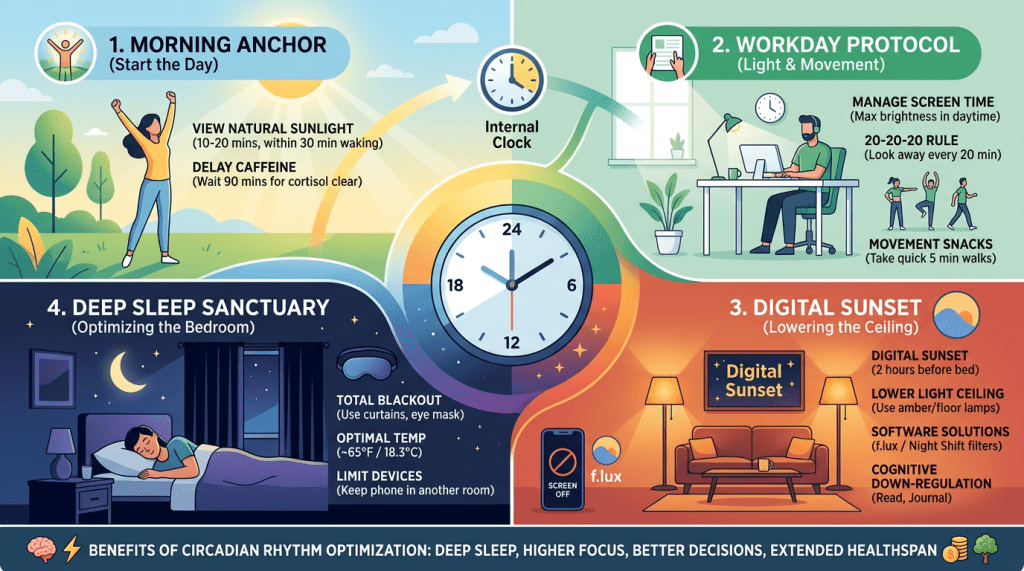
The Science of the “Master Clock”
Deep within your brain lies the Suprachiasmatic Nucleus (SCN). Think of this as your body’s project manager. It coordinates your body temperature, hormone release (cortisol and melatonin), and metabolic rate based on one primary input: Light.
For most of human history, light was synonymous with the sun. Today, light is synonymous with the screen.
When blue light from your monitor hits your retinas, it tells your SCN that it is high noon, even if it’s 11:00 PM. This suppresses melatonin—the hormone of “darkness” and repair—leaving your brain in a state of high-alert agitation. To fix this, we need to implement a “Light Management System.”
Phase 1: The Morning Anchor (0–30 Minutes Post-Wake)
The most important minute of your sleep tonight actually happens tomorrow morning. To set your circadian rhythm, you must “anchor” the start of the day.
1. View Sunlight, Not a Screen
Before you check Slack, emails, or the news, you need photons. Natural sunlight is orders of magnitude brighter than any office lamp. Aim for 10–20 minutes of direct outdoor light exposure within 30 minutes of waking.
- The Benefit: This triggers a timed release of cortisol (to wake you up) and sets a timer for melatonin production 14–16 hours later.
- The Remote Work Hack: If you work in a dark climate, invest in a 10,000 Lux light therapy lamp and sit it on your desk while you do your first block of deep work.
2. Delay Caffeine by 90 Minutes
Most remote workers reach for coffee immediately. However, your body uses a molecule called Adenosine to track how long you’ve been awake. If you mask it with caffeine too early, you face the inevitable “2:00 PM crash”. Delaying your first cup allows your natural cortisol to clear out the residual sleepiness first.
Phase 2: The Workday Protocol (Light and Movement)
As a remote worker, your “environment” is often static. To keep your body clock synchronized, you need to introduce biological “punctuation marks” throughout the day.
1. The Screen Time Triage
High-intensity blue light is fine during the day—it actually helps focus. However, the distance and duration matter.
- The 20-20-20 Rule: Every 20 minutes, look at something 20 feet away for 20 seconds. This relaxes the ciliary muscles in the eyes and signals to the nervous system that you aren’t in a state of hyper-focused “survival” mode.
- Max Brightness During the Day: Keep your workspace brightly lit. Working in a dim room with a bright screen creates “Visual Friction,” which leads to headaches and fatigue.
2. Movement Snacks vs. “The Big Workout”
I’ve discussed about Movement Snacks before. For your circadian rhythm, movement is a secondary time-setter. Instead of sitting for 8 hours and doing one 60-minute gym session, try to get 5 minutes of movement every 2 hours. A quick walk around the block or a set of air squats signals to your body that it is the active phase of your 24-hour cycle.
3. Manage the Temperature
Your body temperature needs to rise during the day and drop at night. If you work from home, you likely keep your thermostat at a constant 72°F (22°C). This lack of thermal variance can make you feel sluggish. Try to keep your workspace slightly warmer and your bedroom significantly cooler.
Phase 3: The Digital Sunset (2 Hours Before Bed)
This is where most remote workers fail. Because our “office” is always with us (in our pockets), the workday never truly ends. To fix your sleep, you must implement a hard “Digital Sunset.”
1. Lower the “Light Ceiling”
As the sun goes down, the lights in your house should move down, too. Overhead lights are more likely to suppress melatonin. Switch to floor lamps or amber-tinted bulbs in the evening.
2. The Software Solution: f.lux and Night Shift
If you must work late, use software like f.lux (for desktop) or Night Shift (for iOS/Android). These programs shift the color temperature of your screen toward the red end of the spectrum.
- Note: This is a “harm reduction” strategy, not a cure. The brightness itself still impacts your brain, even if the light is orange.
3. Cognitive Down-Regulation
The “Inbox Infinity” problem keeps your brain in a state of cognitive arousal. Use the final 60 minutes of your day for low-dopamine activities:
- Reading a physical book (or a dedicated E-reader with the backlight turned off).
- Journaling or “Brain Dumping” your to-do list for tomorrow to reduce “Open Loop” anxiety.
- Gentle stretching or mobility work.
Phase 4: Environmental Design for Deep Sleep
Your bedroom should be a “Recovery Lab.” For a remote worker who spends all day in a digital world, the bedroom must be the ultimate analog sanctuary.
- Total Blackout: Use blackout curtains or a high-quality eye mask. Even a small LED from a power strip can disrupt sleep quality.
- The 65-Degree Rule: Research suggests the optimal sleep temperature is around 65°F (18.3°C). Your body needs to drop its core temperature by 2–3 degrees to initiate deep sleep.
- Kill the Wi-Fi? While the EMF debate continues, many find that physically turning off the router or putting the phone in a different room provides a psychological “permission” to disconnect.
Summary: The Compounding Interest of Sleep
In the world of FIRE (Financial Independence, Retire Early) and personal growth, we often talk about the power of compounding. Sleep is the ultimate compounder.
When you fix your circadian rhythm, you aren’t just “sleeping better.” You are:
- Improving Decision Making: Reducing the “Lifestyle Inflation” that comes from impulsive, tired choices.
- Increasing Focus: Getting more done in 4 hours than a tired person does in 8 (The 4-Day Workweek strategy).
- Extending Your Healthspan: Ensuring you are actually healthy enough to enjoy the financial freedom you are working so hard to build.
Start tomorrow. Get 10 minutes of sun. Delay your coffee. Set a digital sunset. Your future self—the one living on their own terms—will thank you.
Related Reading from the Archives
- The Sleep Efficiency Blueprint: How to Improve Sleep Quality and Wake Up Rested (Without More Hours)
- 7 Sleep Habits Every Developer Needs for Rest and Sharper Coding
- How to Optimize Your Nervous System for Better Focus, Performance, and Health
- The Cost of Being “On” All Day: How Modern Work Overloads Your Nervous System
- Code Well, Live Well: Essential Health Hacks for Remote Developers
- How I Balance Screen Time (as a Developer and Reader) with Physical Health
- Designing a Body That Tolerates Modern Life: How to Stay Healthy in a Sedentary, Screen-Based World
- Biohacking Simplicity: Small Habits, Big Health Gains


Leave a Reply