Most people think the hardest part of Financial Independence is the final stretch.
They imagine the pressure builds as they approach the number.
They assume anxiety increases the closer they get.
They believe the climb gets steeper near the top.
But in reality, the opposite is often true.
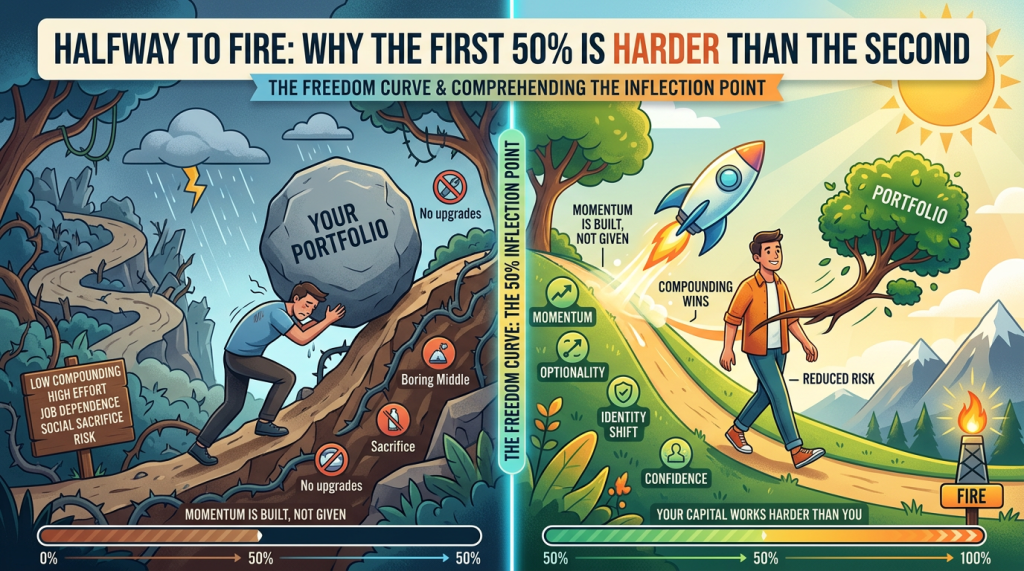
For many pursuing FIRE (Financial Independence, Retire Early), the first 50% is dramatically harder than the second 50% — financially, psychologically, and behaviorally.
There’s a quiet turning point around the halfway mark.
Progress starts to feel different.
Risk decreases.
Confidence increases.
Momentum builds.
I call this inflection point the Freedom Curve — the stage where compounding, optionality, and identity begin working in your favor instead of against you.
Let’s unpack why the first half is so hard — and why life often gets easier after 50%.
The Mathematics of Momentum
In the early stages of FIRE, progress feels painfully slow.
Your savings rate matters.
Your side hustles matter.
Your budgeting discipline matters.
But compounding doesn’t.
Not yet.
When your portfolio is small, market returns are insignificant compared to contributions. If you have $50,000 invested, even a strong 10% year only adds $5,000. That’s helpful — but it’s not transformative.
So the burden falls on you.
You are the engine.
In the second half, the dynamic shifts.
At $500,000, a 10% return is $50,000.
At $1,000,000, it’s $100,000.
Eventually, market growth rivals — or exceeds — your annual contributions.
That’s when compounding stops being theoretical and starts being visible.
The first half requires force.
The second half benefits from momentum.
The Psychological Wall of the Early Years
The first 50% isn’t just financially difficult. It’s psychologically heavy.
You’re:
- Saying no to lifestyle upgrades
- Avoiding lifestyle inflation
- Investing instead of spending
- Watching others upgrade homes, cars, vacations
- Living in the “boring middle”
And there’s no visible freedom yet.
You still need your job.
You still depend on your paycheck.
You still feel exposed to layoffs and market downturns.
You’re sacrificing today for a future that feels abstract.
This is the hardest phase because the rewards are invisible.
The Turning Point: What Changes at 50%
Reaching 50% of your FIRE number doesn’t mean you’re financially independent.
But it does mean something important:
You are no longer starting from zero.
Here’s what changes.
1. Compounding Becomes Meaningful
At the halfway point, growth accelerates naturally.
Even modest returns meaningfully reduce your remaining timeline.
Instead of thinking,
“I need to save $1,000,000,”
You think,
“I only need to build the second half.”
And that second half is partially built by markets — not just you.
Your capital starts working harder than you do.
2. Your Risk Profile Improves
At 10% progress, losing your job feels catastrophic.
At 50%, it feels disruptive — but survivable.
You likely have:
- A large emergency fund
- Years of living expenses invested
- Skills that have increased in value
- Stronger financial habits
You move from fragile to resilient.
And resilience reduces stress.
3. Optionality Emerges
Optionality is the ability to make choices without financial desperation.
At 50%, you can often:
- Take a sabbatical
- Downshift to part-time
- Change industries
- Turn down toxic work
- Move to a lower-cost location
You may not be retired — but you are less trapped.
That shift changes how you show up in life.
You negotiate differently.
You tolerate less.
You take smarter risks.
This is where FIRE stops being about retirement and starts being about leverage.
4. Identity Shifts
Early FIRE feels like deprivation.
Mid-stage FIRE feels like competence.
You no longer feel like someone trying to escape work.
You feel like someone building strength.
Your identity evolves from:
“I’m sacrificing.”
To:
“I’m disciplined.”
To:
“I’m capable.”
That identity upgrade compounds in other areas — health, learning, relationships.
Why the First 50% Feels So Slow
There are structural reasons the early phase drags.
1. Income Is Still Growing
Early in your career, income may be inconsistent. You’re building skills, negotiating raises, and discovering leverage.
Your earning power hasn’t peaked.
Later, higher income accelerates savings.
2. Habits Are Not Yet Automated
At the beginning, every financial decision requires effort:
- Tracking expenses
- Saying no to impulse buys
- Investing manually
- Learning tax optimization
Eventually, systems take over.
Automatic investments.
Stable spending patterns.
Clear financial principles.
Discipline turns into routine.
3. Lifestyle Friction Is Higher
Cutting expenses from $100,000 to $60,000 feels painful.
Maintaining $60,000 once you’re used to it feels normal.
The first adjustment hurts. The maintenance phase doesn’t.
4. You’re Still Building Slack
Slack is margin.
Financial slack.
Time slack.
Emotional slack.
In the early phase, there is none.
You are optimizing constantly.
After 50%, small mistakes don’t derail you.
That psychological cushion matters.
The Coast FIRE Illusion
Some people hit 50% and realize something surprising:
If they stopped contributing entirely, compounding alone could carry them to full FIRE by traditional retirement age.
That’s Coast FIRE.
And even if you don’t choose to coast, knowing you could changes your mental state.
Work becomes optional long before retirement.
Pressure decreases.
Decisions become strategic instead of urgent.
Why Many People Quit Before 50%
Here’s the danger: most people abandon FIRE during the first half.
Why?
Because the math hasn’t become rewarding yet.
They see slow portfolio growth.
They feel social comparison.
They question whether the tradeoffs are worth it.
But the steepest part of the curve is at the beginning.
The mistake isn’t starting.
The mistake is quitting before momentum kicks in.
The Freedom Curve Explained
Imagine a graph:
- The x-axis: time
- The y-axis: financial freedom
The early years rise slowly.
The middle years accelerate.
The final years steepen sharply.
The curve bends upward.
This isn’t just math. It’s behavioral.
- Confidence compounds.
- Income compounds.
- Skills compound.
- Investment returns compound.
By the second half, you’re not just wealthier.
You’re better at building wealth.
What to Do When You Reach 50%
The halfway point is powerful — but it requires strategic thinking.
Here’s how to maximize it.
1. Recalculate Risk
You may be able to:
- Increase equity exposure
- Take career risks
- Launch a side project
- Negotiate more aggressively
Your downside risk has shrunk.
Use that leverage wisely.
2. Protect Against Lifestyle Creep
Ironically, the biggest threat at 50% isn’t failure — it’s comfort.
Income often peaks around this time.
If spending expands too quickly, the target moves further away.
Guard your baseline.
3. Shift From Optimization to Sustainability
Early FIRE requires intensity.
Mid-stage FIRE requires consistency.
You don’t need extreme frugality anymore.
You need durability.
The goal is to avoid burnout before the finish line.
4. Strengthen Non-Financial Assets
At 50%, your finances are stable enough to invest more in:
- Health
- Relationships
- Skill-building
- Geographic flexibility
Remember: FIRE is not just about money.
It’s about building a life that feels expansive.
Why the Second 50% Feels Faster
Even if the timeline is similar in years, it feels faster because:
- Growth is visible.
- Market gains are meaningful.
- Your habits are automatic.
- You trust your system.
- You’ve proven it works.
Confidence compresses time perception.
The early years feel uncertain.
The later years feel inevitable.
That psychological shift is powerful.
The Hidden Benefit: Emotional Calm
At 50% FIRE, something subtle happens.
You stop checking your portfolio obsessively.
You stop worrying about every minor expense.
You stop feeling behind.
You realize you’re on a path — not scrambling.
That calm improves decision-making.
And better decisions accelerate progress further.
A Reality Check
Reaching 50% doesn’t mean:
- You’re invincible.
- You can ignore risk.
- You should double your lifestyle.
- Markets can’t hurt you.
It simply means the slope of the climb has changed.
Respect the process.
But recognize the leverage.
The Long Game Perspective
The first half builds discipline.
The second half builds freedom.
If you’re early in your journey, understand this:
It’s supposed to feel hard.
It’s supposed to feel slow.
You are building the engine.
Once the engine is strong enough, it carries you.
Final Thought: Stay for the Inflection Point
The most common FIRE regret isn’t overspending.
It’s quitting too early.
The difference between 30% and 50% is massive — not just financially, but psychologically.
If you’re below halfway:
Stay consistent.
If you’re near halfway:
Prepare for acceleration.
If you’re past halfway:
Protect the momentum.
The first 50% builds resilience.
The second 50% builds freedom.
And once you feel that shift, you’ll understand:
Life doesn’t suddenly get easy after FIRE.
It starts getting easier long before it.
Related Reading
If this resonated, you may enjoy:
- The First $100K Is the Hardest: Why Reaching $100,000 Changes Your Financial Freedom
- The Boring Middle of FIRE: How to Stay Consistent While Compounding Works
- Why Your FIRE Progress Feels Slow (And What to Do About It)
- Financial Independence Is a Skill, Not a Number
- Freedom Forecasting: How to Predict Your FIRE Date with a Simple Framework
- The Optionality Playbook: Why Financial Independence Is About Better Choices, Not Early Retirement
- Designing Cash Flow for Financial Independence (Not Maximum Returns)
- Why Financial Independence Is Really About Slack (Not Early Retirement)


Leave a Reply