Most people read vertically.
Engineers read engineering.
Investors read finance.
Developers read programming.
Academics read within their discipline.
It feels efficient. It feels focused. It feels productive.
But over time, something subtle happens: thinking narrows.
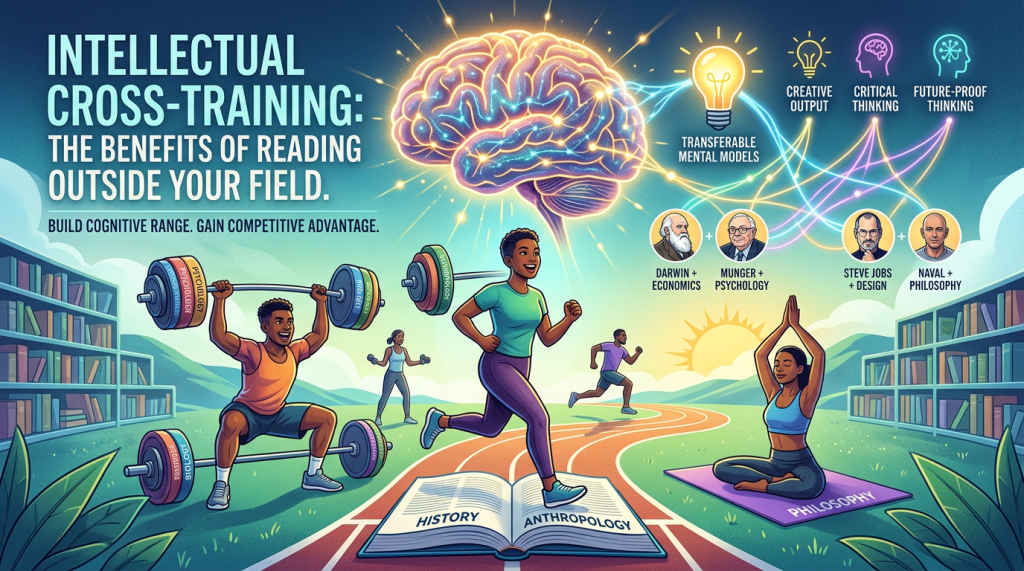
The smartest people I know don’t just go deeper. They go wider. They practice what I call intellectual cross-training — deliberately reading outside their primary field to build cognitive range.
Just like physical cross-training strengthens muscles you didn’t know were weak, intellectual cross-training strengthens mental capacities your profession alone can’t fully develop.
If you want better ideas, sharper thinking, and more creative leverage in your work, reading outside your field isn’t optional.
It’s a competitive advantage.
What Is Intellectual Cross-Training?
In fitness, cross-training means training in complementary disciplines to avoid overuse, improve balance, and enhance overall performance.
A runner lifts weights.
A lifter swims.
A cyclist practices yoga.
The goal isn’t distraction — it’s resilience and adaptability.
Intellectual cross-training works the same way.
It means deliberately reading:
- Outside your industry
- Outside your ideology
- Outside your expertise
- Outside your comfort zone
A software developer reads behavioral psychology.
A doctor studies philosophy.
An investor reads anthropology.
A writer studies biology.
This doesn’t dilute expertise. It multiplies it.
Why Specialization Alone Isn’t Enough
Modern careers reward specialization. That’s how we get world-class surgeons, elite engineers, and quantitative analysts.
But specialization has side effects:
- Cognitive blind spots
- Recycled thinking
- Fragile frameworks
- Low creative elasticity
When you read only within your field, you begin to operate inside a closed intellectual loop. Everyone references the same ideas. The same models circulate. The same assumptions go unquestioned.
Depth without breadth leads to intellectual inbreeding.
History shows that breakthrough thinking often happens at intersections:
- Darwin borrowed from economics (Malthus).
- Charlie Munger blended psychology with investing.
- Naval Ravikant merges philosophy with business.
- Steve Jobs fused technology with design and calligraphy.
Innovation rarely comes from going deeper alone. It often comes from connecting distant domains.
The Cognitive Benefits of Reading Outside Your Field
1. You Develop Transferable Mental Models
Every discipline encodes patterns.
Biology teaches adaptation and systems.
Physics teaches constraints and trade-offs.
Psychology teaches bias and motivation.
Economics teaches incentives and scarcity.
Philosophy teaches clarity and reasoning.
When you read across disciplines, you collect mental models that transfer.
A developer who understands incentives designs better platforms.
An investor who understands evolutionary biology thinks better about competition.
A manager who studies stoicism handles volatility calmly.
The broader your library of models, the more adaptable your thinking becomes.
2. You Increase Creative Output
Creativity is combinatorial.
New ideas are rarely invented from nothing. They are formed by combining existing concepts in novel ways.
If you only consume ideas from one domain, your combinations are limited.
If you read broadly, the combinatorial possibilities explode.
This is why interdisciplinary thinkers often feel “original”. They aren’t necessarily smarter. They just have more raw material to connect.
Creativity isn’t magic. It’s cross-pollination.
3. You Reduce Overconfidence
Reading inside your field increases confidence.
Reading outside your field increases humility.
When you explore unfamiliar territory, you confront how much you don’t know. That friction sharpens thinking. It reduces intellectual arrogance.
And humility is a thinking upgrade.
It prevents you from mistaking expertise in one domain for universal intelligence.
4. You Strengthen Critical Thinking
When you read competing frameworks, you learn that:
- Different fields define problems differently.
- Solutions depend on assumptions.
- Data can be interpreted in multiple ways.
Exposure to multiple lenses makes you less dogmatic.
You stop asking:
“What’s the right answer?”
And start asking:
“What framework is most useful here?”
That shift alone improves decision quality.
5. You Future-Proof Your Thinking
Industries evolve. Skills become obsolete.
But cognitive flexibility compounds.
If you’ve trained your brain to learn across domains, you adapt faster when your primary field changes.
Intellectual agility becomes a form of career insurance.
Signs You’re Not Cross-Training Enough
- You only read books directly tied to your job.
- You feel intellectually “stuck.”
- You rarely encounter ideas that challenge you.
- Your conversations revolve around one theme.
- You consume information primarily through one lens (technical, financial, ideological).
This isn’t a moral issue. It’s a strategic one.
Monoculture thinking is fragile.
What to Read Outside Your Field
You don’t need random chaos. You need intentional contrast.
Here are high-leverage domains for most knowledge workers:
1. Psychology
Understanding incentives, bias, habit formation, and cognitive distortion upgrades every profession.
2. Evolutionary Biology
Teaches adaptation, competition, signaling, and long-term survival patterns.
3. Philosophy
Improves clarity, reasoning, and moral grounding.
4. History
Provides pattern recognition across centuries.
5. Anthropology
Reveals cultural assumptions you didn’t know you held.
6. Design
Teaches usability, aesthetics, and human-centered thinking.
7. Behavioral Economics
Bridges rational theory and messy human reality.
You don’t need mastery. You need exposure.
How to Practice Intellectual Cross-Training (Without Overwhelm)
Reading broadly can become chaotic if unstructured. Here’s a simple system.
The 70/30 Rule
- 70% of your reading: your primary field
- 30%: adjacent or distant domains
This keeps depth intact while adding breadth.
The Seasonal Rotation Method
Instead of reading five disciplines at once, rotate:
- Quarter 1: Philosophy
- Quarter 2: Biology
- Quarter 3: History
- Quarter 4: Psychology
Focus reduces cognitive switching costs.
The Contrast Pair Method
Read two books from different domains simultaneously.
Example:
- A finance book
- A psychology book
Then deliberately ask:
“How do these ideas connect?”
This is where cross-training becomes active rather than passive.
The Application Filter
After finishing a book outside your field, ask:
- What principle transfers?
- Where does this challenge my current thinking?
- What would change if I applied this to my work?
Without application, breadth becomes trivia.
With application, it becomes leverage.
Intellectual Cross-Training and Financial Independence
If you’re pursuing FIRE or long-term freedom, cross-training is especially valuable.
Financial independence isn’t just about math. It’s about:
- Behavioral psychology (spending, incentives)
- Sociology (status signaling)
- Philosophy (what is “enough”?)
- Geography (location arbitrage)
- Health science (longevity planning)
Reading only finance limits your understanding of wealth.
Wealth is interdisciplinary.
Intellectual Cross-Training and Longevity
Health is not just physiology.
It’s psychology, stress regulation, habit formation, sociology, environment design, and even philosophy.
A purely “biochemical” approach misses behavior.
A purely “motivational” approach misses physiology.
Reading broadly creates integrated health thinking.
Intellectual Cross-Training and Travel
Travel itself is a form of cross-training.
New environments expose you to different systems — economic, social, cultural.
When combined with broad reading, travel becomes layered:
You don’t just see a place.
You interpret it through multiple lenses.
This deepens experience and insight.
The Risk of Reading Too Broadly
There is one trap: intellectual tourism.
Jumping from topic to topic without depth.
Cross-training works because it complements a primary discipline. It does not replace it.
The goal isn’t to become a shallow generalist.
The goal is to become a deep specialist with wide cognitive range.
Depth anchors you.
Breadth stretches you.
Building Your Intellectual Edge
In a world of algorithmic feeds and niche specialization, broad thinking is rare.
Rare thinking compounds.
Over time, cross-training does something subtle:
- Your analogies improve.
- Your pattern recognition sharpens.
- Your problem-solving speeds up.
- Your writing gains texture.
- Your conversations deepen.
You start seeing connections others miss.
That’s not accidental. It’s trained.
A Simple Starting Point
If you’ve been reading narrowly, begin here:
- Pick one field you know almost nothing about.
- Choose one foundational book.
- Read slowly.
- Take notes on transferable principles.
- Apply one insight to your work.
Then repeat.
Intellectual cross-training doesn’t require dozens of books. It requires intentional variety.
The Long-Term Compounding Effect
The true benefit isn’t immediate.
It compounds.
Five years of interdisciplinary reading creates:
- Layered thinking
- Flexible reasoning
- Creative agility
- Conceptual depth
Your mind becomes more anti-fragile.
When industries shift, when technologies evolve, when assumptions break — you adapt.
Because your thinking was never one-dimensional.
Final Thought: Train Your Mind Like an Athlete
Athletes don’t train only their strengths.
They strengthen weak links.
They balance opposing muscles.
They improve mobility to avoid injury.
Your thinking deserves the same care.
If you only read inside your field, you may become strong — but brittle.
If you cross-train intellectually, you become adaptable, creative, and resilient.
In a rapidly changing world, that may be the highest leverage skill of all.
Related Reading
If this resonated, you may enjoy:
- Reading Across Disciplines: How Interdisciplinary Learning Fuels Creative Thinking
- How to Improve Your Thinking: Why Reading Alone Isn’t Enough
- The Learning Bottleneck: Why Smart People Plateau (And How to Break Through)
- Learning Like an Investor: How to Allocate Attention for Long-Term Growth
- Cognitive Nutrition: Why Information Quality Matters More Than Quantity
- The Literature Gym: Daily Reading Exercises to Improve Your Thinking
- How to Understand Any Book Better: The 3-Pass Reading System Explained
- The Reading Flywheel: How to Remember, Apply, and Learn More From Books


Leave a Reply