There is a specific kind of silence that only exists in a foreign city. It is the silence of the third week of a solo trip – the moment when the initial adrenaline of discovery has faded, and you realize that you haven’t had a conversation longer than three sentences with another human being in four days.
The romanticized image of the solo traveler is one of radical independence. We are told that traveling alone is the ultimate path to self-discovery, a way to move through the world unencumbered by the needs and opinions of others. And for the most part, this is true. Solo travel is a superpower. It allows for the “Long Walk”, the deep reflection, and the “Mental Carry-On”.
But human beings are biologically wired for connection. Even the most stoic, introverted remote worker eventually hits a wall. Solitude, when left unchecked, slowly degrades into isolation. The “Self-Discovery” stops because there is no “Social Mirror” to reflect your growth.
The challenge for the long-term solo traveler is not just finding people to talk to. It is Managing the Social Battery. It is the delicate art of architecting a community that provides depth and support without draining the very energy you need to explore, work, and grow.
The Metabolic Cost of Socializing
To manage your social battery, you must first understand what it is. For many in our community – thinkers, developers, and introverted explorers – social interaction is not a “charging station.” It is a metabolic process. It requires the expenditure of cognitive and emotional energy.
When you are in your home city, your social life is mostly “automated”. You have established scripts with friends, family, and colleagues. You don’t have to explain your “deal” every time you go for coffee.
When you are traveling solo, every social interaction is “Manual”.
- The Small Talk Tax: You are constantly stuck in the “Introduction Phase.” Where are you from? How long are you here? What do you do for work? For an intellectual worker, this repetitive loop is the equivalent of a digital “memory leak”. It eats up processing power without producing any useful output.
- The Vigilance Factor: In a new country, your nervous system is in a state of high-alert. You are processing new phonemes in the language, new street signs, and new cultural etiquette. Socializing on top of this “Environmental Vigilance” is exhausting.
- The Performance Burden: There is a pressure in solo travel to be “The Interesting Person”. Because you are a temporary fixture in people’s lives, you often feel the need to perform a curated version of yourself, which is significantly more taxing than just “being”.
If you don’t manage these costs, you will experience Social Burnout. This manifests as a sudden, intense desire to hide in your Airbnb, order food on an app, and speak to no one for forty-eight hours. While recovery is necessary, the goal is to design a life where you don’t “redline” your battery in the first place.
The Three Layers of Social Architecture
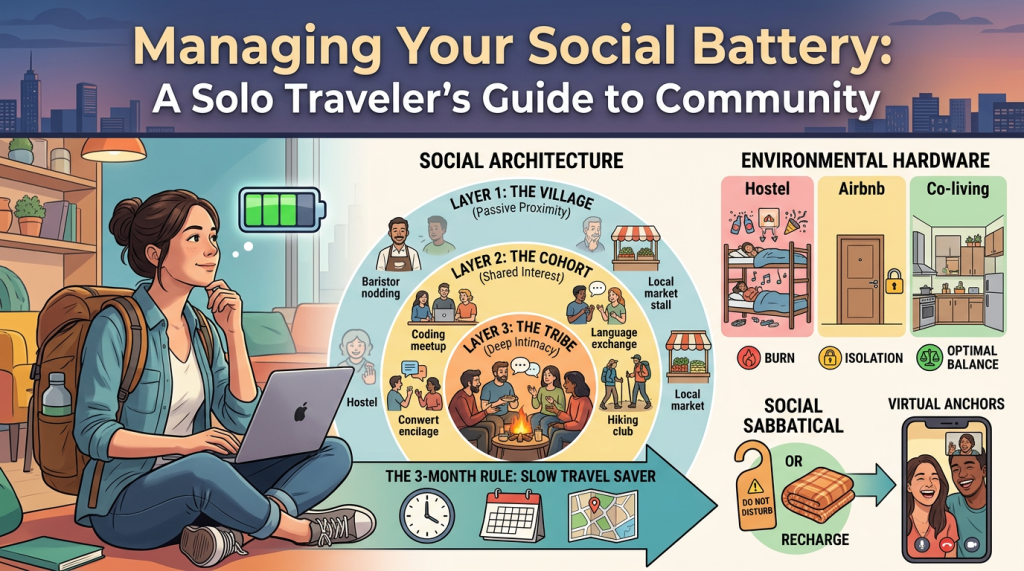
To build a sustainable community while traveling, you need to stop thinking about “meeting people” and start thinking about “Social Architecture”. I divide social connections into three distinct layers, each with a different energy cost and nutritional value.
Layer 1: The Village (Passive Proximity)
This is the most underrated layer of travel. The “Village” consists of the people you see every day but don’t necessarily have deep conversations with. It’s the barista at the corner café who recognizes you. It’s the person at the coworking desk next to yours who nods when you sit down.
- Energy Cost: Near Zero.
- Nutritional Value: High (provides a sense of belonging and “Slack” in your nervous system).
- How to Build It: Stay in one neighborhood. Go to the same coffee shop at the same time every morning. Become a “regular” somewhere within 72 hours of arriving.
Layer 2: The Cohort (Shared Interest)
These are connections built around an activity rather than just “socializing”. Think of a Jiu-Jitsu gym, a local coding meetup, a language exchange, or a hiking club.
- Energy Cost: Moderate.
- Nutritional Value: High (the focus is on the thing, which reduces the pressure to perform).
- How to Build It: Lead with your hobbies. Don’t look for “travelers”; look for “people who like the thing I like”.
Layer 3: The Tribe (Deep Intimacy)
These are the people who know your “Second Brain.” They know your fears, your FIRE (Financial Independence, Retire Early) goals, and your history. In solo travel, these are rare and hard to find.
- Energy Cost: High (initially), then Low (once established).
- Nutritional Value: Essential for long-term mental health.
- How to Build It: Proximity + Vulnerability + Time. This usually requires staying in one place for at least three months.
The 3-Month Rule: Why Slow Travel is a Social Life Saver
The biggest drain on a social battery is the “Constant Arrival.” If you are moving every two weeks, you are permanently stuck in the “Small Talk Tax” zone of Layer 1. You never have time to move into Layers 2 or 3.
I advocate for the 3-Month Rule. By staying in one city for 90 days, the social dynamics shift in your favor:
- Month 1 (The Search): You are the “New Person.” You spend energy exploring different “Villages” and “Cohorts”.
- Month 2 (The Selection): You stop going to the things that drain you and double down on the groups that recharge you. You start being recognized.
- Month 3 (The Integration): You have a routine. You have “Social Slack”. You no longer feel the need to “hunt” for connection because connection is baked into your weekly schedule.
Choosing Your Social Base: Hostels vs. Co-living vs. Airbnbs
Your physical environment is the “hardware” upon which your social life runs.
- Hostels: These are “Social High-Fructose Corn Syrup”. They provide an immediate, intense spike of interaction, but it is often shallow and exhausting. Great for a weekend, but a recipe for burnout for a digital nomad.
- Airbnbs: These are “Social Isolation Chambers”. Unless you are incredibly proactive, an Airbnb will allow you to go weeks without a meaningful interaction. Great for “Recovery Phases,” but dangerous for “Growth Phases”.
- Co-living Spaces: This is the “Goldilocks” solution. Co-living spaces are designed with social architecture in mind. You have a private “Cave” (your room) to recharge, but a “Commons” (shared kitchen/workspace) where Layer 1 and 2 connections happen effortlessly. For the remote worker, this is the most energy-efficient way to maintain a social battery.
The Art of the Social Sabbatical
Just as we must manage our “Energy Budget” for travel fatigue, we must manage our social budget. This requires the Social Sabbatical.
A Social Sabbatical is a pre-planned period – usually 2 to 4 days – where you intentionally “zero out” your social obligations. You don’t go to the group dinner. You don’t answer the WhatsApp group. You don’t “network”.
For many solo travelers, there is a guilt associated with this. We feel that because we are in a beautiful, foreign place, we should be out meeting people. But as I’ve discussed in Why Financial Independence Is Really About Slack, the ultimate goal of freedom is the ability to say “No” to things that drain you, even if those things are “fun”.
A social sabbatical allows your nervous system to return to baseline. It gives you the “Idea Carrying Capacity” to actually process the conversations you’ve been having.
Virtual Anchors: The Role of the “Old Tribe”
Finally, we must recognize that our social battery is often propped up by our “Virtual Anchors” – the friends and family back home.
When you are traveling solo, you are constantly “re-inventing” yourself for new people. This is liberating, but it’s also unmooring. Maintaining a weekly “Deep Talk” call with someone who knew you ten years ago is a massive energy saver. It provides an emotional “Grounding Wire.” When your virtual tribe is strong, you don’t “need” the strangers you meet in a new city to validate you, which ironically makes you more attractive and relaxed in those new social situations.
Conclusion: Designing for Connection
The “Social Battery” is not something that happens to you; it is something you manage. By moving from a “Professional Tourist” mindset to a “Social Architect” mindset, you can solve the loneliness of solo travel without suffering the burnout of over-extension.
Build your Village through proximity. Find your Cohort through shared interests. And give yourself the time – the full three months – to let a Tribe emerge.
Solo travel is the best way to see the world, but community is the only way to sustain the journey. Manage your battery wisely, and you’ll find that the “silence” of a foreign city stops feeling like isolation and starts feeling like peace.
Related Reading
If you’re looking to build a more meaningful social and travel lifestyle, these articles provide the frameworks you need:
- How to Maintain Friendships While Traveling: Building New Connections Without Losing Old Ones – How to stay anchored while you roam.
- How Long to Stay in One Place While Traveling: Why 3 Months Changes Everything – The mathematical and psychological case for slow travel.
- How to Build Deep Connections While Traveling: The Social Architecture of Temporary Places – Moving beyond the “Small Talk Tax.”
- How to Make Friends While Traveling Solo: A Guide to Finding Community – Practical strategies for the solo explorer.
- Digital Sabbaticals: How to Travel to Disconnect (Not Just Work Remotely) – Protecting your focus from the digital and social noise.
- Why Some Cities Recharge You (and Others Drain You): The Hidden Energy Cost of Urban Living – How your location dictates your social energy.
- Travel Stacking: How to Combine Learning, Fitness, and Reflection Into Every Trip – Using your solo time for high-leverage growth.
- Why Traveling Alone Will Change Your Perspective on Life – Embracing the “Self-Reliance” side of the solo journey.


Leave a Reply