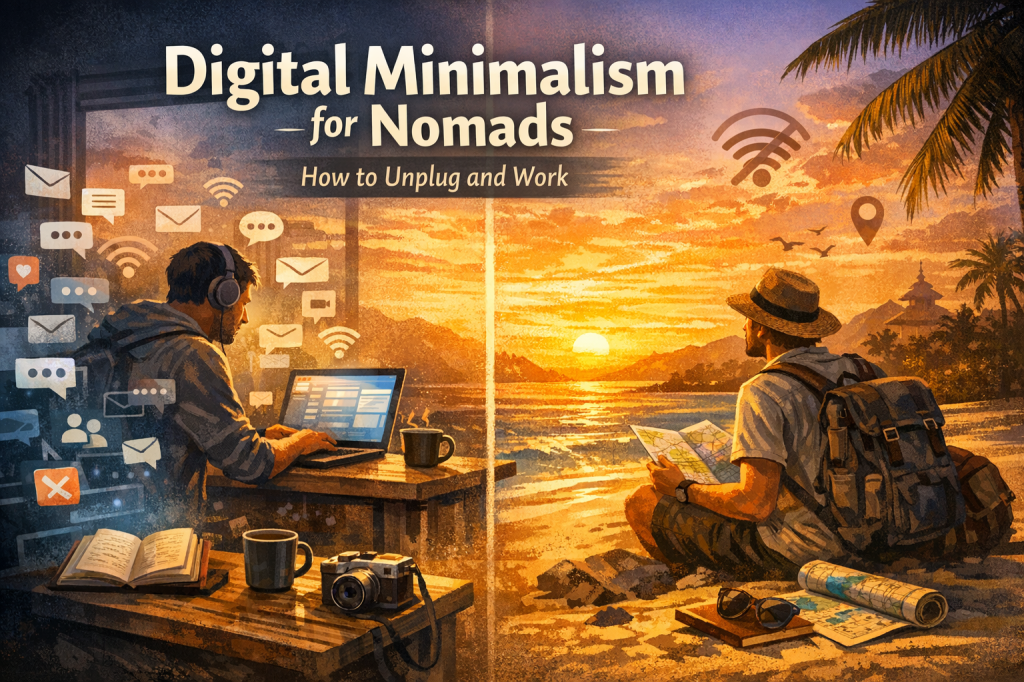
The great irony of the digital nomad lifestyle is that we often travel halfway across the world to see a sunset, only to spend the “golden hour” squinting at a laptop screen or editing a video of that same sunset for an audience we left behind.
We are a generation of travelers who have achieved the dream of location independence, yet we have traded our physical cubicles for digital ones. When your office is your backpack, your office is always with you. The boundary between “being in a place” and “working in a place” has completely dissolved. For many of us, “freedom” has become a state of being constantly “on”, tethered to Wi-Fi signals and Slack notifications while the vibrant reality of a new culture passes us by.
To survive this lifestyle without burning out, we need more than just time management. We need Digital Minimalism.
Digital minimalism, a philosophy popularized by Cal Newport, is not about being a Luddite or living in a cave. It is about technology optionality – the ability to focus your online time on a small number of carefully selected activities that support your deepest values, while happily missing out on everything else. For the nomad, this isn’t just a productivity hack; it is a survival mechanism for the nervous system.
1. The Nomad’s Digital Tax
Every app, notification, and browser tab is a withdrawal from your “Cognitive Carrying Capacity”. As a traveler, your brain is already working overtime. You are processing new languages, navigating unfamiliar subway systems, and adapting to different social norms. This “environmental processing” is a high-energy activity for the brain.
When you add the “Digital Tax” of constant connectivity – checking email every ten minutes, scrolling through local Instagram tags, or obsessively checking flight prices – you push your nervous system into a state of chronic overwhelm.
The result is “Professional Tourism”. You are physically in Lisbon or Tokyo, but your mind is stuck in the global “Everywhere” of the internet. You aren’t experiencing the city; you are just working in a different climate. To truly unplug, we must first recognize that our attention is a finite resource that is being taxed by the very tools meant to set us free.
2. Intentional Friction: Designing Your Interface
The goal of a digital minimalist is to make the things that matter easy and the things that distract hard. In a nomadic context, your hardware is your environment. You must design it to serve your focus.
The “Single-Purpose” Device Strategy
If your budget and backpack space allow, treat your laptop strictly as a tool for “Deep Work”. When the laptop is open, you are a professional. When it is closed, the “office” has disappeared. Avoid the “hybrid” state of lying in a hammock with a laptop on your lap. It ruins the relaxation of the hammock and it degrades the quality of the work.
The Smartphone Purge
As a nomad, your phone is your map, your translator, and your boarding pass. It is an essential survival tool. But it is also a casino in your pocket.
- The 24-Hour Rule: Delete all social media and news apps from your phone. If you want to check them, you must do it on your laptop. This creates “intentional friction.” You won’t check Instagram while waiting for a bus if you have to pull out a laptop and find Wi-Fi to do it.
- Grayscale Mode: Turn your phone’s display to grayscale. By removing the color, you strip away the dopamine triggers that keep you scrolling. Your phone becomes a dull, utilitarian tool – which is exactly what it should be.
3. The “Analog Morning” Framework
For many nomads, the first thing they do upon waking up in a new country is check their phone to see what happened in the time zone they just left. This is a catastrophic way to start the day. It hooks your nervous system into a reactive state before you’ve even had a cup of local coffee.
The System: No digital inputs for the first 90 minutes of the day.
Instead of scrolling, engage in what I call the “Nomad Trinity”:
- Geography: Go for a 20-minute walk without your phone. Observe the architecture, the smell of the bakeries, and the way the light hits the street. This “grounds” your brain in your current location.
- Cognition: Spend 30 minutes reading a physical book or a Kindle (with Wi-Fi off). This trains your brain to focus on a single, deep stream of information.
- Reflection: Use a paper journal to write down your goals for the day and your observations of the city.
By the time you finally open your laptop, you have already “arrived” in your location. You are working from a place of presence, not a place of digital anxiety.
4. Digital Sabbaticals: Reclaiming the “Local” Experience
In the FIRE (Financial Independence, Retire Early) world, we talk about “Slack” – the extra space in a system that prevents it from breaking. A digital sabbatical is the “Slack” for your brain.
Once a month, or during transition days between cities, go fully analog for 24 to 48 hours.
- No Google Maps: Use a paper map or, better yet, just walk until you get lost and then ask for directions. This builds “cognitive maps” and forces you to interact with locals.
- No Spotify: Listen to the ambient sounds of the environment. The “soundscape” of a city is 50% of its character.
- No Photography: Try to experience one beautiful thing without feeling the need to document it.
This “Digital Detox” allows your dopamine receptors to reset. You will find that your memory of the trip becomes much more vivid. We don’t remember the emails we sent; we remember the feeling of a rainstorm in a foreign city or the taste of a meal we found by accident.
5. Navigating the “Always-On” Work Culture
The biggest barrier to digital minimalism for nomads is the fear of being “unresponsive”. We worry that if we aren’t reachable 24/7, our clients or managers will realize we are actually on a beach in Thailand and lose trust.
The solution is Proactive Communication.
- Set clear “Office Hours” based on your current time zone.
- Use an auto-responder that says: “I check my email at 9 AM and 4 PM [Your Time Zone]. If this is an emergency, please call.” (Note: It is almost never an emergency).
- Batch your communications. Instead of replying to Slack messages as they arrive, spend one hour at the end of your day clearing everything.
When you are “off”, be truly off. When you are “on”, be 100% productive. Your clients will value your high-quality output more than your lightning-fast response times.
Conclusion: Reclaiming Your Attention
Your attention is the most valuable asset you own. It is more valuable than your frequent flyer miles, your remote salary, or even your FIRE portfolio.
As a nomad, you have fought hard for the freedom to be anywhere. Don’t waste that hard-earned freedom by being “everywhere” at once through a 6-inch screen. Use digital minimalism to close the tabs in your mind so you can finally see the world that is right in front of you. Travel is a gift to the senses, but only if you are present enough to receive it.
Related Reading
- Digital Posture: How Screens Reshape Your Body (and How to Fix It Fast)
- How to Stay Productive with a 4-Day Workweek as a Digital Nomad
- Digital Sabbaticals: How to Travel to Disconnect (Not Just Work Remotely)
- How to Optimize Your Nervous System for Better Focus, Performance, and Health
- The Cost of Being “On” All Day: How Modern Work Overloads Your Nervous System
- How to Recover from Burnout and Rebuild Your Energy After a Long Stint at Work
- How to Use Travel for Personal Growth and Self-Discovery
- Energy Management vs Time Management: How to Increase Focus and Avoid Burnout


Leave a Reply