We spend decades obsessed with the numbers on our brokerage accounts. We track withdrawal rates, expense ratios, and the “boring middle” of compounding. But there is another metric – one purely biological – that acts as the ultimate “insurance policy” for your future self.
If your net worth is the capital you intend to spend in retirement, your VO2 Max is the vessel that allows you to actually enjoy it.
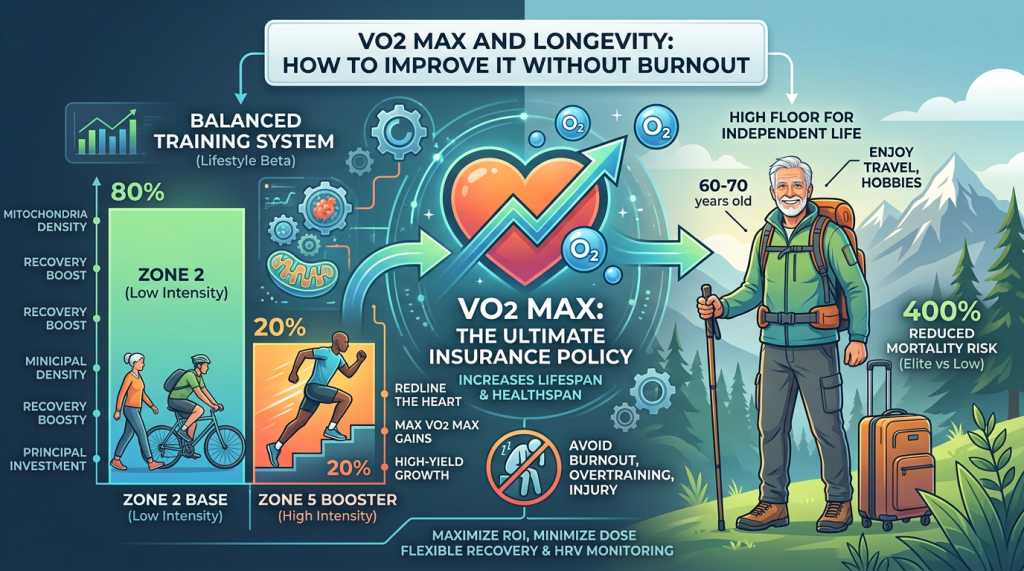
The data is now undeniable: VO2 Max is perhaps the single most powerful predictor of how long you will live (lifespan) and how well you will live (healthspan). According to long-term studies, moving from the “low” category of aerobic fitness to the “below average” category reduces your risk of all-cause mortality by 50%. If you can get into the “elite” category, the risk reduction is closer to 400% compared to the bottom tier.
For the remote worker, the FIRE (Financial Independence, Retire Early) seeker, and the traveler, VO2 Max is the “alpha” of health. But there’s a problem. Most people hear “high-intensity training” and think of soul-crushing workouts that lead to burnout, injury, or a fried nervous system.
In this guide, we’re going to apply the same “Lifestyle Beta” approach we use for finances to our fitness. We’re looking for the maximum ROI with the minimum effective dose, ensuring we build a heart that lasts a century without burning out in the process.
What is VO2 Max (And Why Should You Care?)
In simple terms, VO2 Max is the maximum amount of oxygen your body can utilize during intense exercise. It is a measurement of the efficiency of your “supply chain”:
- The Pump: How much blood your heart can push out.
- The Pipes: How effectively your vascular system delivers that blood.
- The Factory: How well your muscles (mitochondria) extract that oxygen to create energy.
As we age, our VO2 Max naturally declines by about 10% per decade after the age of 30. If you start with a “standard” level of fitness, by the time you are 70, you may lack the functional capacity to hike a trail, carry your own luggage through a terminal, or even get up from the floor easily.
By training your VO2 Max now, you are “front-loading” your health. You are building a higher ceiling so that when the natural decline happens, your “floor” remains high enough for a high-quality, independent life.
The Assessment: Where Do You Stand?
Before we optimize the system, we need a baseline. While a laboratory “gas exchange” test is the gold standard, you can get a very accurate estimate using two simpler methods:
1. The Cooper Test
Run as far as you can in 12 minutes on a flat surface (a track is best). Plug your distance into an online Cooper Test calculator. It’s simple, but it requires a “max effort” that can be taxing.
2. The Apple Watch / Wearable Estimate
Modern wearables use heart rate and walking speed data to estimate VO2 Max. While not 100% accurate in terms of the absolute number, they are excellent for tracking trends. If your Apple Watch says your VO2 Max is 42 and it goes up to 45 over three months, your system is improving.
The Training System: The 80/20 Rule of Aerobic Health
To improve VO2 Max without burning out, we must respect the polarized training model. This is the same system used by Olympic cross-country skiers and marathoners.
- 80% of your time should be spent in Zone 2 (Low intensity).
- 20% of your time should be spent in Zone 5 (High intensity).
The biggest mistake people make is spending 100% of their time in “Zone 3″—that middle ground where you’re working too hard to recover quickly, but not hard enough to trigger massive VO2 Max gains. This is the “Gray Zone,” and it is the primary cause of fitness burnout.
The Base: Zone 2 (The Foundation)
You cannot build a skyscraper on a swamp. Zone 2 training – walking briskly, light jogging, or steady cycling – increases mitochondrial density and improves your body’s ability to burn fat. It keeps your nervous system in a “parasympathetic” state, meaning it helps you recover from your work day rather than adding to your stress.
- The Goal: 150–200 minutes per week.
- The Test: You should be able to maintain a conversation, but it should be slightly uncomfortable.
The Peak: Zone 5 (The VO2 Max Booster)
To actually move the needle on your VO2 Max, you need to occasionally “redline” the engine. This strengthens the heart’s stroke volume (the amount of blood pumped per beat).
The most evidence-based protocol for this is the Norwegian 4×4:
- Warm-up: 10 minutes of light movement.
- Interval: 4 minutes of high intensity (85–95% of Max Heart Rate). You should be breathing too hard to speak.
- Active Recovery: 3 minutes of very light movement (Zone 1).
- Repeat: Do this 4 times.
How to Avoid Burnout: Managing the Nervous System
High-intensity intervals are a massive “ask” of your nervous system. If you are already stressed from a 50-hour workweek, a long-haul flight, or a caloric deficit, adding a 4×4 session can push you into overtraining.
Here is how to stay consistent for the long haul:
1. The “Once a Week” Rule
For most people, one dedicated VO2 Max session per week is enough to see significant gains, provided the Zone 2 base is there. Do not try to do three HIIT sessions a week; you will likely crash within a month.
2. Monitor Your HRV (Heart Rate Variability)
Use your wearable to check your HRV in the morning. If your HRV is significantly lower than your baseline, your nervous system is still recovering. On those days, swap your VO2 Max session for a gentle walk. Flexibility is the key to longevity.
3. The Minimum Effective Dose for Travelers
When you’re traveling, a 4×4 run might not be feasible. Use “Movement Snacks”. Find a steep hill or a set of stairs in your new city. Sprint up for 30 seconds, walk down for 60 seconds, and repeat 10 times. It’s not the “perfect” protocol, but it maintains the adaptations you’ve worked hard for.
The Financial Parallel: Compounding Your Health
Think of your VO2 Max training like your 401(k) contributions.
- Zone 2 is the principal investment: It’s the steady, boring work that provides the foundation.
- Zone 5 is the high-yield growth: It’s the aggressive part of the portfolio that drives the total value up.
If you only invest in the high-risk stuff, you might go bust (burnout). If you only do the steady stuff, you might not reach your goals in time. You need the balance.
Conclusion: The 60-Year-Old Version of You
Visualize yourself at 60 or 70. You have reached Financial Independence. You have the time and the money to travel the world, read every book on your TBR pile, and engage with your community.
Will you have the breath to do it?
Improving your VO2 Max isn’t about becoming a professional athlete. It’s about ensuring that your physical “carrying capacity” remains larger than your lifestyle ambitions. Start with one session. Build the base. Respect the recovery. Your future self will thank you for the “alpha.”
Related Reading
- Zone 2 Cardio Explained: The Boring Workout That Boosts Longevity and Adds Years to Your Life
- Why Grip Strength Predicts Longevity (And How to Improve It)
- Training for Longevity: How to Exercise for Long-Term Health, Not Just Looks
- The Minimum Effective Longevity Habits: What Actually Improves Healthspan
- How to Optimize Your Nervous System for Better Focus, Performance, and Health
- Recovery is a skill: Why it doesn’t happen automatically (and how to improve it)
- Designing a Body That Tolerates Modern Life: How to Stay Healthy in a Sedentary, Screen-Based World
- Training Your Nervous System for Modern Work: How to Reduce Stress and Avoid Burnout


Leave a Reply