Most people think reading more makes them smarter. But reading without thinking is like watching someone else work out. You don’t get stronger by observing. You get stronger by lifting.
We live in an age of infinite information. Podcasts, newsletters, books, threads, videos – the inputs never stop. And yet, despite consuming more than any generation in history, most of us don’t feel like sharper thinkers. We feel overwhelmed. Scattered. Reactive.
Here’s the uncomfortable truth: reading is not thinking.
Reading is input. Thinking is processing. And most people dramatically over-invest in input while almost completely neglecting the processing side.
Think of it this way. If your brain were a body, reading would be eating. Thinking would be exercising. You wouldn’t expect to get fit just by eating well. You need to move. You need to train. You need resistance.
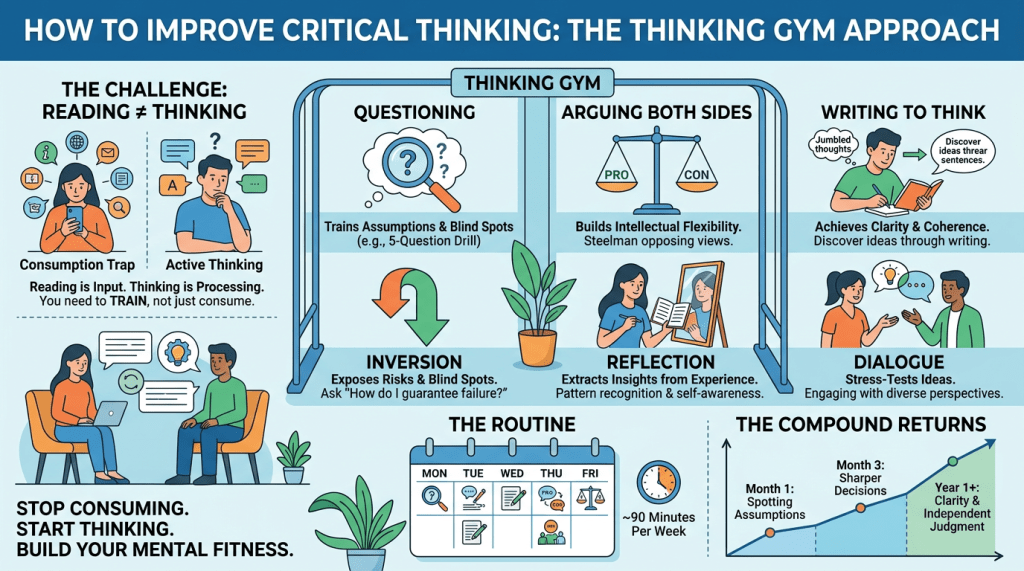
That’s the core idea behind what I call The Thinking Gym — a set of deliberate mental exercises that train your ability to reason, question, analyze, and decide. Not passively. Not accidentally. But intentionally, like a workout.
This isn’t about brain teasers or IQ puzzles. It’s about building a sustainable thinking practice that compounds over time — the same way strength training, financial discipline, or a reading habit does.
Let’s build your Thinking Gym from the ground up.
Why Most People Don’t Think Critically (Even Smart Ones)
Critical thinking isn’t something most of us were ever explicitly taught. School rewarded memorization. Work rewards execution. Social media rewards reaction.
None of these environments reward slow, deliberate, independent thought.
As a result, most smart, well-read people fall into one of three traps:
1. The Consumption Trap
You read a lot, listen to a lot, absorb a lot — but you rarely stop to question, synthesize, or challenge what you’ve consumed. You mistake familiarity with understanding.
2. The Opinion Trap
You form strong opinions quickly based on surface-level exposure, then defend them. This feels like critical thinking, but it’s actually just pattern-matching dressed up as analysis.
3. The Productivity Trap
You’re so busy executing — optimizing systems, checking tasks, building habits — that you never pause to ask whether you’re solving the right problems in the first place.
Critical thinking is the antidote to all three. But it doesn’t happen automatically. It needs space, structure, and practice.
That’s where the Thinking Gym comes in.
What Is the Thinking Gym?
The Thinking Gym is a framework for building mental fitness through deliberate cognitive exercises — done regularly, like a workout.
Just as a physical gym has different stations (cardio, strength, mobility, recovery), the Thinking Gym has different modes of mental training:
| Station | What It Trains |
|---|---|
| Questioning | Assumptions, blind spots |
| Arguing Both Sides | Intellectual flexibility |
| Writing to Think | Clarity, coherence |
| Inversion | Risk awareness, problem-solving |
| Reflection | Pattern recognition, self-awareness |
| Dialogue | Stress-testing ideas |
You don’t need to do all of them every day. But like a balanced training program, hitting each one regularly will make you a dramatically better thinker over time.
Let’s go through each station.
Station 1: Questioning — The Foundation of Critical Thinking
Most people accept information passively. The first thinking exercise is simply learning to question more deliberately.
Not cynically. Not combatively. But curiously.
Here’s a simple daily practice:
The 5-Question Drill
Pick one idea you encountered today — from a book, article, podcast, or conversation — and ask:
- What is this person assuming? Every argument rests on hidden assumptions. Find them.
- What evidence supports this? Is it data, anecdote, logic, or authority?
- What would change my mind? If you can’t answer this, you’re not thinking — you’re defending.
- Who disagrees with this, and why? Steelman the opposition.
- So what? Even if this is true, does it actually matter for my life or decisions?
This takes five minutes. Do it over coffee. Do it in a journal. Do it in your head while walking.
Over weeks, this rewires your default response from passive absorption to active interrogation. That shift alone puts you ahead of 90% of information consumers.
Station 2: Arguing Both Sides — Building Intellectual Flexibility
One of the most powerful thinking exercises is one most people resist instinctively: genuinely arguing the other side.
Not as a debate trick. Not to “win”. But to understand.
Here’s how to practice:
The Devil’s Advocate Journal
- Pick a belief you hold strongly (about money, health, work, politics — anything).
- Write 3–5 compelling arguments against your own position.
- Don’t strawman. Make the opposing case as strong as possible.
This is uncomfortable. That’s the point.
If you can’t argue the other side convincingly, you don’t fully understand your own position. You’re just repeating it.
This exercise builds what psychologists call cognitive flexibility — the ability to hold multiple perspectives simultaneously without collapsing into certainty. It’s the hallmark of sophisticated thinkers across every field.
Try this once a week. Pick beliefs about spending, about productivity, about health, about travel. You’ll be surprised how often the opposing view has merit you never considered.
Station 3: Writing to Think — The Most Underrated Cognitive Tool
Most people think of writing as a way to communicate ideas. But writing is actually a way to discover ideas.
When you write, you’re forced to:
- Organize fuzzy thoughts into sequences
- Identify gaps in your reasoning
- Commit to specific claims (instead of vague impressions)
- Notice contradictions you’d otherwise ignore
The Clarity Page
Every morning (or evening), write one page — longhand or digital — about something you’re trying to figure out. Not a journal entry about your day. A thinking entry about an idea, a decision, or a problem.
No audience. No editing. No performance.
Just you, working through your own thinking on paper.
Prompts to get started:
- “I’ve been assuming __, but I’m not sure that’s true because…”
- “The real problem isn’t __. It’s actually…”
- “If I had to explain __ to someone with no context, I’d say…”
- “I changed my mind about __ because…”
This single habit — writing to think, not to publish — is probably the highest-leverage cognitive exercise that exists. Many of the sharpest thinkers in history (Darwin, Feynman, Montaigne, Marcus Aurelius) were prolific private writers. They didn’t write because they had clear thoughts. They wrote to get clear thoughts.
Station 4: Inversion — Thinking Backward to See Forward
Inversion is a mental model popularized by Charlie Munger, but practiced by mathematicians and strategists for centuries. The idea is simple:
Instead of asking “How do I succeed?”, ask “How would I guarantee failure?”
Then avoid those things.
This flips your thinking and exposes risks, blind spots, and assumptions that forward-thinking misses.
The Inversion Exercise
Pick any goal or decision you’re working on. Then ask:
- “What would make this fail completely?”
- “What am I ignoring because it’s uncomfortable?”
- “What has gone wrong for others in this exact situation?”
- “If I wanted to sabotage this, what would I do?”
Examples:
- FIRE (Financial Independence, Retire Early) goal: “How would I guarantee I never reach financial independence?” → Lifestyle inflation, no emergency fund, optimizing for returns over consistency.
- Health goal: “How would I guarantee poor health at 60?” → Sit all day, ignore sleep, skip strength training, avoid recovery.
- Travel goal: “How would I guarantee burnout on a long trip?” → Change cities every 3 days, say yes to everything, never rest.
Inversion doesn’t replace forward planning. It complements it. Together, they give you a much more complete picture of any problem.
Station 5: Reflection — Turning Experience Into Insight
Experience without reflection is just… time passing.
Most people live through hundreds of meaningful experiences — decisions, failures, surprises, conversations — and extract almost nothing from them. Not because they’re unintelligent, but because they never pause to process.
The Weekly Reflection Protocol
Set aside 20–30 minutes once a week to answer three questions:
- What did I learn this week that I didn’t know before?
Not trivia. Real insight — about yourself, your work, your thinking. - Where was I wrong?
This is the most valuable question. Mistakes are data. But only if you examine them. - What would I do differently next time?
This closes the loop. It turns reflection into a decision — not just a feeling.
Write it down. Keep it in a simple notebook or document. Over months, you’ll start to notice patterns — in your thinking, your behavior, your blind spots.
This is how self-awareness compounds.
Station 6: Dialogue — Stress-Testing Ideas Through Conversation
Thinking alone has limits. Your own mind has biases, defaults, and comfortable grooves it tends to slide into.
Dialogue with others — especially people who think differently — introduces cognitive friction. It forces you to articulate, defend, revise, and sometimes abandon ideas.
But not all conversation is dialogue. Dialogue requires:
- Genuine curiosity (not just waiting for your turn to talk)
- Willingness to be wrong (not just defending your position)
- Engaging with the strongest version of the other person’s argument (steelmanning, not strawmanning)
How to Practice:
- Have one conversation per week where you ask more questions than you make statements
- Find one person who disagrees with you on something meaningful and try to understand why they believe what they believe
- After a conversation, write down one thing the other person said that made you reconsider your own view
You don’t need a philosophy club. You need one honest conversation where you’re genuinely open to updating your thinking.
Building Your Weekly Thinking Routine
Here’s a simple, sustainable Thinking Gym schedule you can follow:
| Day | Exercise | Time |
|---|---|---|
| Monday | 5-Question Drill on weekend reading | 10 min |
| Tuesday | Clarity Page (write to think) | 15 min |
| Wednesday | Inversion on a current decision | 10 min |
| Thursday | Devil’s Advocate Journal | 15 min |
| Friday | Intentional dialogue / conversation | 20 min |
| Saturday | Weekly Reflection Protocol | 20 min |
| Sunday | Rest (let ideas simmer) | 0 min |
Total: ~90 minutes per week.
That’s less time than most people spend scrolling on a single weekday. But the compound effect on your clarity, judgment, and decision-making is enormous.
The Compound Returns of Thinking
Here’s what happens when you practice the Thinking Gym consistently:
Month 1: You start noticing assumptions — yours and others’. You become harder to manipulate and easier to reason with.
Month 3: Your writing gets sharper. Your decisions feel more grounded. You stop reacting and start responding.
Month 6: You begin connecting ideas across domains. You see patterns others miss. Conversations become richer.
Year 1: Critical thinking becomes your default mode — not something you “do” but something you are. You trust your own judgment more, not because you’re always right, but because you know how to correct course.
This is the real payoff. Not cleverness. Not winning arguments. But clarity — the ability to see situations accurately, think independently, and act decisively.
In a world drowning in noise, clarity is the ultimate competitive advantage.
Thinking Is the Workout. Everything Else Is Just Consuming.
We live in a culture that celebrates consumption — more books, more courses, more content, more inputs. But the bottleneck for most people isn’t information. It’s processing.
Reading gives you raw material. But critical thinking is what transforms that material into judgment, decisions, and wisdom.
The Thinking Gym isn’t complicated. It doesn’t require special tools, expensive courses, or more hours in the day. It requires intention — the willingness to slow down, engage deeply, and do the uncomfortable work of questioning your own mind.
Start small. Pick one station. Practice it this week. Then add another.
Your mind, like your body, responds to consistent training. The reps are quiet. The progress is invisible at first. But the compounding is real.
Build the habit of thinking well, and everything else — your reading, your decisions, your finances, your health, your relationships — gets better as a side effect.
Stop consuming more. Start thinking better.
That’s the Thinking Gym approach.
📚 Related Reading
If this resonated, you might enjoy these related posts:
- How to Improve Your Thinking: Why Reading Alone Isn’t Enough
- Cognitive Friction: Why Some Books Change Your Thinking (and Others Don’t)
- The Learning Bottleneck: Why Smart People Plateau (And How to Break Through)
- Why Smart Readers Still Don’t Change: How to Apply What You Read
- Cognitive Nutrition: Why Information Quality Matters More Than Quantity
- How to Read Critically: Why Disagreeing With Books Makes You a Smarter Reader
- Daily Reflection for Mental Clarity and Growth: The Compounding Effect on Your Thinking
- Idea Carrying Capacity: How Many Concepts Can You Actually Use at Once?
Like this post? Follow the blog for weekly deep dives on learning, health, travel, and financial independence — designed for people who think long-term.
 VD
VD 
Leave a comment