Your body was designed to run on two fuels. Modern life has quietly disabled that ability — and it’s costing you more than you realize.
There’s a concept in metabolic science that explains an enormous amount about why some people have consistent energy throughout the day while others crash at 3pm. Why some people lose fat relatively easily while others struggle despite eating less and moving more. Why some people handle a missed meal with equanimity while others become irritable, foggy, and desperate for food within hours.
The concept is metabolic flexibility — and it may be the single most important health variable that most people have never heard of.
It’s not a diet. It’s not a supplement. It’s not a biohacking protocol. It’s a fundamental measure of how well your metabolism is functioning — specifically, how efficiently your body can switch between burning carbohydrates and burning fat depending on what’s available and what’s needed.
When this ability is intact, your energy is stable, your body composition is easier to manage, your focus is consistent, and your long-term health outlook is significantly better. When this ability is impaired — which is the case for a growing majority of people living modern, sedentary, processed-food-heavy lives — the consequences quietly accumulate in ways that eventually become impossible to ignore.
This post is a complete guide to metabolic flexibility: what it is, why it matters, how modern life degrades it, and — most importantly — how to restore and improve it through evidence-based, sustainable practices.
What Is Metabolic Flexibility?
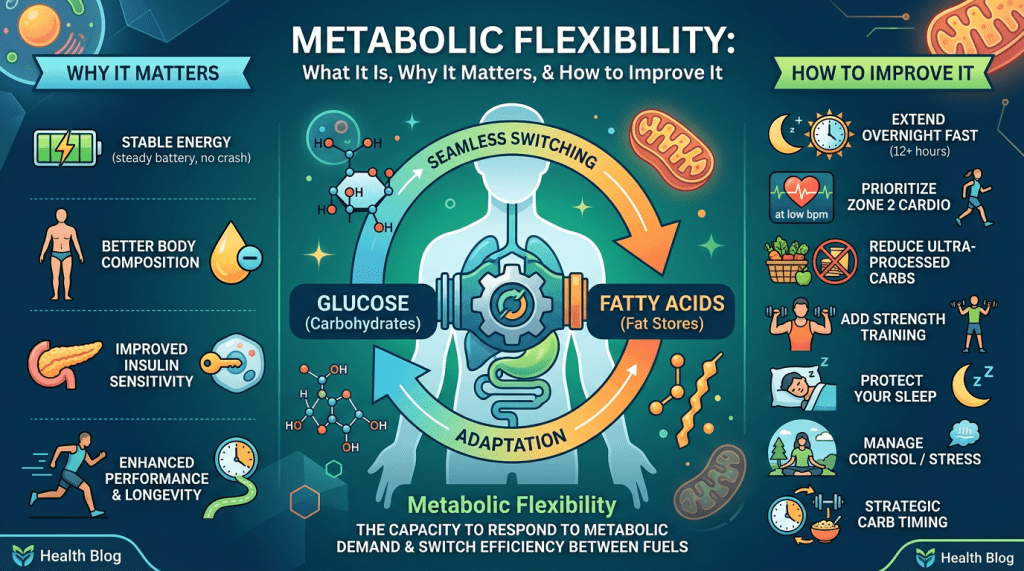
Your body has two primary fuel sources: glucose (from carbohydrates) and fatty acids (from fat). A metabolically flexible person can efficiently use either one, switching between them smoothly based on availability, activity level, and metabolic demand.
Think of it like a hybrid car. A well-functioning hybrid seamlessly transitions between electric and petrol power depending on conditions — optimizing efficiency without any input from the driver. A metabolically flexible body works the same way. At rest, it burns predominantly fat. During intense exercise, it shifts toward glucose. After a meal, it processes carbohydrates efficiently. During a fast, it transitions back to fat burning without drama.
A metabolically inflexible person, by contrast, is stuck in one mode — typically heavy glucose dependence. Their body struggles to access stored fat for energy, relies almost entirely on dietary carbohydrates to function, and responds poorly to any disruption in fuel supply. Miss a meal and they’re foggy and irritable. Eat carbohydrates and blood sugar spikes dramatically. Exercise on an empty stomach and performance collapses.
The formal definition, as used in research literature, is:
Metabolic flexibility is the capacity to respond or adapt to conditional changes in metabolic demand — specifically, the ability to increase fat oxidation during fasting or low-intensity exercise, and to increase glucose oxidation after carbohydrate intake.
Researchers measure it by looking at the respiratory exchange ratio (RER) — the ratio of carbon dioxide produced to oxygen consumed. A lower RER indicates fat burning. A higher RER indicates glucose burning. A metabolically flexible person shows a wide range of RER values across different conditions. A metabolically inflexible person shows a narrow, consistently high range regardless of conditions.
Why Modern Life Destroys Metabolic Flexibility
Metabolic inflexibility is not a genetic inevitability. It’s largely an acquired condition — the predictable result of how most people in developed countries eat, move, and live.
Here’s what drives it:
Chronic Carbohydrate Overconsumption
The modern diet is extraordinarily carbohydrate-dense — and specifically dense in refined, rapidly absorbed carbohydrates. Ultra-processed foods, refined grains, sugary beverages, and constant snacking keep blood glucose and insulin perpetually elevated.
When insulin is chronically elevated, fat burning is suppressed. Insulin is a storage hormone — its job is to shuttle glucose into cells and signal the body to store rather than burn. In a state of chronic hyperinsulinemia, your body essentially never gets the signal to access fat stores. The fat-burning machinery atrophies from disuse.
Constant Eating Patterns
The shift from three meals a day to near-continuous eating — driven by food availability, social norms, and aggressive food industry marketing — means most people’s bodies never experience the fasted state long enough to practice fat oxidation.
Fat burning ramps up significantly after roughly 12–14 hours without food. If you’re eating from 7am to 10pm and snacking throughout, you’re never giving your body the metabolic signal to switch fuels. The pathway exists but goes unpracticed — and like any unpracticed skill, it deteriorates.
Sedentary Living
Physical activity — particularly low-intensity, aerobic exercise — is one of the most powerful drivers of fat oxidation and metabolic flexibility. Muscle tissue is the primary site of fat burning in the body. More muscle, more mitochondria, more fat oxidation capacity.
Sedentary modern work means most people’s muscles spend the vast majority of the day in a low-activity state, running almost exclusively on glucose. The fat oxidation capacity that our ancestors maintained through constant movement quietly degrades.
Poor Sleep
Sleep deprivation — even mild, chronic sleep restriction of the kind most people normalize — significantly impairs metabolic flexibility. It disrupts insulin sensitivity, increases cortisol, drives carbohydrate cravings, and impairs the body’s ability to regulate fuel selection.
One week of sleeping six hours per night produces measurable insulin resistance in otherwise healthy adults. This isn’t a minor side effect. It’s a direct attack on metabolic flexibility.
Chronic Stress
Chronically elevated cortisol — the hallmark of modern, always-on work culture — promotes glucose dependence, impairs insulin sensitivity, and drives visceral fat accumulation. Stress essentially locks the body into a high-alert, glucose-burning state, making the parasympathetic, fat-burning mode increasingly inaccessible.
Why Metabolic Flexibility Matters
1. Stable, Consistent Energy
The 3pm energy crash. The brain fog before lunch. The desperate need for coffee or a snack to function. These are not normal features of human biology. They’re symptoms of metabolic inflexibility — specifically, the inability to access fat stores smoothly when blood glucose dips.
A metabolically flexible person doesn’t crash between meals because their body seamlessly transitions to fat oxidation when dietary glucose isn’t available. Energy remains stable because the fuel supply remains uninterrupted.
This matters enormously for cognitive performance, mood, and productivity — especially for knowledge workers and anyone whose professional output depends on sustained mental clarity.
2. Better Body Composition
Fat loss requires, at a fundamental level, that your body burns fat. This sounds obvious but has a non-obvious implication: if your fat-burning machinery is impaired, losing body fat becomes dramatically harder regardless of caloric deficit.
Metabolically flexible people burn fat more efficiently at rest and during low-intensity activity. They also handle dietary carbohydrates better — processing them efficiently rather than storing them as fat. The result is a body composition that’s easier to manage and maintain long-term, without extreme dietary restriction.
3. Improved Insulin Sensitivity
Metabolic flexibility and insulin sensitivity are deeply interrelated. Improving one generally improves the other. Better insulin sensitivity means your cells respond more efficiently to insulin signals, keeping blood glucose stable with lower insulin output.
Over the long term, this is one of the most important metabolic health markers available. Poor insulin sensitivity is the foundation of type 2 diabetes, metabolic syndrome, cardiovascular disease, and a growing list of conditions increasingly linked to metabolic dysfunction including certain cancers and neurodegenerative diseases.
4. Enhanced Athletic Performance
For athletes and active people, metabolic flexibility offers a significant performance advantage. The body’s glycogen stores — its glucose reserves — are limited. Even a lean person carries roughly 2,000 calories of glycogen but over 50,000 calories of stored fat.
An athlete who can efficiently access fat stores during lower-intensity exercise spares glycogen for when it’s truly needed — high-intensity efforts. This translates to better endurance, more consistent energy during long efforts, and faster recovery.
5. Longevity and Healthspan
The metabolic health research of the past two decades increasingly points to a cluster of interrelated variables — insulin sensitivity, mitochondrial function, body composition, inflammatory markers — that collectively predict not just lifespan but healthspan: the years of life spent in good health and full function.
Metabolic flexibility sits at the center of this cluster. Improving it tends to improve all the others simultaneously. It’s one of the highest-leverage variables available for anyone interested in maintaining quality of life as they age.
How to Improve Metabolic Flexibility: The Evidence-Based Approach
Strategy 1: Extend Your Overnight Fast
The simplest, most accessible entry point for improving metabolic flexibility is extending your overnight fast to at least 12–14 hours consistently.
This doesn’t require dramatic dietary changes. It simply means finishing dinner by 7–8pm and not eating breakfast until 7–8am the following morning. That’s it.
This window gives your body enough time in the fasted state to practice fat oxidation. Over weeks and months, this consistent practice rebuilds the metabolic machinery for efficient fat burning.
If you want to go further, a 16:8 intermittent fasting protocol — eating within an 8-hour window — provides stronger metabolic flexibility benefits for most people. But start with 12 hours and build gradually.
Important: The quality of your eating window matters as much as its timing. An 8-hour window filled with ultra-processed food will not produce the metabolic benefits of a 16-hour fast.
Strategy 2: Prioritize Zone 2 Cardio
Zone 2 cardio — low-intensity aerobic exercise at roughly 60–70% of maximum heart rate, where you can hold a conversation but are definitely working — is the most powerful exercise tool for building metabolic flexibility.
At this intensity, fat is the primary fuel source. Consistent Zone 2 training builds mitochondrial density in muscle tissue, increases fat oxidation capacity, improves insulin sensitivity, and essentially trains your body to become more efficient at burning fat.
Aim for 150–180 minutes of Zone 2 per week, spread across 3–5 sessions. This can be walking, cycling, swimming, rowing, or any sustained aerobic activity at the appropriate intensity.
The key is patience. Zone 2 adaptations happen over months, not weeks. But the compound effect on metabolic flexibility — and longevity — is significant.
Strategy 3: Reduce Ultra-Processed Carbohydrates
You don’t need to eliminate carbohydrates to improve metabolic flexibility. What you need to reduce is the specific type of carbohydrate that most aggressively drives chronic hyperinsulinemia: refined, rapidly absorbed carbohydrates with minimal fiber.
Sugary beverages, refined grains, ultra-processed snack foods, and desserts eaten frequently throughout the day are the primary culprits. These foods spike blood glucose rapidly and dramatically, driving high insulin output and suppressing fat oxidation.
Replacing these with whole food carbohydrate sources — vegetables, legumes, whole grains, fruit — that come with fiber, micronutrients, and slower glucose absorption profiles, produces significantly lower insulin responses and better metabolic outcomes.
This isn’t about carb phobia. It’s about carbohydrate quality and timing.
Strategy 4: Add Strength Training
Muscle tissue is metabolically active tissue. More muscle means more mitochondria, more fat oxidation capacity, and better glucose disposal — because muscle is the primary site where dietary glucose is stored and burned.
Two to three strength training sessions per week produce measurable improvements in insulin sensitivity and metabolic flexibility over time. This doesn’t require a complicated program. Compound movements — squats, deadlifts, rows, presses, carries — that work large muscle groups provide the strongest metabolic stimulus.
Strength training and Zone 2 cardio are complementary rather than competing. Together they produce metabolic flexibility improvements that neither achieves as effectively alone.
Strategy 5: Protect Your Sleep
Given the degree to which sleep deprivation impairs metabolic flexibility, improving sleep quality is often the highest-leverage intervention available — especially for people who are already eating reasonably well and exercising.
Prioritize:
- Consistent sleep and wake times (including weekends)
- 7–9 hours of sleep opportunity per night
- A dark, cool sleeping environment
- Limiting bright light exposure in the 90 minutes before bed
- Avoiding alcohol within 3 hours of sleep (it dramatically impairs sleep quality and metabolic recovery)
Strategy 6: Manage Cortisol Through Stress Regulation
Chronic stress is a direct metabolic flexibility inhibitor. A stress management practice isn’t a luxury for the metabolically concerned — it’s a clinical necessity.
Effective evidence-based approaches include:
- Daily low-intensity movement (walking is particularly effective at lowering cortisol)
- Breathwork and deliberate parasympathetic activation
- Consistent sleep (again)
- Reducing caffeine intake, particularly after noon
- Spending time in nature
- Social connection and genuine rest
The goal is to spend more time in parasympathetic (rest-and-digest) mode and less time in sympathetic (fight-or-flight) mode — because fat burning happens primarily in the parasympathetic state.
Strategy 7: Consider Strategic Carbohydrate Timing
Once basic metabolic flexibility is improving, strategic carbohydrate timing can further optimize fuel switching. The core principle is simple:
Eat carbohydrates when your body is most prepared to use them.
This means:
- Around exercise — before or after training sessions when glucose disposal is most efficient
- Earlier in the day rather than later — insulin sensitivity is generally higher in the morning
- Less at rest and in the evening — when glucose disposal is slower and fat oxidation should be dominant
This isn’t a rigid prescription. It’s a framework for thinking about carbohydrate timing in a way that supports rather than undermines metabolic flexibility.
How to Know If Your Metabolic Flexibility Is Improving
You don’t need laboratory testing to gauge your progress. These practical markers tell you a great deal:
Positive signs of improving metabolic flexibility:
- Energy remains stable between meals without snacking
- You can skip a meal without significant mood disruption or cognitive impairment
- Morning energy is stable without immediate caffeine dependence
- Exercise performance is consistent even in a fasted state
- You feel genuinely hungry for meals rather than chronically snacky
- Fat loss becomes easier without extreme caloric restriction
- Sleep quality improves
- Mental clarity is more consistent throughout the day
Signs of remaining metabolic inflexibility:
- Strong energy crashes between meals
- Intense irritability or cognitive fog when meals are delayed
- Inability to exercise comfortably in a fasted state
- Persistent carbohydrate cravings, especially for refined foods
- Energy that spikes and crashes in direct response to food intake
- Difficulty losing body fat despite caloric restriction
Track these markers honestly over 8–12 weeks of consistent practice. Metabolic flexibility doesn’t change overnight — but it does change, reliably, in response to the right inputs.
The Underlying Engine of Modern Health
Metabolic flexibility isn’t a trending wellness concept. It’s a fundamental biological capacity — one that humans maintained for most of evolutionary history through movement, varied food availability, and natural fasting periods, and one that modern life has systematically degraded.
Restoring it doesn’t require extreme measures. It requires consistent, evidence-based practices applied over meaningful time horizons: extending your overnight fast, building your aerobic base, reducing ultra-processed carbohydrates, training consistently, sleeping properly, and managing stress with the same seriousness you manage your diet and exercise.
Do these things consistently, and your metabolism will respond. Energy stabilizes. Body composition improves. Cognitive performance becomes more consistent. Longevity markers move in the right direction.
Metabolic flexibility is the missing piece not because it’s exotic or complicated. It’s missing because it requires patience, consistency, and a willingness to address the root causes of metabolic dysfunction rather than reaching for quick fixes.
Your metabolism was designed to be flexible. Help it remember how.
📚 Related Reading
If this resonated, you might enjoy these related posts:
- Zone 2 Cardio Explained: The Boring Workout That Boosts Longevity and Adds Years to Your Life
- Designing a Body That Tolerates Modern Life: How to Stay Healthy in a Sedentary, Screen-Based World
- The Minimum Effective Longevity Habits: What Actually Improves Healthspan
- How to Build Healthy Eating Habits That Last (Without the Overwhelm)
- The Sleep Efficiency Blueprint: How to Improve Sleep Quality and Wake Up Rested (Without More Hours)
- Training for Longevity: How to Exercise for Long-Term Health, Not Just Looks
- The Longevity Dividend: Healthy Habits That Boost Both Health and Wealth
- Habits That Matter After 40: What Actually Improves Longevity
Like this post? Follow the blog for weekly deep dives on health, financial independence, travel, and learning — designed for people who think long-term about freedom.
 VD
VD 
Leave a comment