Your FIRE (Financial Independence, Retire Early) number isn’t fixed. It depends entirely on where you live. The same portfolio that buys you modest comfort in San Francisco buys you an extraordinary life in Lisbon, Medellín, or Chiang Mai.
Most FIRE conversations focus on the same variables: savings rate, investment returns, the 4% rule, passive income streams. These matter enormously. But there’s one lever that almost nobody talks about with enough seriousness — geography.
Where you choose to live after reaching financial independence isn’t just a lifestyle decision. It’s a financial decision. Possibly the biggest one you’ll make post-FIRE.
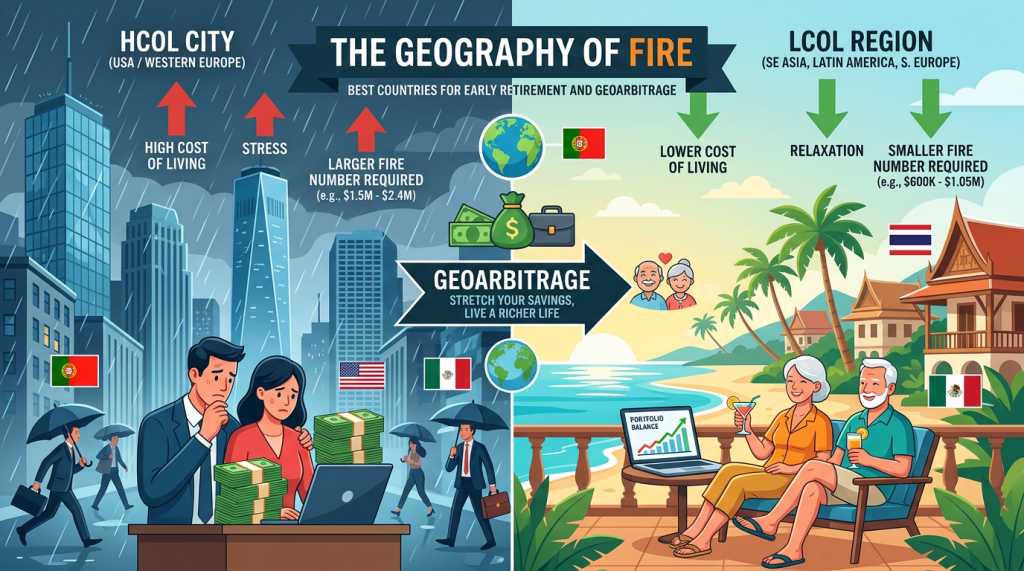
The difference between retiring in a high cost-of-living city in the United States or Western Europe versus a well-chosen city in Southeast Asia, Latin America, or Southern Europe isn’t marginal. It can be the difference between needing $2.5 million and needing $800,000. Between working five more years and leaving now. Between a life of careful frugality and a life of genuine abundance.
This is the core idea behind geoarbitrage — the strategic use of location to stretch your purchasing power, reduce your required FIRE number, and design a richer life on less money.
This post is your guide to understanding geoarbitrage as a FIRE strategy, what to look for in a destination, and which countries consistently offer the best combination of affordability, quality of life, healthcare, safety, and infrastructure for early retirees.
Let’s start with the math.
Why Geography Is the Most Underrated FIRE Variable
The 4% rule — the cornerstone of most FIRE planning — states that you can safely withdraw 4% of your portfolio annually without depleting it over a 30-year retirement. To generate $40,000 per year in income, you need $1,000,000 invested. To generate $60,000, you need $1,500,000.
These numbers assume a relatively stable cost of living. But cost of living varies dramatically by location.
Consider this comparison:
| Location | Comfortable Monthly Budget | Required Portfolio (4% Rule) |
|---|---|---|
| New York City, USA | $6,000–$8,000 | $1.8M–$2.4M |
| London, UK | $5,000–$7,000 | $1.5M–$2.1M |
| Lisbon, Portugal | $2,500–$3,500 | $750K–$1.05M |
| Medellín, Colombia | $1,500–$2,500 | $450K–$750K |
| Chiang Mai, Thailand | $1,200–$2,000 | $360K–$600K |
| Mexico City, Mexico | $1,800–$2,800 | $540K–$840K |
The numbers don’t lie. Geography can cut your required FIRE number by 50–70%.
That’s not a rounding error. That’s years of your life — years you could spend living freely instead of grinding toward an arbitrarily high number in an unnecessarily expensive city.
Geoarbitrage doesn’t mean sacrificing quality of life. In many cases, it means dramatically upgrading it. Better weather, richer culture, more walkable cities, excellent food, affordable healthcare, and a pace of life that actually supports health and longevity.
What to Look for in a FIRE Destination
Before diving into specific countries, here’s the framework for evaluating any destination as a long-term FIRE base:
1. Cost of Living
The most obvious factor. Look at housing, food, transportation, utilities, and entertainment. Numbeo and Expatistan are reliable databases for real-time comparisons.
2. Healthcare Quality and Cost
This is non-negotiable for early retirees who don’t yet qualify for government healthcare programs. Look for countries with strong private healthcare systems at a fraction of Western prices.
3. Visa and Residency Options
Many countries now offer dedicated digital nomad visas or retirement residency programs. Look for straightforward pathways to legal long-term residence.
4. Safety and Stability
Political stability, low crime rates, and reliable rule of law matter enormously for long-term planning. Look beyond headlines to expatriate communities and actual crime data.
5. Infrastructure and Internet
Reliable internet, good transport links, and functional infrastructure are essential — especially if you maintain any remote income.
6. Quality of Life
Climate, culture, language accessibility, food quality, walkability, social scene. These are harder to quantify but deeply important for long-term satisfaction.
7. Tax Implications
Some countries offer favorable tax treatment for foreign income or retirees. Others tax worldwide income. Always consult a tax professional before relocating.
The Best Countries for FIRE and Geoarbitrage
🇵🇹 Portugal — The European Gold Standard
Monthly budget: $2,500–$3,500
Required portfolio: ~$750K–$1.05M
Best cities: Lisbon, Porto, the Algarve, Coimbra
Portugal has been the top European geoarbitrage destination for over a decade — and for good reason.
It offers everything you’d want from Western Europe: safety, excellent infrastructure, world-class food and wine, beautiful coastline, mild climate year-round, and English widely spoken — at roughly 40–50% of the cost of France, Germany, or the UK.
Lisbon is one of the most walkable, livable cities in Europe. Porto is smaller, quieter, and even more affordable. The Algarve offers Mediterranean-style coastal living with some of the most reliably sunny weather in Europe.
Portugal’s Non-Habitual Resident (NHR) tax regime (recently updated but still favorable in modified form) has historically offered significant tax advantages to foreign retirees. Healthcare is high quality and dramatically cheaper than the US — both through the public system and private insurance.
FIRE fit: Excellent for people who want European quality of life without European prices. Particularly strong for those who want stability, safety, and a relaxed but cultured lifestyle.
🇲🇽 Mexico — The Proximity Advantage
Monthly budget: $1,800–$2,800
Required portfolio: ~$540K–$840K
Best cities: Mexico City, Oaxaca, Mérida, San Miguel de Allende, Puerto Vallarta
Mexico is the most practical geoarbitrage destination for North Americans. Same time zones (or close to them). Short flights home. Large English-speaking expat communities. And a cost of living that’s roughly 50–60% lower than most US cities.
Mexico City in particular has undergone a remarkable transformation. It’s now one of the most vibrant, culturally rich, and gastronomically celebrated cities in the world — with world-class restaurants, museums, parks, and neighborhoods — at a fraction of what comparable living costs in New York or Los Angeles.
Oaxaca and Mérida offer slower, more traditional Mexican lifestyles with even lower costs. San Miguel de Allende has a long-established expat community with excellent infrastructure and a thriving arts scene.
Healthcare in Mexico’s private hospitals is excellent and affordable. Many US-trained physicians practice there, and procedures cost 20–40% of US prices.
FIRE fit: Best for North Americans who want proximity to home, easy travel logistics, and significant cost savings without cultural shock.
🇨🇴 Colombia — The South American Surprise
Monthly budget: $1,500–$2,500
Required portfolio: ~$450K–$750K
Best cities: Medellín, Cartagena, Bogotá, Santa Marta
Colombia — particularly Medellín — has become one of the most talked-about FIRE destinations of the past decade. Once avoided for obvious reasons, Medellín has transformed into a modern, innovative city with exceptional infrastructure, a perfect spring-like climate year-round (it sits at altitude), excellent food, and a growing international community.
The cost of living is remarkable. A spacious apartment in a good neighborhood, daily restaurant meals, a gym membership, and regular travel within Colombia can be done comfortably on $1,500–$2,000 per month.
Colombia’s Pensionado visa offers straightforward residency for those with sufficient passive income. Healthcare, particularly in Medellín and Bogotá, is genuinely world-class — the country is a medical tourism destination for a reason.
FIRE fit: Strong for adventurous early retirees who want low costs, good infrastructure, and a vibrant urban lifestyle in a fast-developing country.
🇹🇭 Thailand — The Southeast Asian Classic
Monthly budget: $1,200–$2,000
Required portfolio: ~$360K–$600K
Best cities: Chiang Mai, Bangkok, Koh Lanta, Pai
Thailand has been a geoarbitrage staple for decades — and it remains one of the most compelling options for early retirees willing to venture further afield.
Chiang Mai is the spiritual home of the location-independent movement. It offers excellent internet infrastructure, a massive expat and digital nomad community, outstanding food at unbelievably low prices, and a laid-back lifestyle surrounded by mountains and temples.
Bangkok offers world-class urban infrastructure — exceptional healthcare, food, transport, and nightlife — at costs that remain far below comparable Western cities. For a more beach-oriented lifestyle, Koh Lanta and other southern islands offer beautiful environments at still-reasonable costs (though beachside living anywhere carries a premium).
Thailand’s Long-Term Resident (LTR) visa, introduced in 2022, offers a legitimate 10-year residency pathway for retirees and passive income earners. Healthcare in Bangkok’s private hospitals is internationally accredited and costs a fraction of Western prices.
FIRE fit: Outstanding for those who want very low costs, excellent food and culture, and don’t mind being further from home. Best for people comfortable with more significant cultural differences.
🇪🇸 Spain — Lifestyle Without Compromise
Monthly budget: $2,800–$4,000
Required portfolio: ~$840K–$1.2M
Best cities: Valencia, Seville, Granada, Las Palmas (Gran Canaria), Málaga
Spain is slightly more expensive than Portugal but offers arguably superior urban infrastructure, more diverse regional cultures, and some of Europe’s most attractive cities.
Valencia consistently ranks among Europe’s most livable cities — excellent food, beautiful beaches, warm climate, world-class architecture, and a relaxed Mediterranean pace of life at costs well below Madrid or Barcelona.
Seville and Granada offer deep cultural richness, stunning historic centers, and lower costs still. Las Palmas on Gran Canaria — technically Spain but off the coast of Africa — offers a near-perfect climate year-round with lower costs than mainland Spain.
Spain’s Non-Lucrative Visa and newly introduced Digital Nomad Visa provide legitimate residency pathways for early retirees with passive income.
FIRE fit: Best for those who want European quality of life, exceptional food and culture, and warm climate — and who have a slightly higher FIRE number to work with.
🇵🇦 Panama — The Americas’ Hidden Gem
Monthly budget: $2,000–$3,000
Required portfolio: ~$600K–$900K
Best cities: Panama City, Boquete, Coronado
Panama is one of the most underrated FIRE destinations in the Americas. It uses the US dollar (eliminating currency risk), has a modern, sophisticated capital city, excellent private healthcare, and one of the most generous retirement visa programs in the world.
The Pensionado visa offers extraordinary discounts for legal retirees — 25% off airline tickets, 20% off medical consultations, 15% off hospital bills, and significant discounts on entertainment and restaurants. It’s essentially a permanent discount card for life.
Boquete, in the highlands, offers a cooler climate and a well-established North American expat community. Panama City itself offers genuine urban sophistication — modern infrastructure, excellent restaurants, and easy connections throughout the Americas.
FIRE fit: Excellent for those who want dollar-denominated stability, proximity to North America, and a structured, expat-friendly retirement infrastructure.
🇻🇳 Vietnam — The Emerging Frontier
Monthly budget: $1,000–$1,800
Required portfolio: ~$300K–$540K
Best cities: Ho Chi Minh City, Hanoi, Da Nang, Hội An
Vietnam offers some of the lowest costs of any quality FIRE destination globally. The food is extraordinary. The culture is rich and fascinating. Da Nang and Hội An offer beautiful coastal living at costs that seem almost impossible by Western standards.
The infrastructure is developing rapidly, and internet quality in the major cities is now excellent. Private healthcare has improved dramatically, particularly in Ho Chi Minh City and Hanoi.
The main limitation is visa complexity — Vietnam doesn’t yet have a clean long-term retirement visa, requiring more creative residency strategies. This is a solvable problem for the determined, but worth factoring in.
FIRE fit: Best for highly adventurous early retirees who want maximum cost reduction and rich cultural immersion, and who are comfortable navigating less structured expat infrastructure.
The Geoarbitrage Mindset Shift
There’s a mental barrier many FIRE-seekers face when considering geoarbitrage: it feels like settling. Like you couldn’t quite make it work at home.
This framing gets it exactly backwards.
Choosing to live in Lisbon over London, or Medellín over Miami, isn’t a consolation prize. It’s often a deliberate upgrade — more sunshine, better food, richer culture, slower pace, more human-scale cities, and the cognitive expansion that comes from genuine immersion in another way of life.
The people who thrive with geoarbitrage aren’t those who couldn’t afford to stay home. They’re the ones who recognized that location is a financial asset — and decided to use it strategically.
Your FIRE number is not fixed. Your lifestyle requirements are not fixed. Your geography is not fixed.
The most financially sophisticated thing you can do is recognize that these variables interact — and design accordingly.
Practical First Steps
If geoarbitrage appeals to you, here’s how to move from idea to action:
- Test before committing. Spend 1–3 months in a destination before making it your base. The 30-day city experiment is your best friend.
- Run your actual numbers. Use Numbeo to build a realistic budget for your shortlisted cities. Compare it honestly to your current spending.
- Understand the visa landscape. Research residency options early. Some programs require passive income thresholds or specific documentation.
- Sort your healthcare strategy. Get international health insurance quotes. Research private hospital quality in your target destination.
- Consider a base-and-travel model. Many FIRE retirees choose one affordable home base and use the savings to fund regular travel — getting the best of both worlds.
- Talk to people already doing it. Expat forums, subreddits, and Facebook groups for specific destinations are invaluable for ground-level intelligence.
Where You Live Is a Financial Decision
The geography of FIRE is ultimately about one thing: recognizing that your freedom has a price tag, and that price tag is negotiable.
You don’t have to accept the cost of living imposed by the city you grew up in, went to school in, or built your career in. That geography made sense for one chapter of your life. It doesn’t have to define the next one.
The world is full of extraordinary places where the sun shines reliably, the food is excellent, the people are warm, the healthcare is competent, and a thoughtfully invested portfolio of $600,000–$900,000 buys you a genuinely rich life.
The question isn’t whether geoarbitrage could work for you. The question is whether you’re willing to think geographically about your freedom.
Your FIRE number isn’t just about markets and savings rates. It’s about where you choose to be free.
📚 Related Reading
If this resonated, you might enjoy these related posts:
- Geoarbitrage 101: Living Well for Less Around the World
- Geographic Flexibility as Wealth: How Location Independence Multiplies Your Income
- Travel Optionality: How to Stay Location-Independent Without Feeling Rootless
- Barista FIRE vs. Lean FIRE vs. Fat FIRE Explained: How to Choose the Right Path to Financial Independence
- How Long to Stay in One Place While Traveling: Why 3 Months Changes Everything
- Slow Travel: Why Staying Longer Saves Money and Creates Richer Experiences
- Designing a Life That Travels Well: A Framework for Sustainable, Location-Flexible Living
- Life After Financial Independence: How to Navigate the Identity Crisis When Work No Longer Defines You
Like this post? Follow the blog for weekly deep dives on financial independence, travel, health, and learning — designed for people who think long-term about freedom.
 VD
VD 
Leave a comment