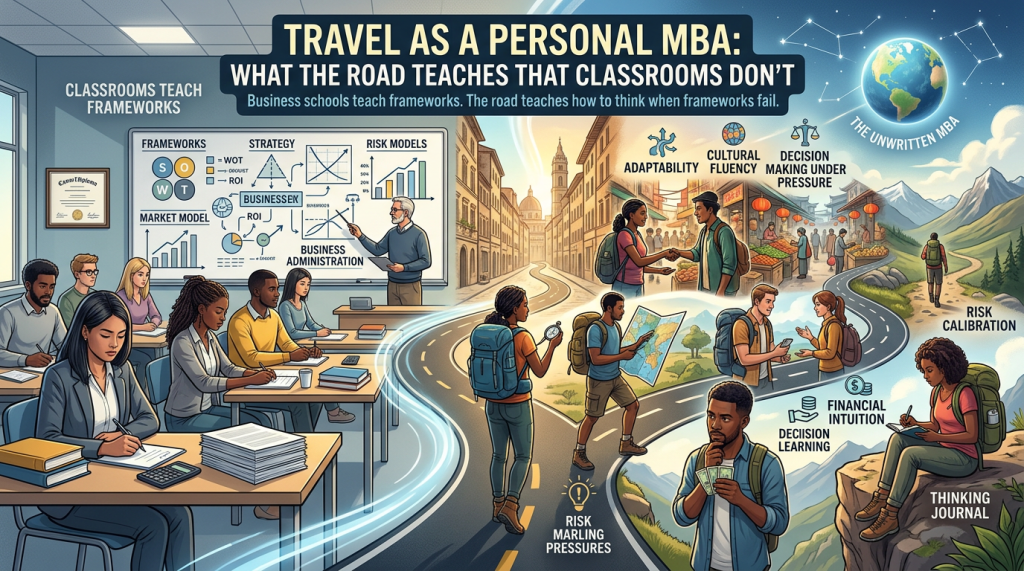
Business schools teach you frameworks. The road teaches you how to think when the frameworks fail.
There’s a moment every long-term traveler knows well.
You’re in an unfamiliar city. Your accommodation fell through. You don’t speak the language. Your phone is at 4% battery. You have three hours to solve a problem that shouldn’t exist — and nobody is coming to help you.
No professor. No rubric. No office hours.
Just you, the situation, and whatever cognitive resources you’ve built up over a lifetime.
This is where real education happens.
Not in the solving of the problem — though that matters. But in the moment you realize you can solve it. That you’ve developed a kind of calm, resourceful, adaptive intelligence that no classroom ever explicitly taught you. That somewhere between the border crossings and the language barriers and the missed connections and the unexpected kindnesses, you became someone genuinely capable of navigating uncertainty.
That’s the travel MBA.
Not a credential. Not a certificate. Not something you put on LinkedIn. But a deep, embodied, compounding education in the skills that actually determine quality of life and professional effectiveness — adaptability, judgment, emotional intelligence, cultural fluency, risk calibration, and the rare ability to stay clear-headed when things go wrong.
This post is about what that education looks like, why it’s harder to get any other way, and how to travel deliberately enough to actually receive it.
Why Formal Education Has a Blind Spot
Before we get into what travel teaches, it’s worth being honest about what formal education — including the MBA — does well.
Business school teaches frameworks, models, and analytical tools. It builds networks. It provides credentials that open doors. For certain career paths, in certain industries, it delivers genuine value.
But here’s what it structurally cannot teach:
How to operate under genuine uncertainty.
Case studies have answers. Real life doesn’t. Every business school case study is reverse-engineered from a known outcome. The uncertainty has been removed before you encounter it. This is pedagogically useful but experientially misleading.
How to read people across cultural contexts.
Most business education happens within a single cultural framework — usually Western, usually urban, usually middle-to-upper class. The ability to read motivations, build trust, and communicate effectively across genuinely different cultural contexts is almost impossible to simulate in a classroom.
How to make decisions with incomplete information under time pressure.
Exams have time limits, but they also have defined parameters. Real decisions — in business, in life, in travel — rarely come with clear parameters. The skill of deciding well with imperfect information, under real pressure, with real consequences, is forged in experience, not coursework.
How to recover from failure without a safety net.
Academic failure has defined consequences. Real failure is messier, more personal, and more instructive. The psychological resilience built from navigating actual failure — especially in unfamiliar environments — is qualitatively different from anything a curriculum can manufacture.
Travel doesn’t replace formal education. But it fills these blind spots in ways that are difficult to replicate otherwise.
The Travel Curriculum: What the Road Actually Teaches
Module 1: Adaptability — The Master Skill
If you had to name the single most valuable skill for the 21st century — in business, in relationships, in health, in finance — adaptability would be a strong candidate.
The ability to encounter an unexpected situation, update your model of reality, and respond effectively rather than reactively is extraordinarily valuable. And extraordinarily rare.
Travel is an adaptability gymnasium.
Every new destination disrupts your defaults. The transport system works differently. The social norms are unfamiliar. The food, the timing, the pace, the unwritten rules — all different. You can’t operate on autopilot. You’re forced to be present, observant, and flexible by default.
Over time, this builds something deeper than just “being good at travel.” It builds a general cognitive flexibility — a comfort with discomfort, a trust in your ability to figure things out — that transfers directly to professional and personal life.
People who’ve traveled extensively tend to be better at:
- Navigating organizational change
- Working with diverse teams
- Entering new markets or roles
- Handling ambiguity without anxiety
- Updating their views when new information arrives
None of this is accidental. It’s the direct result of accumulated reps in adaptive thinking.
The deliberate practice: Don’t just travel. Travel without over-planning. Leave some itinerary gaps. Take the local bus instead of the tourist shuttle. Eat where the locals eat, not where the guidebook points. Every moment of navigating genuine uncertainty is a rep.
Module 2: Cultural Intelligence — Reading the Room at Global Scale
Cultural intelligence (CQ) is the ability to understand, respect, and operate effectively across different cultural contexts. It’s increasingly recognized as one of the most valuable professional competencies — and one of the hardest to develop without direct experience.
Reading about Japanese business culture is useful. Spending three months in Japan — navigating real interactions, making real mistakes, observing real social dynamics — is transformative.
Travel builds cultural intelligence in layers:
Layer 1: Awareness. You become aware that your cultural defaults are not universal. Your assumptions about time, hierarchy, directness, hospitality, personal space, and reciprocity are cultural constructs, not objective truths.
Layer 2: Curiosity. You develop genuine interest in understanding why people do things differently — not as a novelty, but as a window into different ways of organizing human life.
Layer 3: Fluency. Over time, with enough exposure and attention, you develop the ability to shift your communication style, build trust across difference, and read social situations that would be opaque to someone with less cross-cultural experience.
This is enormously valuable in any professional context involving international clients, diverse teams, or global markets — which is to say, most serious professional contexts today.
The deliberate practice: In each destination, identify one local norm that differs from yours. Study it. Try to understand its internal logic — not why it’s wrong or right, but why it makes sense within its own cultural context. This single habit accelerates cultural learning dramatically.
Module 3: Negotiation and Resourcefulness
Travel — especially budget and independent travel — is a continuous negotiation.
Not in the aggressive, adversarial sense. But in the deeper sense: finding mutually acceptable solutions under constraints, reading what the other party actually wants, and creating value where none seemed to exist.
Negotiating a fair price at a market in Marrakech. Convincing a guesthouse owner to hold your bags for six hours after checkout. Finding accommodation in a town where everything is “fully booked”. Getting upgraded, extended, accommodated, or assisted in ways that aren’t on the official menu.
These situations teach practical negotiation skills that no textbook covers:
- Empathy over aggression. The best travel negotiators understand what the other person needs and find ways to meet it.
- Patience as leverage. The person most willing to wait usually wins.
- Creative problem-framing. Often the stated problem isn’t the real problem. Finding the actual obstacle unlocks solutions.
- Reading non-verbal cues. Across language barriers, you develop extraordinary sensitivity to body language, tone, and energy.
Beyond negotiation, travel builds raw resourcefulness — the ability to solve problems with whatever is available. This is a deeply underrated professional skill. The most valuable people in any organization aren’t those who perform well under ideal conditions. They’re those who deliver when the conditions are difficult.
The deliberate practice: Deliberately choose situations that require negotiation or creative problem-solving. Travel without confirmed accommodation occasionally. Take routes that require more improvisation. Each constraint is a curriculum.
Module 4: Risk Calibration — The Difference Between Fear and Danger
One of the most practically valuable things travel teaches is the difference between perceived risk and actual risk.
Most people dramatically overestimate the danger of unfamiliar places and underestimate the risks of familiar ones. This cognitive bias — rooted in availability heuristic and media distortion — leads to systematically poor risk assessment in both personal and professional domains.
Traveling to places that feel risky — and discovering they’re not — recalibrates this.
When you’ve navigated cities that your home culture labeled “dangerous” and discovered vibrant, safe, welcoming communities, you develop a more nuanced, evidence-based relationship with risk. You learn to ask better questions: Who is actually at risk here, under what circumstances? What’s the base rate? What do people who actually live here say?
This matters enormously in professional contexts. The executives, entrepreneurs, and investors who make the best decisions aren’t those who avoid risk — they’re those who assess it accurately. They distinguish between risks worth taking and risks worth avoiding, based on evidence rather than anxiety.
Travel builds this calibration in your bones, not just your intellect.
The deliberate practice: After each trip, write down one thing you were afraid of beforehand that turned out to be unfounded. Examine where the fear came from. Over time, this builds a personal database of calibrated risk assessment.
Module 5: Decision-Making Under Pressure
Travel compresses decision-making timelines in ways that everyday life doesn’t.
At home, most decisions have slack. You can sleep on it, research it, ask around, change your mind. Travel often doesn’t offer this luxury. Missed trains, changing weather, sudden opportunities, unexpected closures — these force rapid, consequential decisions with incomplete information.
Over hundreds of these micro-decisions, you develop:
- Decision-making heuristics that work under pressure
- Comfort with imperfect choices — the recognition that a good decision made quickly often beats a perfect decision made too late
- Post-decision equanimity — the ability to commit fully to a chosen path rather than endlessly second-guessing
This directly improves professional decision-making. The paralysis that afflicts many smart people — analysis paralysis, decision fatigue, fear of commitment — is significantly reduced by the accumulated experience of making real decisions under real pressure and discovering that you can handle the consequences.
The deliberate practice: When facing a travel decision with a time constraint, notice your decision-making process. Are you gathering information efficiently? Are you clear on your actual priorities? Are you comfortable committing? Use each pressure decision as a case study in your own thinking.
Module 6: Financial Intuition — Money Becomes Real
Travel has a remarkable effect on financial intuition.
When you’ve lived on $1,500 a month in Chiang Mai and $4,000 a month in Tokyo, money stops being an abstract number. You develop a visceral, embodied understanding of purchasing power, value, and the relationship between spending and experience.
You learn what actually generates satisfaction and what doesn’t. You discover that a $3 bowl of noodles in Vietnam can be more deeply satisfying than a $60 restaurant meal in London. That a $400-a-month apartment in Medellín can feel more like home than a $2,500 studio in San Francisco.
These aren’t just travel insights. They’re financial insights — about the actual relationship between money, experience, and wellbeing. They directly inform:
- Spending decisions at home
- FIRE (Financial Independence, Retire Early) planning and required portfolio size
- Understanding of geoarbitrage as a financial tool
- The psychology of enough
Travel also teaches opportunity cost viscerally. Every day in an expensive city is a day you could have spent in an affordable one. Every unnecessary expense is time added to your working life. These tradeoffs become tangible in a way that financial theory rarely achieves.
The deliberate practice: Track your spending by category in each destination you visit. Compare across locations. Build a personal database of what different qualities of life actually cost in different places. This becomes invaluable for FIRE planning.
Module 7: Self-Knowledge — The Most Underrated Business Skill
Here’s the module no MBA program offers at all: genuine self-knowledge.
Knowing your actual values — not the ones you perform, but the ones revealed by your behavior under pressure. Knowing your real risk tolerance, not the theoretical version you imagine. Knowing how you actually respond to stress, discomfort, loneliness, failure, and unexpected joy.
Travel creates the conditions for this kind of self-discovery because it strips away the scaffolding of your normal life. Your routines, your social roles, your professional identity, your comfortable defaults — all of these fall away. What’s left is closer to who you actually are.
Solo travel accelerates this dramatically. Without the buffer of companions to manage social dynamics, you encounter yourself more directly. You discover what you genuinely enjoy versus what you do because it’s expected. What energizes you versus what drains you. How much solitude you need. What you actually value when nobody is watching.
This self-knowledge is extraordinarily valuable professionally. The leaders, entrepreneurs, and professionals who perform most consistently over time are almost always those with the clearest understanding of themselves — their strengths, their blind spots, their actual motivations.
The deliberate practice: After each significant trip, answer three questions in writing: What did I discover I value that I didn’t know before? Where did I surprise myself — positively or negatively? What does this tell me about what I should be doing more or less of?
How to Travel Like a Student, Not a Tourist
The difference between travel that educates and travel that merely entertains is intentionality.
Tourists consume experiences. Students extract lessons.
Here’s how to shift from one to the other:
Before each trip:
- Set a learning intention. Not an itinerary — an intention. “I want to understand how this culture relates to time”. “I want to get better at navigating uncertainty”. “I want to practice reading social situations across language barriers”.
During each trip:
- Keep a thinking journal. Not a diary of events, but a record of observations, questions, and insights. What surprised you? What challenged your assumptions? What would you do differently?
After each trip:
- Extract the lessons deliberately. What did you learn about yourself? About people? About systems? About money, risk, communication, adaptability? What will you do differently as a result?
This structure transforms travel from entertainment into education. Not by making it less enjoyable — but by making it more meaningful.
The Credential Nobody Can Take Away
A formal MBA is a credential that opens doors. The travel MBA is something different — it’s a capability that changes how you walk through them.
It doesn’t show up on a resume. It doesn’t come with a diploma. It won’t impress a hiring manager who values pedigree over substance.
But it shows up in every conversation, every decision, every moment of uncertainty. In your ability to read a room, navigate ambiguity, build trust across difference, make clear decisions under pressure, and remain grounded when things go sideways.
These are the skills that actually determine the quality of your professional life. And your personal life. And your financial life.
The road is a remarkable teacher. It’s patient, rigorous, and utterly honest. It gives you exactly the curriculum you need — not the one you planned for.
The only enrollment requirement is showing up with genuine curiosity and the willingness to learn from what you find.
Class is always in session.
📚 Related Reading
If this resonated, you might enjoy these related posts:
- Mental Carry-On: How to Learn From Travel (Not Just Visit Places)
- The Return on Travel: How Travel Builds Skills, Perspective, and Long-Term Value
- How to Use Travel for Personal Growth and Self-Discovery: Unlock Your True Potential
- Travel Stacking: How to Combine Learning, Fitness, and Reflection Into Every Trip for Personal Growth
- First-Time Traveler Lessons: Why Your First 3 Trips Matter More Than the Next 30
- How to Create a Meaningful Travel Itinerary for Personal Growth and Self-Discovery
- Lifestyle Prototyping: How to Test-Drive a New Life Before You Commit
- Why Getting Lost Improves Memory, Creativity, and Thinking
Like this post? Follow the blog for weekly deep dives on travel, financial independence, health, and learning — designed for people who think long-term about freedom.
 VD
VD 
Leave a comment