You track your steps. You track your sleep. You might even track your macros. But there is one metric that quietly reveals more about your health than almost anything else on your wrist – and most people either ignore it or misunderstand it completely.
It is called Heart Rate Variability, or HRV. And once you understand what it is telling you, you will never look at recovery, stress, or training the same way again.
What Is Heart Rate Variability?
Here is the counterintuitive part.
You would think a healthy heart beats like a metronome — perfectly steady, perfectly even. But it does not. A healthy heart actually has slight irregularities between beats. One beat might come 0.85 seconds after the last. The next might come 0.92 seconds later. The next, 0.87.
That variation – measured in milliseconds – is your Heart Rate Variability.
And here is the paradox that confuses most people when they first encounter HRV:
More variation is better. Less variation is worse.
A high HRV means your nervous system is flexible, responsive, and capable of adapting to whatever comes next – a hard workout, a stressful meeting, a red-eye flight, a big decision. Your body has capacity in reserve.
A low HRV means your system is already under load. It is rigid. Occupied. Dealing with something – even if you are not consciously aware of what that something is.
Think of it this way. A high HRV is like having a full battery on your phone at 8 AM. A low HRV is like starting your day at 23%. You can still make calls. But you are going to have to be very careful about what you spend energy on.
This is why HRV has quietly become one of the most important biomarkers in modern health science. It does not tell you what is wrong. It tells you how much capacity you have to handle what is coming.
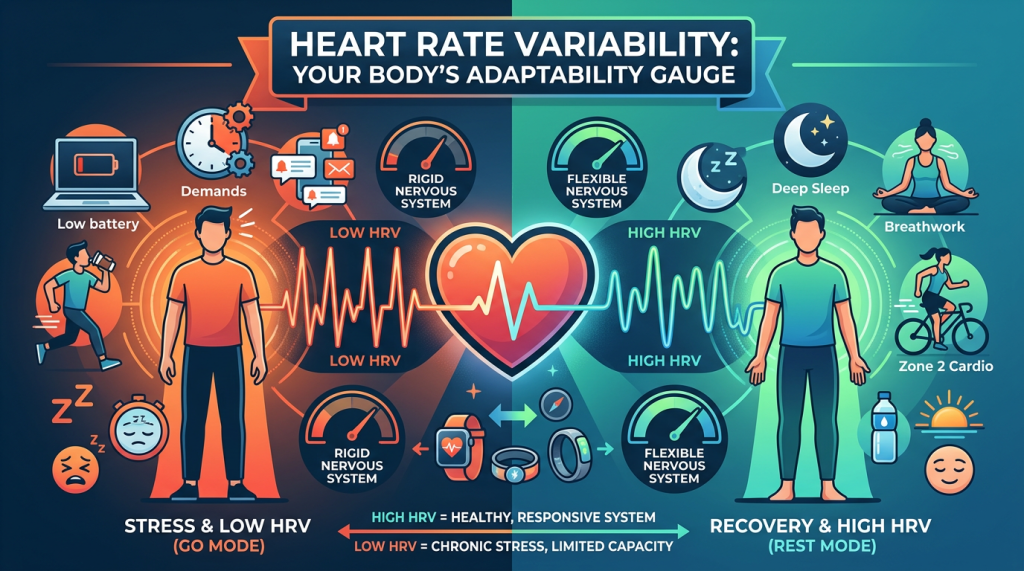
The Science Behind It: Your Nervous System in Two Modes
To understand why HRV matters, you need a quick primer on your autonomic nervous system. It operates in two complementary modes.
The Sympathetic Branch is your accelerator. It governs fight-or-flight. When you are stressed, under threat, exercising hard, or running on caffeine and deadlines, this branch is dominant. Heart rate goes up. Breathing becomes shallow. Digestion slows. You are in “go” mode.
The Parasympathetic Branch is your brake. It governs rest-and-digest. When you are calm, recovering, sleeping deeply, or breathing slowly after a meal, this branch is dominant. Heart rate drops. Muscles relax. Repair happens.
Here is the key insight: HRV reflects the balance between these two systems.
When both branches are working well and your body can fluidly shift between acceleration and braking, your HRV is high. Your nervous system is flexible.
When one branch dominates – usually the sympathetic, because modern life is essentially one long low-grade stress response – your HRV drops. Your nervous system becomes rigid. Stuck in one gear.
This is not just a fitness metric. It is a window into how your entire body is managing the invisible load of daily life — work pressure, poor sleep, travel fatigue, emotional stress, screen time, inflammation, even food choices.
Your HRV captures all of it. Often before you feel anything yourself.
How to Measure HRV (And When It Actually Counts)
The good news is that measuring HRV has become remarkably accessible. You no longer need a lab or a chest strap. Modern consumer devices do a solid job.
Popular tools include:
- Oura Ring – Measures HRV passively during sleep. Great for overnight trends.
- Whoop – Continuous monitoring with recovery scores based on HRV.
- Apple Watch – Tracks HRV throughout the day and during sleep.
- Garmin – Offers HRV status and trends in newer models.
- Polar H10 Chest Strap – The gold standard for accuracy during morning readings.
But here is the part most people get wrong. They check their HRV once, see a number, and either celebrate or panic. That single number is almost meaningless.
The rules of useful HRV measurement:
- Measure at the same time every day. The best window is first thing in the morning or during sleep. HRV fluctuates wildly throughout the day based on activity, meals, hydration, and even posture. Comparing a morning reading to a post-coffee reading is comparing apples to traffic lights.
- Watch trends, not snapshots. A single low reading means very little. A downward trend over five to seven days means something real is happening – accumulated stress, inadequate recovery, early-stage illness, or overtraining.
- Never compare your number to someone else’s. HRV is wildly individual. A fit 25-year-old might average 65 ms. A healthy 45-year-old might average 35 ms. Both can be perfectly fine. Your baseline is yours alone. What matters is how your number moves relative to your own history.
Think of HRV tracking not as a daily grade but as a weather forecast for your body. It helps you decide: Should I push hard today, or should I pull back?
What Tanks Your HRV (The Usual Suspects and the Surprising Ones)
Once you start tracking consistently, patterns emerge fast. Some of the biggest HRV killers are exactly what you would expect. Others might surprise you.
The Obvious Ones
- Poor sleep. Even one night of fragmented or short sleep can drop your HRV significantly the next morning. Two or three bad nights in a row and the decline becomes unmistakable.
- Alcohol. This is the one that shocks most people. Even a single glass of wine with dinner can suppress HRV for 24 to 48 hours. Two or three drinks and your nervous system essentially goes into damage-control mode overnight. Your resting heart rate rises. Your deep sleep shrinks. Your HRV craters.
- Overtraining. Hard workouts are supposed to stress your body – that is how adaptation happens. But if you stack intense sessions without adequate recovery, your HRV stops bouncing back. This is one of the earliest and most reliable signs of overtraining.
- Illness. Your HRV often drops one to two days before you feel sick. Many regular trackers report seeing their numbers fall off a cliff 48 hours before a cold or flu hits. Your immune system is already fighting; your nervous system reflects it.
The Surprising Ones
- Travel and jet lag. Crossing time zones disrupts your circadian rhythm, and your HRV shows it immediately. Even domestic travel – the disrupted sleep, the airport stress, the dehydration – can suppress recovery for days.
- Emotional stress. A difficult conversation, financial anxiety, relationship tension – none of these involve physical exertion, but they light up your sympathetic nervous system just the same. Your body does not distinguish between a tiger chasing you and a passive-aggressive email from your boss.
- Screen time before bed. Blue light exposure in the evening suppresses melatonin production and keeps your sympathetic system elevated. The result: lower HRV during the first half of sleep, which is when your deepest recovery should happen.
- Dehydration. Even mild dehydration – the kind you do not notice – reduces blood volume, which forces your heart to work harder at rest. HRV drops accordingly.
- Late meals. Eating a large meal close to bedtime forces your body to divert energy toward digestion during sleep. Your parasympathetic system is busy processing food instead of repairing tissue.
The pattern is clear. Anything that keeps your body “on” when it should be “off” will suppress your HRV. And modern life is essentially designed to keep you on.
How to Improve Your HRV (Without Overcomplicating It)
The good news is that HRV responds to lifestyle changes relatively quickly. Unlike cholesterol or body composition, which shift over months, HRV can improve noticeably within weeks. Sometimes days.
Here is what actually moves the needle, ranked roughly by impact.
1. Sleep Consistency
This is the single most powerful lever. Not just sleep duration — sleep consistency. Going to bed and waking up at roughly the same time every day, even on weekends, does more for your HRV than almost any supplement, device, or biohack.
Your circadian rhythm is the conductor of your entire hormonal orchestra. When the conductor keeps a steady tempo, everything else falls into line.
2. Zone 2 Cardio
Low-intensity aerobic exercise – the kind where you can hold a full conversation – builds your aerobic base and strengthens parasympathetic tone over time. This is not the workout that makes you feel heroic. It is the workout that makes everything else in your life work better.
Thirty to forty-five minutes of walking, easy cycling, or light jogging three to four times per week is enough. The HRV improvements typically show up within four to six weeks.
3. Breathwork
This is the closest thing to a manual override for your nervous system.
Slow, controlled breathing – particularly exhale-dominant patterns — directly activates the parasympathetic branch. The simplest protocol: inhale for four counts, exhale for six to eight counts. Five minutes before bed or during a midday break.
Box breathing (four counts in, four hold, four out, four hold) is another effective option, especially for acute stress.
This is not meditation. This is not spiritual. This is mechanical. You are using your diaphragm to send a direct signal to your vagus nerve: stand down.
4. Limiting Alcohol
You do not need to eliminate it entirely. But if you are serious about recovery and long-term health, understanding the HRV cost of alcohol is important. Track your numbers on nights you drink versus nights you do not. Let the data speak. Most people quietly reduce their intake once they see the evidence on their own wrist.
5. Morning Light Exposure
Getting bright natural light within the first 30 to 60 minutes of waking helps anchor your circadian rhythm, improves cortisol timing, and sets the stage for better melatonin production at night. All of which cascades into better sleep and higher HRV.
6. Cold Exposure
Brief cold exposure – a cold shower for 60 to 90 seconds at the end of your regular shower – stimulates the vagus nerve and can improve parasympathetic tone over time. The initial shock activates your sympathetic system, but the recovery afterward trains your body to downregulate faster.
7. Hydration
Simple but often overlooked. Start your morning with water before coffee. Maintain steady hydration throughout the day. Your blood volume, and therefore your heart’s workload at rest, depends on it.
Using HRV as a Decision-Making Tool
Here is where HRV becomes genuinely practical — not just interesting, but useful.
Once you have two to three weeks of baseline data, you can start using your morning HRV reading to guide real decisions.
HRV is above your baseline? Green light. Push hard in your workout. Take on the demanding project. Schedule the difficult conversation. You have capacity today.
HRV is at your baseline? Proceed normally. Maintain your routine, but do not add extra load.
HRV is significantly below your baseline? Pull back. Swap the intense workout for a walk. Prioritize sleep tonight. Reduce decisions and stimulation where possible. Your system is telling you it needs recovery — even if your brain insists you feel fine.
This is not about being fragile. It is about being strategic. Elite athletes have used this approach for years. They do not train hard every day. They train hard on the days their body signals readiness, and they recover aggressively on the days it does not.
The same logic applies to knowledge work, travel planning, and even financial decision-making. Your cognitive performance, emotional regulation, and risk tolerance all correlate with your recovery state. Making important decisions when your HRV is in the basement is the biological equivalent of grocery shopping when you are hungry.
The Bigger Picture: HRV and Longevity
Zooming out from daily decisions, there is a larger reason to care about HRV.
Research consistently links higher resting HRV with reduced risk of cardiovascular disease, better immune function, lower chronic inflammation, and longer lifespan. It is not that high HRV directly causes these outcomes. It is that high HRV reflects a nervous system that is well-regulated, a body that recovers efficiently, and a lifestyle that supports both.
Conversely, chronically low HRV is associated with higher all-cause mortality, greater susceptibility to illness, and faster biological aging. It is an early-warning system for the kind of slow, invisible damage that accumulates over years of unmanaged stress, poor sleep, and inadequate recovery.
If you are building toward financial independence, investing in longevity projects, or simply trying to perform well for decades rather than months – HRV gives you a feedback loop that most health metrics cannot match.
Your net worth compounds over time. So does your health. And HRV is the closest thing you have to a real-time portfolio tracker for your body.
The Bottom Line
HRV is not a magic number. It will not diagnose disease. It will not replace your doctor. And obsessing over daily fluctuations will drive you crazy.
But used correctly – measured consistently, interpreted as a trend, and applied as a decision-making input – it becomes one of the most valuable feedback loops available to you.
It tells you what your body already knows but your mind often ignores: whether you are genuinely recovering or just getting by. Whether you are building capacity or quietly depleting it.
In a world that rewards constant output and punishes rest, HRV is the quiet reminder that recovery is not laziness. It is strategy.
Start tracking. Watch the trends. And when the data tells you to rest, listen.
Your future self – the one enjoying the health and freedom you are building toward right now – will thank you.
Related Reading
If this post resonated, you might also find these helpful:
- Zone 2 Cardio Explained: The Boring Workout That Boosts Longevity and Adds Years to Your Life
- How to Optimize Your Nervous System for Better Focus, Performance, and Health
- Training Your Nervous System for Modern Work: How to Reduce Stress and Avoid Burnout
- The Cost of Being “On” All Day: How Modern Work Overloads Your Nervous System
- Recovery is a Skill: Why It Doesn’t Happen Automatically (And How to Improve It)
- The Sleep Efficiency Blueprint: How to Improve Sleep Quality and Wake Up Rested (Without More Hours)
- Your Body’s Dashboard: Early Physical Signs of Burnout You Shouldn’t Ignore
- Cold Exposure Benefits: The Science Behind Cold Showers, Recovery, and Longevity


Leave a comment