Most people plan trips around prices.
Cheap flights.
Hotel deals.
Off-season discounts.
But very few plan trips around biology.
And that’s why so many vacations end in exhaustion.
You don’t return refreshed.
You return depleted.
You call it jet lag. Or travel burnout. Or just “getting older”.
But often, the real issue is simpler:
You ignored your energy systems.
Travel is a stressor. Even enjoyable travel taxes your nervous system, sleep cycle, digestion, and attention. If you don’t account for that load, fatigue accumulates quickly.
The solution isn’t to travel less.
It’s to plan around your circadian rhythm, recovery capacity, and natural energy cycles.
This is travel energy mapping — aligning your itinerary with your biology instead of fighting it.
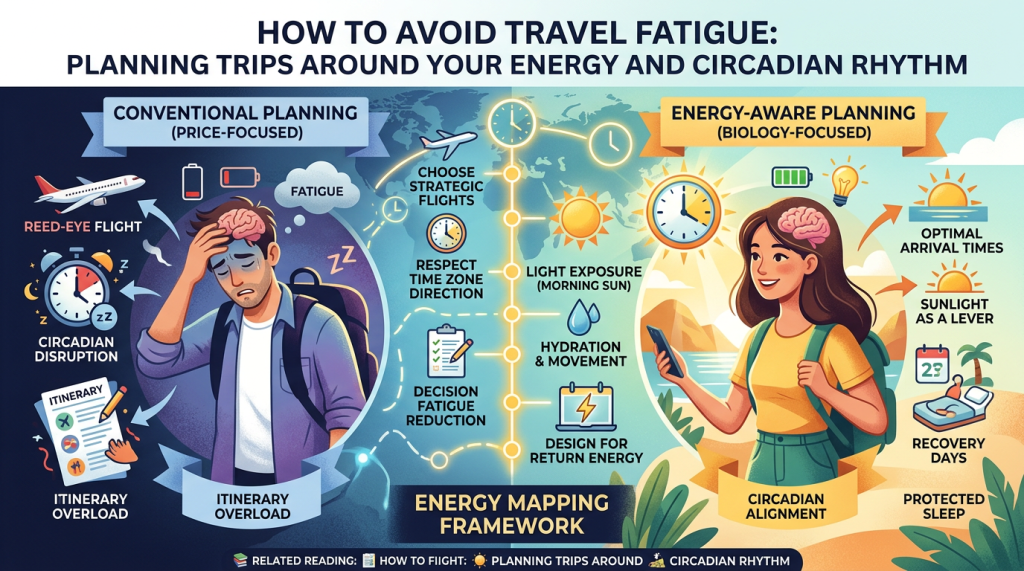
Why Travel Fatigue Happens (Even When You’re Excited)
Travel fatigue isn’t just about long flights.
It’s a combination of:
- Disrupted circadian rhythm
- Poor sleep quality
- Novel sensory overload
- Decision fatigue
- Changes in diet and hydration
- Increased walking or physical strain
- Social intensity
- Lack of routine
Each factor alone is manageable.
Together, they overwhelm your system.
Excitement masks the early warning signs. Adrenaline keeps you moving. But once the trip ends — or even halfway through — the crash hits.
To avoid that crash, you need to understand one core principle:
Energy is finite. Travel increases energy expenditure.
If you don’t budget for it, you go into deficit.
Your Circadian Rhythm: The Foundation of Travel Energy
Your circadian rhythm is your internal 24-hour clock.
It regulates:
- Sleep and wake timing
- Hormone release
- Body temperature
- Digestion
- Cognitive performance
- Physical coordination
When you cross time zones or drastically shift routines, your circadian rhythm desynchronizes.
Symptoms include:
- Poor sleep
- Brain fog
- Irritability
- Low motivation
- Digestive discomfort
- Reduced exercise performance
Jet lag is simply circadian misalignment.
The greater the misalignment, the deeper the fatigue.
Energy Mapping: A Better Way to Plan Travel
Instead of asking:
“What’s the cheapest flight?”
Ask:
“What will this schedule cost my nervous system?”
Energy mapping means considering:
- Departure time
- Arrival time
- Time zone difference
- Sleep disruption
- Activity intensity
- Recovery windows
Travel becomes more sustainable when you treat energy like money.
You budget it.
You protect it.
You allocate it intentionally.
Step 1: Choose Departure and Arrival Times Strategically
Red-eye flights feel efficient.
They’re often cheap.
They “save” a day.
But biologically, they’re expensive.
If you can, prioritize:
- Flights that align with your normal waking hours
- Arrivals in late afternoon or early evening
- Enough buffer to sleep at the destination’s nighttime
Arriving at 6 a.m. after zero sleep forces you into a brutal choice:
Stay awake and suffer.
Or nap and destroy nighttime sleep.
Neither is ideal.
If possible, aim to:
- Arrive close to local bedtime
- Get light exposure strategically
- Avoid immediate high-demand activities
This single adjustment reduces travel fatigue dramatically.
Step 2: Respect Time Zone Direction
Not all jet lag is equal.
Eastward travel (losing hours) is harder than westward travel (gaining hours).
Why?
Because your circadian rhythm naturally runs slightly longer than 24 hours. It’s easier to stay up later than fall asleep earlier.
If planning a demanding trip (conference, trek, deep work retreat), consider:
- Favoring westward travel when possible
- Adding an adaptation day when traveling east
A simple rule:
Add one recovery day for every 2–3 time zones crossed.
It’s not indulgent. It’s strategic.
Step 3: Build “Low-Demand” First Days
The biggest mistake travelers make:
Landing and immediately stacking high-intensity activities.
City tours.
Long hikes.
Heavy social events.
Deep cultural immersion.
Your brain and body are not calibrated yet.
Instead, design the first 24–48 hours as:
- Light exploration
- Walking without agenda
- Early dinner
- Sunlight exposure
- Minimal decision load
Think of it as calibrating your system.
High performance follows recovery.
Step 4: Manage Light Like a Lever
Light is the strongest regulator of circadian rhythm.
Use it deliberately.
To adjust faster:
- Seek morning sunlight at your destination
- Avoid bright light late at night
- Limit screens before bed
- Use blackout curtains when needed
Morning light tells your brain:
“This is daytime now.”
Even 20–30 minutes outdoors accelerates adjustment.
Ignoring light signals prolongs jet lag.
Step 5: Hydration and Movement Are Non-Negotiable
Air travel dehydrates you.
Dehydration worsens:
- Fatigue
- Headaches
- Brain fog
- Muscle stiffness
Before, during, and after flights:
- Increase water intake
- Limit alcohol
- Walk periodically
- Do simple mobility drills
Movement isn’t just physical. It signals wakefulness and reduces stiffness from prolonged sitting.
Treat flights like sedentary stress events. Counteract them intentionally.
Step 6: Avoid Itinerary Overload
Travel fatigue isn’t only biological. It’s cognitive.
New environments require constant processing:
- Navigating streets
- Understanding cultural cues
- Translating language
- Choosing restaurants
- Planning logistics
Decision fatigue compounds quickly.
Instead of optimizing for quantity of experiences, optimize for depth.
One museum.
One meaningful walk.
One intentional conversation.
Energy spent deeply is more memorable than energy scattered thinly.
Step 7: Match Trip Type to Life Season
Your biological capacity changes over time.
What felt effortless at 25 may feel draining at 40.
Ask:
- How much sleep do I currently need?
- How intense is my work season?
- Am I physically training hard right now?
- Is my stress baseline already elevated?
If work is intense, choose restorative travel.
If you’re in a recovery phase, avoid multi-city sprints.
Travel amplifies your baseline.
It doesn’t fix burnout.
Step 8: Protect Sleep Ruthlessly
Sleep is the anchor.
Without it, everything else deteriorates.
During travel:
- Keep bedtime consistent when possible
- Avoid late heavy meals
- Limit alcohol (especially in new time zones)
- Create a simple sleep ritual
- Use eye masks or earplugs
Even small sleep disruptions compound over multiple days.
You can explore more effectively when rested.
Step 9: Insert Recovery Days
Just like strength training, travel requires recovery.
If you’re traveling for 10 days:
Don’t schedule 10 intense days.
Alternate:
High activity day → Low activity day
Exploration day → Rest morning
Long hike → Café and reading afternoon
Recovery days are not wasted days.
They’re performance enhancers.
Step 10: Design for Return Energy
Most people focus on surviving the trip.
Few plan for re-entry.
Returning home is another circadian disruption.
To soften the landing:
- Avoid arriving back late at night before work
- Schedule a buffer day if possible
- Re-establish routines immediately
- Get sunlight the next morning
Travel fatigue often peaks after return — not during.
Plan accordingly.
The Energy Budget of Travel
Think of your trip like a financial budget.
You have:
- Sleep capital
- Physical capacity
- Cognitive bandwidth
- Social energy
Every activity withdraws from one of these.
If withdrawals exceed deposits, fatigue accumulates.
Energy mapping is simply conscious budgeting.
Travel Is Stress — Even When It’s Positive
Not all stress is bad.
Travel can be deeply enriching.
But it is still stress.
New stimuli.
Uncertainty.
Movement.
Exposure.
Your nervous system works harder in unfamiliar environments.
If you don’t manage that load, burnout follows.
If you do manage it, travel becomes restorative instead of draining.
A Simple Travel Energy Framework
Before any trip, ask:
- How many time zones am I crossing?
- How many sleep disruptions will occur?
- How intense is the itinerary?
- Where are recovery windows built in?
- What is my current life stress baseline?
If multiple variables are high, simplify something else.
You don’t need to eliminate stress.
You need to balance it.
The Long-Term Advantage
When you plan around biology:
- You experience more with less exhaustion.
- You retain memories better (sleep consolidates memory).
- You avoid post-trip burnout.
- You protect your healthspan.
- You travel more frequently without cumulative fatigue.
Travel becomes sustainable.
And sustainability beats intensity.
Final Thought: Align With Your Body, Not Against It
Travel is one of the greatest teachers.
But it shouldn’t cost your well-being.
When you ignore your circadian rhythm, overload your itinerary, and treat sleep as optional, you turn growth into depletion.
When you align your trips with your biology, something changes.
You wake up clear.
You explore deeply.
You return energized.
The goal isn’t to see more.
It’s to feel better while seeing enough.
Plan around your energy.
Your future self — and every future trip — will thank you.
Related Reading
If this resonated, you may enjoy:
- The Energy Budget of Travel: How to Avoid Travel Fatigue and Explore Without Exhaustion
- Travel Warm-Ups: Simple Routines to Help You Arrive Energized and Avoid Travel Fatigue
- The Sleep Efficiency Blueprint: How to Improve Sleep Quality and Wake Up Rested (Without More Hours)
- How to Fix Your Circadian Rhythm as a Remote Worker: Screen Time & Sleep Tips
- Optimize Your Nervous System for Better Focus, Performance, and Health
- Why Rest Days Are the Secret to Better Travel: How Doing Less Helps You Experience More
- Comfort-Optimized Travel: Simple Systems That Reduce Stress and Save Time
- Digital Sabbaticals: How to Travel to Disconnect (Not Just Work Remotely)


Leave a Reply