You have spent the better part of a decade—perhaps two—playing a very specific game. The rules of this game are simple: minimize outflows, maximize inflows, and track the delta with religious precision. You have mastered the art of the “No”. You have looked at thousand-dollar upgrades and seen only the opportunity cost—calculating that $1,000 invested today at a 7% return would be worth $7,600 in thirty years.
This mental calculator has been your greatest ally. It is the engine that powered you toward Financial Independence. But then, a strange thing happens. You reach the summit. You hit your “Number.” The math says you are free.
And suddenly, the mental calculator becomes a curse.
You stand in a grocery store, hesitating over the organic produce. You look at a direct flight that costs $200 more than a grueling six-hour layover and you feel a physical knot in your stomach. You have “won” the money game, but you are still living by the rules of the struggle. This is the Fear of Spending, and for the high-achiever, it is the final boss of the FIRE (Financial Independence, Retire Early) journey.
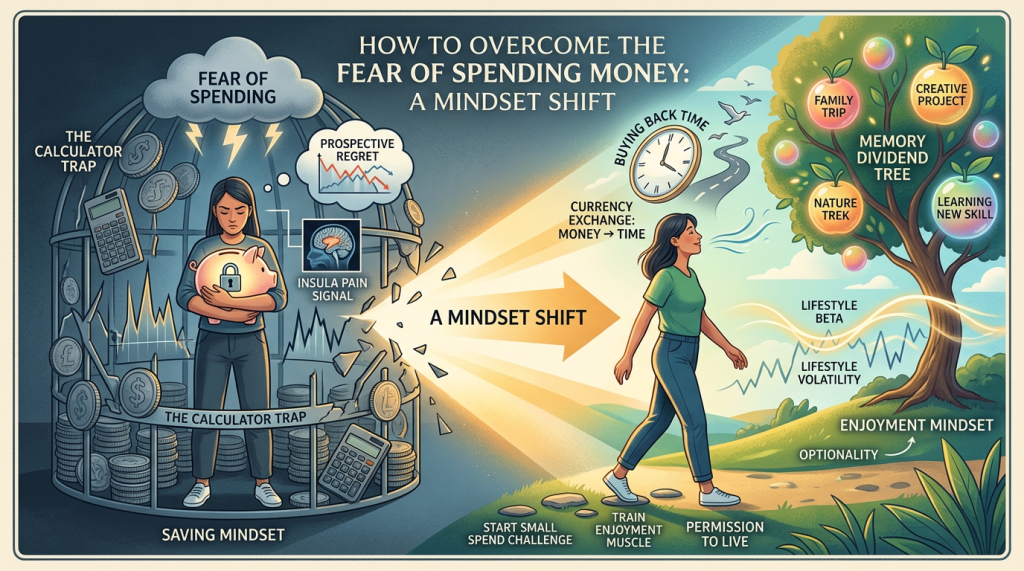
To truly enjoy your wealth, you don’t need a larger portfolio. You need a mindset shift. You need to move from a “Saving Mindset” to an “Enjoyment Mindset”.
The Paradox of the Successful Saver
In the early stages of building wealth, frugality is a virtue. It represents discipline, foresight, and a rejection of mindless consumerism. However, as your net worth grows, there is a “tipping point” where frugality stops being a tool for freedom and starts becoming a barrier to it.
Psychologists call this “Hyperopia” – the opposite of myopia. While myopic people spend for today and forget tomorrow, hyperopic people are so focused on the future that they are incapable of living in the present. They suffer from “Prospective Regret” – the fear that if they spend money now, they will regret it later if the market crashes or an emergency occurs.
The irony is that the most successful savers are often the ones most susceptible to this fear. Why? Because for a decade, you have conditioned your brain to associate “Saving” with “Safety” and “Spending” with “Danger.” Your nervous system has literally hard-wired your identity around being a “saver.” When you try to spend, you aren’t just losing money; you are violating your own sense of self.
The Biology of Spending Guilt
It is important to understand that this isn’t just “in your head”. It is in your biology.
Neuroscience research using fMRI scans has shown that the brain processes the act of paying for something in the insula—the same region that processes physical pain. For “tightwads” (those with a high propensity to save), the insula is hyper-reactive. When you see a price tag, your brain registers a pain signal.
For years, you leaned into that pain to build your fortress of wealth. But now that the fortress is built, the pain signal is still firing. To overcome the fear of spending, you have to realize that your brain is giving you an outdated survival signal. You are no longer in the “scarcity” phase of your life, but your amygdala hasn’t read your brokerage statement.
The Concept of the “Memory Dividend”
One of the most powerful frameworks for shifting your mindset comes from Bill Perkins in his book Die With Zero. He introduces the concept of the Memory Dividend.
In the financial world, we love dividends. We love the idea of an asset that pays us over and over again. Perkins argues that experiences work the same way. When you spend money on a meaningful experience – a trip with your aging parents, a summer spent traveling with your children, a solo trek through the jungle – you aren’t just “consuming” that money. You are investing it in a “Memory Asset.”
Unlike a stock, which can go to zero, a memory asset compounds in value. You get to “collect” the dividend every time you recount the story, look at a photo, or feel the shift in perspective that the experience gave you.
The Math of Experience:
If you take a trip at age 30, you have 50+ years of memory dividends to collect. If you wait until you are 70 because you were “waiting for the number to be higher,” you only have 10 years of dividends. Furthermore, your physical ability to enjoy that experience at 70 is significantly lower. From a rational, ROI-focused perspective, spending money on experiences early is actually the more efficient choice.
Framework 1: The “Safety Floor” vs. The “Play Ceiling”
To stop the fear, you need to draw a line in the sand. Most people fail to spend because they treat their entire net worth as one giant “Emergency Fund.”
Instead, use the Bucket System.
- The Floor: This is your “Never Touch” money. It is the amount required to fund your basic lifestyle forever (using the 4% rule or your preferred withdrawal rate). Once this bucket is full, you are safe.
- The Buffer: An extra 10–20% for sequence of returns risk or major health emergencies.
- The Play Bucket: Every dollar above the Floor and the Buffer is surplus.
Psychologically, it is much easier to spend “Surplus” than it is to spend “Net Worth.” When you realize that your basic needs are mathematically guaranteed, the “pain” of spending from the surplus bucket diminishes. You have given yourself “authorized” money to lose.
Framework 2: Buying Back Time (The Ultimate Rationality)
If you struggle to spend money on “stuff,” start by spending money on Time.
For the intellectual worker, time is the scarcest resource. Every hour you spend doing something you hate (scrubbing floors, sitting in traffic, troubleshooting a lawnmower) is an hour you could have spent reading a “Lindy” book, training for longevity, or working on a creative project.
When you hire a house cleaner or pay for a convenient flight, you aren’t being “lazy” or “extravagant.” You are performing a Currency Exchange. You are trading a commodity you have in abundance (money) for a commodity you have in limited supply (time).
If you have $2 million and you are still spending two hours a week doing a task you could outsource for $50, you are effectively valuing your life at $25 an hour. Is that the rate you want to set for your freedom?
Framework 3: The “Die With Zero” Trajectory
We are taught that wealth should always go up. The “Number” should always be higher this year than it was last year. But if your goal is to maximize your life, your net worth curve should actually look like an inverted U.
There is an “optimal” point to start spending down your capital. If you die with $5 million in the bank, that represents decades of work you didn’t need to do and hundreds of experiences you didn’t have.
Shift your mindset to view a massive inheritance not as a “gift” to your heirs, but as a calculation error. If you want to give to your children or to charity, do it while you are alive (giving them a “Social Dividend” when they actually need the money, rather than when they are 60 years old and already established).
The “Lifestyle Beta” Approach
“Beta” is a measure of volatility. A high-stress life has a “High Beta” – it is reactive to every little annoyance, every broken appliance, every travel delay.
“Lifestyle Beta” is the practice of using your wealth to dampen the volatility of your existence.
- It’s staying at the hotel inside the airport during a layover so you get 8 hours of sleep instead of 4.
- It’s buying the “cancel for any reason” insurance so you don’t stress about a $3,000 trip.
- It’s having the “Freedom Fund” to walk away from a toxic client or project without a second thought.
When you view spending as a way to reduce stress and protect your nervous system, it stops feeling like a luxury and start feeling like a health intervention. As remote workers, our focus and mental clarity are our primary assets. Anything that protects those assets has a positive ROI.
Practice: The Small Spend Challenge
You cannot think your way out of a decade of frugal conditioning; you have to act your way out. You need “Exposure Therapy”.
Start with the 1% Spend. Look at your monthly budget and identify a way to spend 1% more in a way that directly increases your quality of life.
- Upgrade your coffee beans.
- Buy the more expensive, more comfortable gym shoes.
- Say “yes” to the appetizer.
Notice the “pain” signal in your brain. Acknowledge it. Then look at your spreadsheet and realize that your financial security has moved 0.0000% because of this purchase. Repeat this until the pain signal dulls. You are training your “Enjoyment Muscle.”
Conclusion: The Goal is Not the Number
The ultimate trap of the FIRE movement is forgetting that money is a means, not an end. Money is a tool for the construction of a life.
If you have the tool, but you are too afraid to use it because you’re worried the tool might wear down, you have failed the mission. The goal of Financial Independence is not to reach a certain number on a screen; it is to reach a state of Optionality.
The fear of spending is the final shackle. It is the last remnant of your “working” self clinging to a scarcity that no longer exists. Break the shackle. Shift your mindset. Realize that at this stage of your journey, the most “frugal” thing you can do is to stop wasting your limited time on earth just to see a number grow.
You’ve earned the wealth. Now, give yourself the permission to live the life it was meant to buy.
Related Reading
If you’re ready to navigate the complex psychology of wealth and freedom, these articles will help you find your balance:
- How to Reduce Financial Stress Without Earning More (The Lifestyle Beta Approach) – A framework for using money to buy peace of mind.
- Why Financial Independence Is Really About Slack (Not Early Retirement) – Why the real goal is resilience, not just stopping work.
- The Second-Order Effects of Frugality: When Saving Money Starts to Cost You – Identifying when your saving habits start damaging your quality of life.
- The Psychology of Enough: How to Redefine Wealth Beyond Money – How to recognize when you’ve already won the game.
- Lifestyle Prototyping: How to Test-Drive a New Life Before You Commit – A low-risk way to practice spending on your ideal lifestyle.
- Financial Independence Without Extremes: A Sustainable Approach to FIRE – How to avoid burnout on the way to your number.
- The 80/20 of FIRE: Tiny Financial Tweaks That Create Outsized Results (Fast) – Focusing on the high-impact decisions that simplify your finances.
- Life After Financial Independence: How to Navigate the Identity Crisis When Work No Longer Defines You – Dealing with the “Who am I now?” question once the grind ends.


Leave a Reply