We live in a culture obsessed with the “New.” Our social media feeds refresh by the second, our news cycles operate on hourly rotations, and the “New Arrivals” section of the bookstore is bathed in the brightest lights. We have been conditioned to believe that “new” implies “improved”, “updated”, or “more relevant.”
In software, this is often true. In medicine, it is frequently true. But in the realm of ideas – the very things that shape our thinking, our character, and our worldviews – the obsession with the contemporary is a trap.
If you want to build a mind that is resilient, deep, and capable of high-level synthesis, you must stop chasing the bestseller list and start respecting the “Lindy Effect”.
The Tyranny of the New
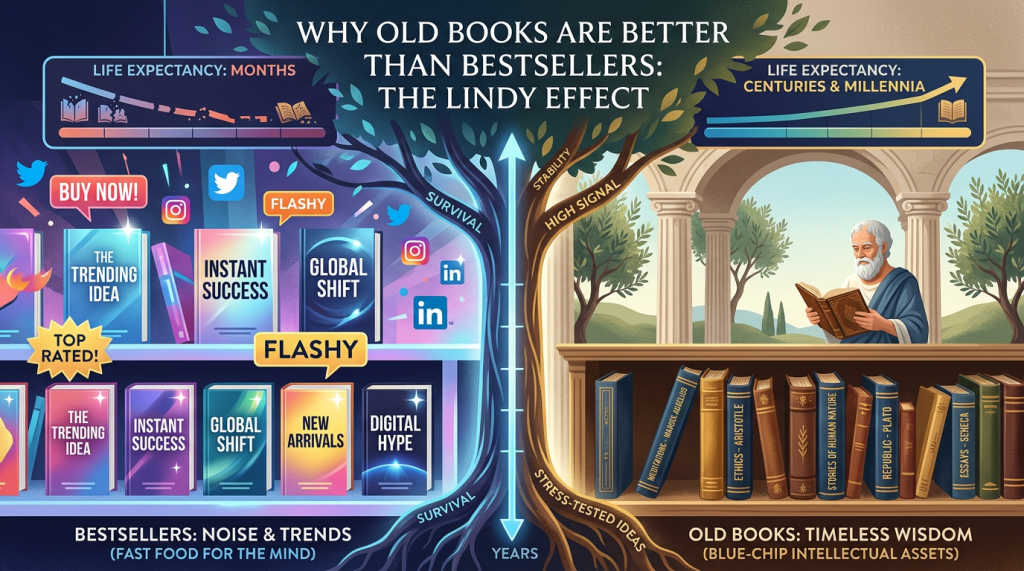
The average lifespan of a modern bestseller is roughly six months. After the initial marketing blitz, the podcast appearances, and the airport bookstore displays, most books vanish into the “used” bin of history. They are products of a specific cultural moment, designed to solve a fleeting problem or capitalize on a temporary trend.
When we fill our “Intellectual Carry-On” exclusively with books published in the last 24 months, we are engaging in a form of intellectual recency bias. We are consuming ideas that have not yet been “stress-tested” by reality. We are eating the “fast food” of the mind – high in immediate stimulation but low in long-term cognitive nutrition.
To escape this, we need a filter. We need a way to distinguish between “noise” (fleeting information) and “signal” (timeless wisdom). That filter is the Lindy Effect.
What is the Lindy Effect?
The Lindy Effect is a concept popularized by Nassim Nicholas Taleb in his book Antifragile. It describes a phenomenon concerning the life expectancy of non-perishable things – ideas, books, technologies, and musical compositions.
For a perishable thing, like a human being or a carton of milk, every day that passes brings it closer to its inevitable end. If a human is 80 years old, they are statistically likely to die sooner than a 20-year-old.
However, for non-perishable things, the opposite is true. Their life expectancy increases with every day they survive.
If a book has been in print for 50 years, the Lindy Effect suggests it is likely to stay in print for another 50 years. If it has been around for 2,000 years (like the Meditations of Marcus Aurelius), it is likely to be read for another two millennia. Conversely, a book that has been out for two weeks has a high probability of being forgotten by next month.
Time is the most brutal, honest, and effective editor in existence. It has no ego, it doesn’t take bribes from publishing houses, and it is immune to marketing hype. If an idea has survived for centuries, it is because it contains a fundamental truth about the human condition that transcends the specific circumstances of the era in which it was written.
The Biology of Information: Signal vs. Noise
Why does this happen? Why are old books often “better” than new ones? It comes down to the ratio of signal to noise.
Modern publishing is a high-volume industry. Because it has never been easier to publish a book, the “noise” in the system is at an all-time high. Authors are incentivized to produce “hot takes” and “disruptive” ideas that grab attention in a crowded marketplace.
However, truly great ideas are rarely “new.” The fundamental challenges of being a human – how to deal with grief, how to manage money, how to find purpose, how to lead a community – have not changed in 5,000 years.
When you read a modern business book on “Leadership in the Digital Age”, you are getting a layer of “signal” (the leadership part) buried under a mountain of “noise” (the digital age part). By the time you finish the book, the “digital age” part may have already shifted.
When you read Xenophon’s Cyropaedia (The Education of Cyrus), written in the 4th century BC, you are getting the pure signal. You are learning the timeless mechanics of influence, logistics, and psychology that worked for a Persian king and still work for a modern CEO. The Lindy Effect has stripped away the fluff and left you with the skeleton of reality.
The “Mental Carry-On”: Why Classics Are Force Multipliers
Reading old books provides what I call “Intellectual Cross-Training”. When you read outside your century, you are forced to engage with a different set of assumptions, a different cadence of language, and a different worldview. This creates a healthy “Cognitive Friction” that modern books—often written to be “snackable” and “easy to digest”—simply cannot provide.
1. They Solve the “Same-Think” Problem
Most modern thinkers are reading the same 10 books that are currently trending on Twitter or LinkedIn. If you read what everyone else is reading, you will think what everyone else is thinking. By reaching back 100 or 500 years, you gain access to “lost” perspectives that give you a competitive advantage in problem-solving and creative thinking.
2. They Are the “First Principles” of Knowledge
Almost every modern self-help or business book is just a watered-down version of Stoicism, Aristotelian ethics, or Machiavellian strategy. Why read the derivative when you can read the source? By reading the “Lindy” books, you are learning the first principles of human behavior. Once you understand the root, you don’t need to study every leaf.
3. They Build Emotional Resilience
There is a profound comfort in realizing that your “modern” problems – burnout, anxiety about the future, the difficulty of maintaining friendships – were documented with precision by Seneca in 65 AD. Knowing that these challenges are part of the permanent human experience reduces the “noise” of personal drama and allows you to focus on the “signal” of solutions.
The Strategy: How to Apply the Lindy Filter
I am not suggesting that you never read a book published in the 21st century. I am suggesting that you treat your reading list like a balanced investment portfolio. You want some “speculative growth” (new books), but the core of your holdings should be “blue-chip” (Lindy books).
Here is my framework for a Lindy-optimized reading habit:
1. The 50/50 Rule
Aim to spend at least 50% of your reading time on books that are older than 50 years. This ensures that half of your mental input has already survived the first major “cull” of the Lindy Effect.
2. The “Wait and See” Protocol
When a new book is released and everyone is talking about it, wait a year. If people are still talking about it 12 months later, it has survived the first filter of the Lindy Effect. If it has vanished from the conversation, you just saved yourself 10 hours of reading time.
3. Read the “Afterlife”
As I’ve written before, what you do after you finish a book matters. For Lindy books, this is even more critical. These books are often denser and require more reflection. Don’t rush through The Odyssey just to say you finished it. Sit with it. Let it “compound” in your mind.
4. Follow the Footnotes
Great authors are usually Lindy readers. If you find a modern author you respect, look at who they cite. If a modern billionaire says they reread Marcus Aurelius every year, ignore the billionaire’s latest book and go read Marcus Aurelius.
Conclusion: Curate Your Mind Like an Investor
In the world of FIRE (Financial Independence, Retire Early), we understand the power of compounding interest. We know that the best returns come from assets that are held for decades, not days.
Your mind works the same way.
Information is a commodity, but wisdom is a rare asset. Information decays rapidly, but wisdom is “Lindy”—it becomes more valuable the longer it survives.
Stop being a consumer of the “New” and start being a curator of the “Timeless”. If you fill your mind with ideas that have survived the scrutiny of centuries, you will find that you don’t just know more – you think better. You will possess a “Mental Carry-On” that serves you in every city, every job, and every stage of life.
The next time you are tempted by the bright, shiny cover of the latest bestseller, ask yourself: “Will anyone care about this in 50 years?” If the answer is no, put it down. Go find a book that has already proven it can survive the test of time. Your future self will thank you for the investment.
Related Reading
If you’re looking to upgrade your learning systems and thinking habits, explore these previously published guides:
- Intellectual Cross-Training: The Benefits of Reading Outside Your Field – Why diving into diverse genres is the key to creative breakthroughs.
- Reading Debt: How to Stop Feeling Guilty About Your Unread Books – How to manage your “To-Be-Read” pile without the overwhelm.
- How to Read Critically: Why Disagreeing With Books Makes You a Smarter Reader – A guide to active engagement with the text.
- Reading Across Disciplines: How Interdisciplinary Learning Fuels Creative Thinking – Why the best ideas often come from the intersection of two “Lindy” fields.
- How to Create a Book Review System That Helps You Retain More – My personal system for ensuring that what I read actually sticks.
- How to Build a Lifelong Reading Habit (Even with a Busy Schedule) – Practical strategies for making time for deep thinking in a distracted world.
- The Literature Gym: Daily Reading Exercises to Improve Your Thinking – How to treat your reading time as a workout for your cognitive health.
- The Reading Flywheel: How to Remember, Apply, and Learn More From Books – Creating a self-reinforcing system of knowledge acquisition.


Leave a Reply