For the modern remote worker, the “office” is often a cave of our own making. We wake up, reach for a smartphone, and immediately bathe our retinas in the short-wavelength blue light of Slack notifications, emails, and news feeds. We move from the bedroom to the kitchen to the desk—sometimes without ever stepping foot outside.
We tell ourselves we are being productive. We have “zero commute”. We are “optimized”.
But by 2:00 PM, the fog sets in. Focus shatters. The third cup of coffee provides jitters but no clarity. By 10:00 PM, despite being exhausted all day, our brains are buzzing, making it impossible to fall into the deep, restorative sleep required to do it all again tomorrow.
The missing link isn’t a better productivity app, a higher dose of caffeine, or a more expensive ergonomic chair. It is the most ancient “software update” available to the human body: Viewable Morning Sunlight.
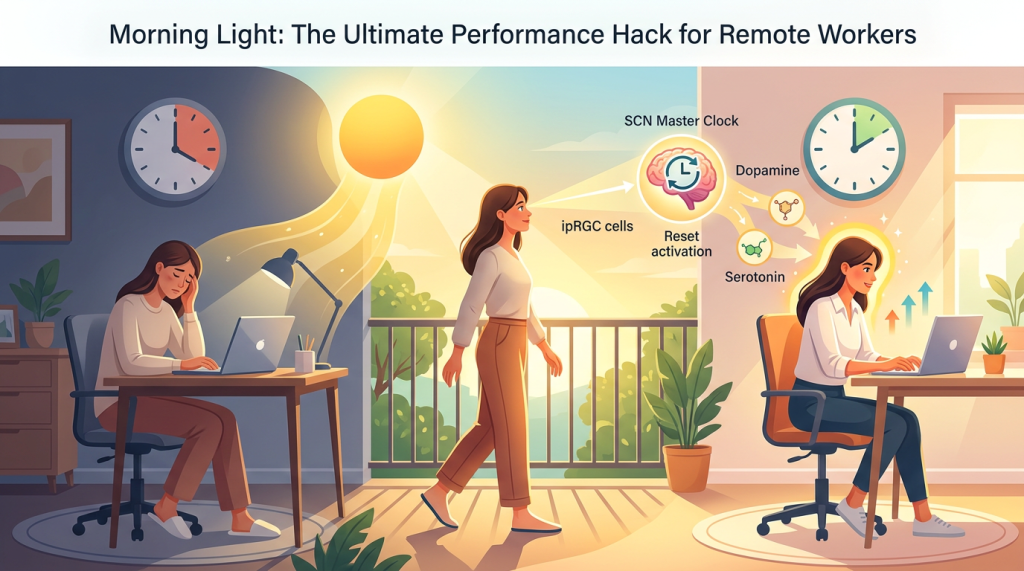
The Biological Clock: Understanding Your Suprachiasmatic Nucleus
To understand why sunlight is a performance hack, we have to look under the hood. Deep inside your brain’s hypothalamus sits a tiny structure called the Suprachiasmatic Nucleus (SCN). This is your Master Circadian Clock.
The SCN regulates almost every biological process in your body: your core body temperature, your metabolism, your hunger, and – most importantly for the knowledge worker – your hormones (specifically cortisol and melatonin).
The SCN does not have a watch. It relies on external signals, known as zeitgebers (time-givers), to know where it is in the 24-hour cycle. While food and exercise are secondary signals, light is the primary driver.
When you view sunlight within the first hour of waking, you trigger a timed release of cortisol. In the modern health narrative, cortisol is often vilified as the “stress hormone.” However, a healthy spike of cortisol in the morning is essential. It acts as a biological “wake-up call”, increasing your body temperature, sharpening your alertness, and setting a countdown timer for the release of melatonin about 14–16 hours later.
If you don’t get that light trigger in the morning, your cortisol peak is delayed or “blunted.” This results in that “tired but wired” feeling at night and a sluggish brain in the morning.
The Physics of Light: Why Your Windows are Killing Your Productivity
A common rebuttal from remote workers is: “I work right next to a window; I get plenty of light.”
Biologically speaking, you don’t.
Glass is a marvel of engineering, but it is an enemy of the circadian system. Standard window glass filters out a significant portion of the blue-light spectrum and the specific wavelengths (around 480nm) required to stimulate the intrinsically photosensitive Retinal Ganglion Cells (ipRGCs) in your eyes. These are the cells that talk directly to your brain’s master clock.
Furthermore, light intensity is measured in lux.
- A brightly lit indoor office is roughly 500 lux.
- A cloudy, overcast morning outside is roughly 10,000 lux.
- A clear, sunny morning is anywhere from 50,000 to 100,000+ lux.
When you are inside, even next to a window, you are essentially sitting in the dark as far as your brain is concerned. By staying indoors, you are providing your SCN with a “low-resolution” signal. The result is a “blurry” circadian rhythm. You never quite feel 100% awake, and you never quite feel 100% asleep.
The Performance Benefits: Focus, Mood, and Deep Work
For those of us obsessed with “Deep Work” and cognitive output, the morning sunlight protocol is a non-negotiable force multiplier. Here is how it directly impacts your output:
1. The Dopamine Baseline
Sunlight exposure triggers the release of dopamine. Unlike the “cheap dopamine” we get from scrolling social media, sunlight-induced dopamine helps regulate our baseline levels. A higher dopamine baseline is directly correlated with increased motivation, better task persistence, and the ability to handle the “friction” of complex problem-solving (like coding or deep writing).
2. Serotonin and Emotional Resilience
Serotonin is the precursor to melatonin, but in the daylight hours, it serves as a mood stabilizer. Remote work can be isolating. The “remote work blues” are often just a result of serotonin deficiency caused by a lack of light. Viewing the sun improves your “affective state,” making you less likely to get frustrated by a difficult bug or a cryptic email from a manager.
3. Metabolic Efficiency
Your brain is a massive energy consumer. Proper circadian alignment ensures that your insulin sensitivity is highest during your working hours. This means your brain is better at utilizing glucose for fuel, preventing the “brain fog” that usually follows a midday meal.
The Protocol: How to Execute the Sunlight Prescription
Like any good system, the “Sunlight Prescription” requires a specific protocol to be effective. You wouldn’t execute a code deployment without a checklist; don’t treat your biology any differently.
1. Timing is Everything
You must view the light within the first 30–60 minutes of waking. If the sun isn’t up when you wake, turn on bright overhead lights, but get outside as soon as the sun rises. The “low-angle sun” (solar noon is too late) contains the specific blend of blue and yellow light that the ipRGCs are most sensitive to.
2. Duration Matters
- Clear Sunny Days: 5–10 minutes.
- Cloudy Days: 15–20 minutes.
- Very Overcast/Rainy Days: 30 minutes.
The more clouds there are, the more photons you need to “collect” to trigger the SCN.
3. No Sunglasses, No Windows
Go outside. Do not wear sunglasses (unless you have a medical condition). Eyeglasses and contact lenses are fine, as they focus the light onto the retina, but polarized sunglasses will block the very wavelengths you need.
4. Low-Angle Sunlight
Position yourself so you are facing the general direction of the sun. You do not need to stare at the sun—please don’t damage your retinas. Looking toward the horizon is sufficient. The light needs to hit the bottom half of your retina to activate the cells that trigger the SCN.
Troubleshooting the Remote Work Lifestyle
“But I have a 9:00 AM meeting!”
This is the most common excuse. The solution is “stacking.” Use your morning meeting as a mobile meeting. If you don’t need to share your screen, take the call on your phone while walking around the block. If you must be at your desk, move your laptop to a balcony or a porch for the first 20 minutes of the day.
“It’s winter and it’s dark.”
If you live in a high-latitude region (like London, Seattle, or Berlin) where the sun doesn’t appear until mid-morning, you need a substitute. A high-intensity SAD (Seasonal Affective Disorder) lamp or a LED light therapy box (minimum 10,000 lux) can act as a bridge. Turn it on at your desk for the first 30 minutes of work, but still try to get outside once the sun eventually emerges.
“I’m a Night Owl.”
“Night Owls” are often just people with “delayed sleep phase syndrome” caused by—you guessed it—too much artificial light at night and not enough sunlight in the morning. By implementing the sunlight protocol, you can actually “pull” your rhythm forward, making 7:00 AM feel as natural as 10:00 AM.
The Long Game: Longevity and the Nervous System
As I’ve written about previously, training for longevity isn’t just about how much you can bench press at age 80; it’s about the health of your nervous system.
A nervous system that is constantly “on” because it doesn’t know what time it is will eventually burn out. This manifests as chronic inflammation, high resting heart rate, and decreased Heart Rate Variability (HRV).
By using morning light to anchor your circadian rhythm, you are giving your Autonomic Nervous System (ANS) a clear signal of when to be “Sympathetic” (Alert/Working) and when to be “Parasympathetic” (Resting/Digesting). This “slack” in the system is what prevents burnout and builds long-term resilience.
Summary: Your New Morning Routine
If you want to maximize your performance as a remote worker, your morning routine should look like this:
- Wake up.
- Hydrate (Water with a pinch of salt).
- Step Outside. Leave the phone in your pocket.
- Observe. Spend 10–20 minutes watching the sky change. Use this time for reflection or a “mental warm-up” for your first task.
- Return to the Cave. Now you are biologically primed to produce your best work.
The sun has been the primary driver of human evolution for millions of years. We are not designed to live under 500-lux LED bulbs. Reclaim your biology, and you will reclaim your focus.
Related Reading
If you found this guide helpful, you may want to explore these related articles on optimizing your health, wealth, and focus:
- How to Fix Your Circadian Rhythm as a Remote Worker: Screen Time & Sleep Tips – A deeper look at the “other half” of the equation: managing light in the evening.
- How to Build a Healthy Morning Routine for Wealth, Focus, and Productivity – How to integrate sunlight into a larger system for daily success.
- How to Optimize Your Nervous System for Better Focus, Performance, and Health – Understanding the “biological dashboard” of your work life.
- The Sleep Efficiency Blueprint: How to Improve Sleep Quality and Wake Up Rested – Practical tips for the 8 hours that define your next 16.
- Training Your Nervous System for Modern Work: How to Reduce Stress and Avoid Burnout – Why morning light is a key defense against professional exhaustion.
- How to Improve Focus Before Deep Work: Simple Mental Warm-Up Rituals – What to do once you come back inside from the sun.
- Designing a Body That Tolerates Modern Life: How to Stay Healthy in a Sedentary, Screen-Based World – The physical cost of our digital careers.
- The Cost of Being “On” All Day: How Modern Work Overloads Your Nervous System – Why “slack” and “rhythm” are the ultimate productivity hacks.


Leave a Reply