In an age of infinite information, we are drowning in content but starving for context. Most people approach reading as a linear activity: you pick up a book, read it from cover to cover, and move on to the next. In the world of finance, this is the equivalent of buying a single stock because you liked the branding, rather than analyzing the entire sector.
If you want to move from being a “casual reader” to a “subject matter expert”, you need a different protocol. You need Syntopical Reading.
Coined by Mortimer Adler in How to Read a Book, syntopical reading is the most complex and demanding level of reading. It is not about mastering a specific book; it is about mastering a subject by reading multiple books on the same topic and forging a synthesis that didn’t exist in any of them individually.
In this guide, we will break down the system of syntopical reading into a repeatable framework. By the end, you will understand how to take five books on a single subject and use them to build a sophisticated mental model that puts you in the top 1% of thinkers in that field.
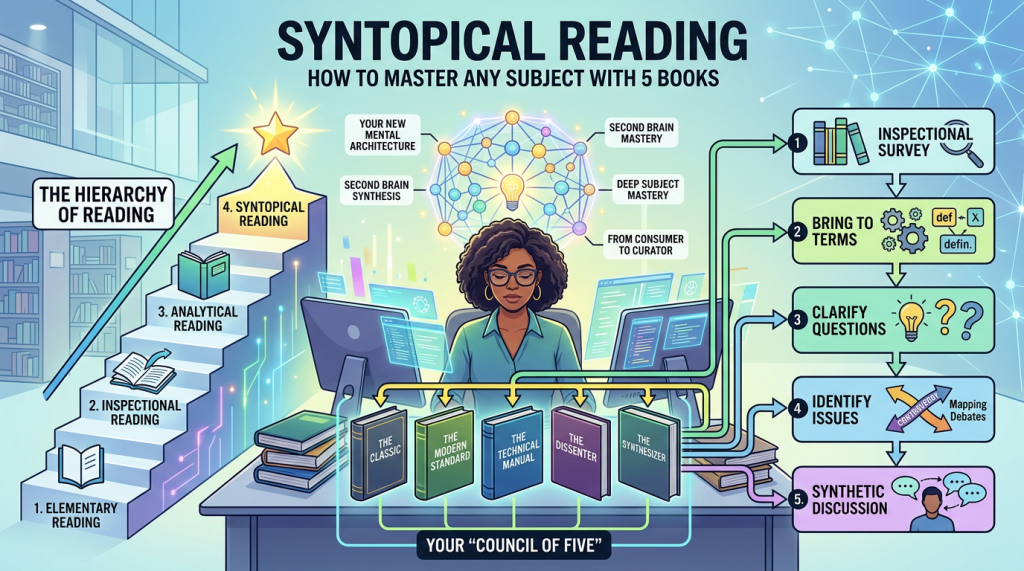
The Hierarchy of Reading: Why Level 4 Matters
To understand syntopical reading, we must recognize where it sits in the hierarchy of learning:
- Elementary Reading: Basic literacy.
- Inspectional Reading: Skimming or “pre-reading” to understand the structure.
- Analytical Reading: Deeply understanding a single book’s message.
- Syntopical Reading: Reading many books on the same subject and comparing their arguments.
Most people never move past Level 3. They become experts on what one author thinks. But authors have biases, blind spots, and agendas. Syntopical reading is the “diversified portfolio” of the mind. It allows you to see the “market” of ideas clearly by observing where different authors agree, where they clash, and where the truth actually lies.
The 5-Book Selection Strategy: Building Your “Council”
Why five books? In my experience, five is the “sweet spot” of cognitive ROI. Three is often too shallow to see a full spectrum of debate, while ten often leads to diminishing returns and “reading debt”.
When mastering a new field (whether it’s Longevity, Macro-economics, or Stoicism), you should select your five books based on these roles:
- The Classic: The foundational text that started the conversation.
- The Modern Standard: The current “best-seller” that reflects contemporary consensus.
- The Technical Manual: A data-heavy or academic look at the mechanics.
- The Dissenter: A book that argues against the mainstream consensus (essential for avoiding echo chambers).
- The Synthesizer: A broad overview that attempts to connect the dots across disciplines.
By selecting this “Council of Five,” you ensure that you aren’t just consuming information – you are triangulating truth.
The 5-Step System for Syntopical Mastery
Syntopical reading is not linear. You do not read Book A, then Book B. Instead, you treat the books as a giant database. Here is the protocol:
Step 1: Inspectional Survey (The Shortlist)
Before you dive deep, you must perform an inspectional reading of all five books. Spend 30–60 minutes with each. Read the table of contents, the index, and the introduction. Your goal here is to identify the chapters that are actually relevant to your specific question.
System Tip: You are not reading the books yet. You are “mapping the terrain” to see which authors address which sub-topics.
Step 2: Bringing the Authors to Terms
Every field has its own “jargon.” One author might use the word “wealth”, while another uses “optionality” or “capital”. In syntopical reading, you cannot be a slave to the author’s language.
You must establish a neutral terminology. Decide on the keywords you will use for your study and translate the authors’ ideas into your words. This is the first step toward building a “Second Brain” that is independent of any single source.
Step 3: Clarifying the Questions
Instead of asking “What is this book about?”, you ask, “How does this book answer my question?”
You must frame a set of questions that you want answered. For example, if you are studying FIRE (Financial Independence, Retire Early), your questions might be:
- How do we define “enough”?
- What is the role of insurance in long-term planning?
- How does lifestyle inflation impact the withdrawal rate?
You then “interrogate” all five books to find their specific answers to these specific questions.
Step 4: Identifying the Issues
Now comes the “Active Learning” phase. When you ask your questions, you will find that authors disagree. This is where the real learning happens.
If Author A says a 4% withdrawal rate is safe, and Author B says it’s reckless, you have identified an Issue. Your job is not to decide who is “right” immediately, but to map the controversy. Why do they disagree? What are their underlying assumptions? Understanding the tension between ideas is the key to mastery.
Step 5: The Synthetic Discussion
The final step is to move beyond the books and form your own “Synthetic View”. If you have done the work, you should now be able to speak about the subject more broadly than any one of the authors.
You aren’t quoting Author A; you are explaining the landscape of the field, using the insights of all five books to support a more nuanced, “third-way” perspective.
Cognitive Friction: Why This System Works
Syntopical reading is difficult. It requires “Cognitive Friction” – the mental effort required to compare conflicting ideas. In the same way that Zone 5 cardio improves your VO2 Max, syntopical reading improves your “Cognitive Carrying Capacity”.
When you read a book cover-to-cover, your brain is in “receive” mode. When you read syntopically, your brain is in “construct” mode. You are building a mental architecture. This is why information learned syntopically “sticks” much longer than information learned through passive consumption.
Applying This to Your Life (FIRE, Health, and Beyond)
The beauty of this system is that it scales.
- For FIRE: Read a book on Index Investing, one on Real Estate, one on Frugality, one on Macro-economics, and one on the Psychology of Happiness. The intersection of those five is where your personal financial strategy lives.
- For Health: Read a book on Nutrition, one on Strength Training, one on Sleep Science, one on Longevity, and one on Evolutionary Biology.
You are no longer a “follower” of a single guru or a single diet. You are a curator of a system that works for your unique biology and goals.
Conclusion: From Consumer to Curator
The goal of reading is not to say “I have read 100 books this year”. That is a vanity metric. The goal of reading is to improve the quality of your thinking and the wisdom of your decisions.
By adopting the Syntopical Reading method, you stop being a consumer of other people’s opinions and start being a curator of your own knowledge. You build a “Second Brain” that isn’t just a folder of notes, but a sophisticated engine for growth.
Pick your subject. Choose your five books. Start the discussion.
Related Reading
- The Reading Flywheel: How to Remember, Apply, and Learn More From Books
- How to Build a Second Brain with What You Read (No Apps Needed)
- Learning Like an Investor: How to Allocate Attention for Long-Term Growth
- The Reading Afterlife: What to Do After You Finish a Book to Remember and Apply It
- Reading Across Disciplines: How Interdisciplinary Learning Fuels Creative Thinking
- How to Turn What You Read Into Real Behavior Change (That Actually Sticks)
- Cognitive Friction: Why Some Books Change Your Thinking (and Others Don’t)
- How to Understand Any Book Better: The 3-Pass Reading System Explained


Leave a Reply