Most people overestimate what they can learn in a year — and wildly underestimate what they can learn in a decade.
You’ve probably felt it before.
You finish a great book. You feel inspired. You highlight passages, maybe even take notes. A month later, you can barely recall the core argument. Six months later, it’s as if you never read it at all.
Now multiply that across ten years of reading, podcasts, courses, and conversations. Thousands of hours invested. But when you look back, the learning feels scattered. Disconnected. Like a shelf full of puzzle pieces from different boxes.
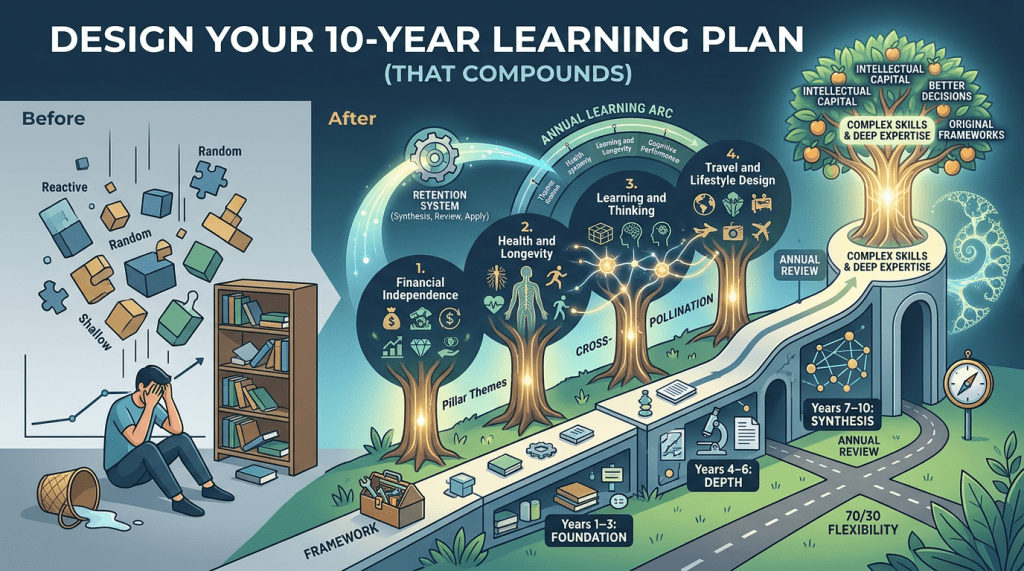
This is the default mode of learning for most adults: reactive, random, and shallow.
But there’s another way — one that mirrors how the best investors think about money. Instead of chasing returns (or insights) one at a time, you build a portfolio. You let compounding do the heavy lifting. You design a system where every new thing you learn makes everything you already know more valuable.
I call this the Compounding Curriculum — a long-term, intentional approach to learning that builds intellectual capital the same way smart investing builds financial capital.
This post is your framework for designing one. Not a rigid syllabus. Not a reading list. A living system that evolves with you over a decade — and pays dividends for the rest of your life.
Why Most Learning Doesn’t Compound
Before we build the plan, let’s understand why most self-directed learning fails to accumulate.
1. No central theme.
Most people read whatever catches their attention. A business book here, a psychology book there, a random biography someone recommended. There’s no throughline. No connective tissue. Each book lives in isolation, so the ideas never cross-pollinate.
2. No retention system.
Learning without a system for retention is like earning money and never investing it. You spend it once (the initial reading), and it’s gone. Without review, synthesis, or application, even brilliant ideas evaporate.
3. No depth progression.
People tend to stay at the introductory level across dozens of topics rather than going deep in a few. They read about psychology but never think psychologically. They consume about economics but never develop economic intuition.
4. No application layer.
The ultimate test of learning isn’t recall — it’s behavior change. If what you learned didn’t change how you think, decide, or act, it didn’t really land. Most people skip this step entirely.
The result? A decade of “learning” that feels impressive on paper but produces surprisingly little transformation.
The Compounding Curriculum fixes all four problems.
The Core Principle: Learning as Investment
Think of your learning like a portfolio.
- Individual books or courses are like individual stocks — they might pay off, or they might not.
- A focused learning theme is like an index fund — broad exposure within a coherent domain.
- Cross-disciplinary connections are like compound interest — they multiply the value of everything in the portfolio.
- Retention and application systems are like reinvesting dividends — they prevent value from leaking out.
The goal isn’t to learn more. It’s to learn in a way where every new input increases the value of all previous inputs.
When you read a book on decision-making after spending a year studying psychology, the decision-making book is exponentially more useful than it would have been in isolation. You see connections others miss. You challenge assumptions others accept. You build mental models that compound.
That’s what a 10-year plan makes possible.
The 10-Year Learning Plan: A Step-by-Step Framework
Step 1: Choose Your 3–5 Pillar Themes
These are the broad domains you want to build deep, interconnected knowledge in over the next decade.
The key criteria:
- Genuine curiosity: You’d explore these even without external rewards.
- Long shelf life: These topics won’t become irrelevant in five years.
- Cross-pollination potential: They interact with and enrich each other.
- Personal relevance: They connect to how you want to live, work, or think.
For example, my pillar themes are:
- Financial independence (wealth, optionality, lifestyle design)
- Health and longevity (nervous system, movement, recovery)
- Learning and thinking (reading systems, mental models, cognitive performance)
- Travel and lifestyle design (slow travel, location independence, cultural exposure)
Notice how these four pillars constantly reinforce each other. Understanding health improves my energy for deep learning. Financial knowledge funds travel. Travel exposes me to new ideas. New ideas reshape my financial strategy. The flywheel spins.
Your pillars don’t need to be the same. But they should talk to each other.
Action step: Write down 3–5 themes you want to spend the next decade mastering. Not topics you “should” learn — topics that genuinely pull you.
Step 2: Map the Depth Progression
Within each pillar, plan a rough trajectory from foundational → intermediate → advanced → synthesis.
Here’s what that looks like:
Years 1–3: Foundation
- Read the 5–10 canonical books in each domain.
- Build a working vocabulary. Understand the key debates.
- Focus on breadth within each pillar.
Years 4–6: Depth
- Go deeper into sub-topics that fascinate you.
- Start reading primary sources, research papers, or technical material.
- Begin forming your own positions and frameworks.
Years 7–10: Synthesis
- Connect ideas across your pillars.
- Develop original thinking that synthesizes multiple domains.
- Teach, write, or create from your integrated understanding.
This isn’t a rigid timeline. You’ll move faster in some areas and slower in others. The point is directionality. You’re not wandering — you’re progressing.
Most people spend a decade stuck at the foundation level across twenty topics. This framework ensures you reach the synthesis level in at least three.
Step 3: Build Annual Learning Arcs
Each year, choose a sub-theme within one or two of your pillars to go deeper on.
Think of these as annual “semesters” in your personal university.
For example:
- Year 1: Foundations of behavioral economics + Zone 2 cardio science
- Year 2: History of financial crises + nervous system regulation
- Year 3: Mental models and decision-making + mobility and longevity
- Year 4: Deep dive into geoarbitrage + cognitive performance
- Year 5: Portfolio theory (applied to life, not just money) + sleep science
Each arc gives you 12 months to read 8–12 books on a focused topic, apply what you learn, and build lasting understanding.
This is dramatically more effective than reading 30 random books a year. Focused learning within a theme creates density — and density is what compounds.
Action step: Choose your learning arc for this year. Pick one sub-theme from your pillars and commit to 6–10 books on it over the next 12 months.
Step 4: Create a Retention System
A 10-year plan without retention is a 10-year forgetting plan.
You don’t need complex apps or tools. You need three things:
1. A synthesis habit.
After finishing a book, write a one-page summary in your own words. Not highlights — synthesis. What did this book argue? What do you agree with? What connects to what you already know? What will you do differently?
2. A review cycle.
Once a quarter, revisit your summaries from the past year. You’ll be surprised how much richer they become when filtered through new knowledge. Ideas that seemed minor six months ago suddenly feel central.
3. An application trigger.
For every book or learning arc, identify one concrete behavior change, decision, or experiment. Learning that doesn’t change behavior is entertainment, not education.
The goal is to build what I think of as a personal knowledge base — not a digital archive, but a living, evolving understanding that you can access and apply in real time.
Step 5: Schedule Cross-Pollination
This is where the magic happens.
Every 6–12 months, deliberately read something that sits at the intersection of two or more of your pillars.
An example:
- A book on urban design that connects to both travel and nervous system health.
- A book on portfolio theory that reshapes how to think about learning allocation.
- A book on evolutionary biology that changes approach to fitness and financial risk.
These cross-pillar books are where breakthrough thinking happens. They’re where you stop consuming ideas and start generating them.
You can also schedule cross-pollination through conversation, writing, or teaching. Explaining a health concept through a financial lens (or vice versa) forces your brain to build new connections.
Action step: Identify one book or topic that sits at the intersection of two of your pillars. Put it on your reading list for the next quarter.
Step 6: Build in Flexibility (The 70/30 Rule)
A common mistake with long-term plans is making them too rigid.
Life changes. Interests evolve. A 10-year plan that doesn’t adapt becomes a cage, not a compass.
My recommendation: 70% planned, 30% spontaneous.
- 70% of your learning follows your pillar themes and annual arcs.
- 30% is open for serendipity — a book a friend recommends, a topic that suddenly becomes relevant, a rabbit hole that calls to you.
The structure provides compounding. The flexibility provides discovery. You need both.
Step 7: Conduct an Annual Review
Once a year sit down and review your learning.
Ask yourself:
- What were my top 3–5 insights this year?
- Which ideas actually changed my behavior or decisions?
- Where did I go deep? Where did I stay shallow?
- What connections did I discover across pillars?
- What do I want to explore next year?
- Am I still drawn to my pillar themes, or is one evolving?
This annual review is the steering mechanism. It keeps your plan alive and responsive. Without it, even the best plan drifts into irrelevance.
What a Compounding Curriculum Looks Like After 10 Years
Imagine it’s 2036. You’ve followed this framework — imperfectly, with detours and distractions, but with consistent directionality.
Here’s what you have:
- Deep expertise in 3–5 interconnected domains.
- A personal knowledge base of hundreds of synthesized ideas, written in your own words.
- Original frameworks that combine concepts from different fields in ways few others can.
- Transformed behavior — not just more knowledge, but better decisions, habits, and instincts.
- Intellectual confidence — the ability to engage with complex topics without feeling like an imposter.
Compare this to the alternative: 10 years of random reading, forgotten insights, and the vague feeling that you’ve “read a lot” without being able to articulate what you actually know.
The difference isn’t talent. It’s architecture.
Common Objections (And Why They Don’t Hold Up)
“Ten years is too long to plan.”
You’re not planning every book. You’re setting a direction. The plan is a compass, not a GPS. It should evolve every year.
“I don’t know what I’ll be interested in five years from now.”
Good. That’s what the 30% flexibility is for. Your pillars will shift. The framework accommodates that. The point is to have some structure, not a perfect one.
“I don’t have time to read that much.”
You don’t need to. 20 minutes a day, focused within a theme, with retention and application, beats two hours a day of scattered reading. Depth beats volume. Always.
“What if I pick the wrong themes?”
There are no wrong themes — only premature ones. If a pillar stops resonating after two years, replace it. The learning you’ve already done doesn’t disappear. It becomes the foundation for whatever comes next.
Start Today: Your Minimum Viable Learning Plan
You don’t need a perfect plan. You need a starting point.
Here’s your homework:
- Write down 3–5 pillar themes that genuinely interest you.
- Choose one sub-theme for this year’s learning arc.
- Pick your first 3 books within that arc.
- After each book, write a one-page synthesis.
- In December, do your first annual review.
That’s it. Five steps. No apps. No complex systems. Just intentional direction applied consistently over time.
The curriculum will evolve. Your interests will shift. Some books will disappoint you, and others will change your life. That’s the process.
The only thing that matters is that a year from now, you can look back and see a thread — not a scattered collection of random inputs, but a coherent body of knowledge that’s starting to compound.
Because the truth about learning is the same as the truth about investing: the best time to start was ten years ago. The second best time is today.
Related Reading
If this post resonated, you might enjoy these related articles from the archive:
- Just-in-Time Learning: Why Timing Matters More Than Volume
- Intellectual Cross-Training: The Benefits of Reading Outside Your Field
- The Reading Flywheel: How to Remember, Apply, and Learn More From Books
- Idea Carrying Capacity: How Many Concepts Can You Actually Use at Once?
- The Learning Bottleneck: Why Smart People Plateau (And How to Break Through)
- Learning Like an Investor: How to Allocate Attention for Long-Term Growth
- Cognitive Friction: Why Some Books Change Your Thinking (and Others Don’t)
- How to Remember More of What You Learn (Using the Forgetting Curve)


Leave a comment