Most people treat their passport as a travel document. A handful of pages that gets stamped at borders and lives in a drawer between trips. But for anyone serious about financial independence, location flexibility, and long-term optionality, your passport is something else entirely.
It’s a financial asset. And like most assets, having only one is a concentration risk.
The Asset You Never Thought to Diversify
You diversify your investment portfolio. You diversify your income streams. You diversify your geographic exposure through geoarbitrage. But almost nobody thinks about diversifying their citizenship.
This is a significant blind spot.
Your passport determines where you can live, work, and retire without bureaucratic friction. It determines your tax obligations in some cases. It determines your access to banking, healthcare, and property ownership across different jurisdictions. It determines how quickly you can relocate if your home country’s political or economic environment deteriorates. And it determines the degree to which a single government’s decisions can constrain your life.
In the language of investing, holding a single citizenship is the equivalent of putting your entire net worth into one stock. It might work out fine. But the concentration risk is real, and the downside scenarios are severe.
This is what sophisticated FIRE (Financial Independence, Retire Early) practitioners and location-independent professionals call passport arbitrage: the strategic acquisition of additional citizenships or residencies to expand your optionality, reduce your vulnerability to single-jurisdiction risk, and multiply the practical dimensions of your freedom.
Let’s build the full picture.
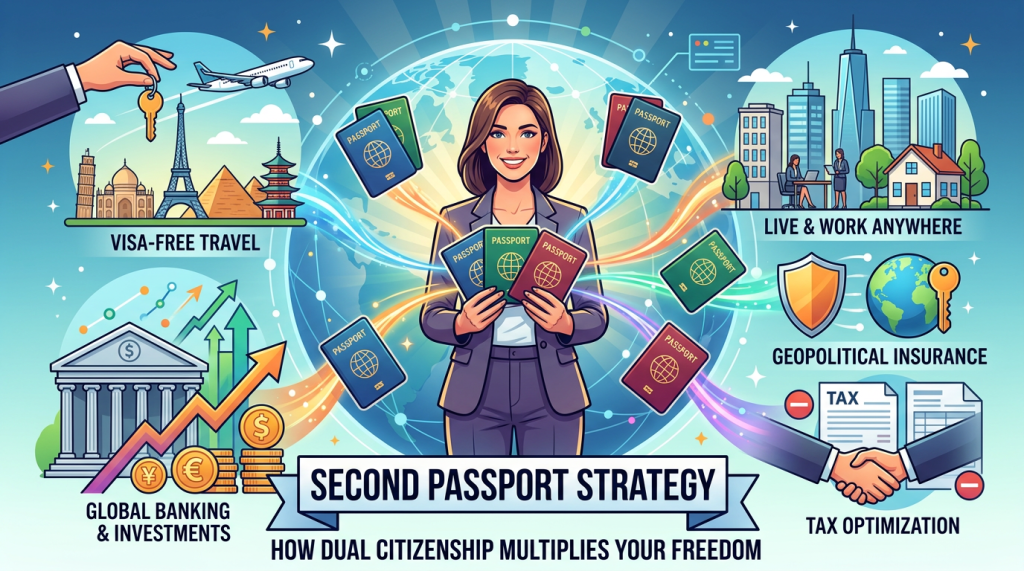
Why your Passport is a Financial Decision
The connection between citizenship and finance is more direct than most people realize.
Taxation is the most obvious link. Citizens of most countries are taxed on their worldwide income regardless of where they live. Americans, for example, must file US taxes even if they’ve lived abroad for decades and earn every dollar outside the United States. This is called citizenship-based taxation, and only two countries in the world practice it: the United States and Eritrea.
For someone pursuing FIRE with international ambitions, this creates a structural drag. Your withdrawal strategy, your investment accounts, your foreign income, all of it remains subject to US tax law no matter where you plant your flag. The only clean exit is renunciation of citizenship, which is a drastic and irreversible step that most people understandably resist.
But for citizens of countries with residence-based taxation, the equation is entirely different. Move abroad, establish tax residency elsewhere, and your home country’s tax authority largely steps aside. This asymmetry in citizenship value is enormous and almost entirely invisible in mainstream FIRE discussions.
Banking and financial access is the second link. A second passport from a well-regarded jurisdiction opens banking relationships that are difficult or impossible to establish with certain passports. It simplifies the process of holding accounts in multiple currencies, which is a meaningful hedge against currency risk for anyone living internationally.
Property and investment access is the third. Some countries restrict foreign property ownership but grant full rights to citizens. A second citizenship can unlock real estate markets, investment vehicles, and business structures that are otherwise inaccessible.
Visa-free travel is the fourth, and most visible. Different passports carry dramatically different levels of global access. The Henley Passport Index ranks passports by the number of destinations their holders can access without a prior visa. The gap between the strongest and weakest passports represents hundreds of countries and the difference between frictionless movement and exhausting bureaucracy.
For someone living a location-independent life, visa-free access to more destinations isn’t a travel luxury. It’s operational infrastructure.
The Four Pathways to a Second Passport
There is no single route to dual citizenship. The right pathway depends on your timeline, budget, ancestry, and specific goals. Here are the four primary mechanisms.
1. Citizenship by Descent
This is the most accessible pathway for many people, and the one that requires the least financial outlay.
If you have grandparents, and in some cases great-grandparents, who were citizens of another country, you may have an automatic legal right to citizenship in that country regardless of where you were born or currently live.
Countries with particularly generous descent policies include Ireland, Italy, Poland, Portugal, Hungary, and several Latin American nations. Italy famously allows citizenship claims through an unlimited generational line on the paternal side, meaning that a great-great-grandchild of an Italian emigrant may still qualify.
The process is primarily documentary: gathering birth certificates, marriage records, and naturalization documents across multiple generations. It can be time-consuming and occasionally frustrating, but the outcome is a full citizenship with no ongoing financial commitment and no residency requirement.
For anyone with European ancestry, this is the single highest-value first step to investigate. A European Union passport is arguably the most powerful second passport available: it grants the right to live and work in 27 countries, access to public healthcare systems, and visa-free entry to over 180 destinations globally.
Timeline: 1 to 5 years depending on country and document availability
Cost: Low to moderate (legal fees, document procurement, translation)
Best for: Anyone with qualifying ancestry, particularly European
2. Citizenship by Naturalization
The traditional pathway. Live in a country legally for a defined period, meet language and integration requirements, and apply for citizenship.
The required residency period varies significantly. Panama offers naturalization after 5 years of legal residency. Portugal after 5 years. Paraguay after 3 years. Some countries offer accelerated pathways for investors or people with special skills.
The strategic version of this pathway involves choosing a country for residency based on its naturalization timeline, lifestyle quality, cost of living, and tax environment simultaneously. Countries like Portugal, Panama, and Georgia have attracted significant FIRE community interest precisely because they offer favorable tax treatment for foreign residents alongside relatively accessible naturalization pathways.
The significant constraint is physical presence. Most naturalization programs require you to spend a minimum number of days per year in the country, which can conflict with a highly nomadic lifestyle. Portugal’s popular Golden Visa program, for example, requires only 7 days per year of physical presence, which is unusually flexible.
Timeline: 3 to 10 years depending on country
Cost: Moderate (residency costs, legal fees, living expenses during the period)
Best for: People willing to establish genuine ties to a specific country
3. Citizenship by Investment
The fastest and most expensive pathway. Several countries offer direct citizenship in exchange for a qualifying investment, typically in real estate, government bonds, or a national development fund.
The Caribbean nations have the most established programs. Saint Kitts and Nevis, which launched the world’s first citizenship by investment program in 1984, Dominica, Grenada, Antigua and Barbuda, and Saint Lucia all offer passports in exchange for investments typically ranging from $100,000 to $200,000.
Grenada’s program is particularly notable for FIRE practitioners because it includes visa-free access to China and, uniquely among Caribbean passports, eligibility for the US E-2 investor visa, which creates a potential pathway for Americans seeking more flexible US access arrangements.
Malta and Jordan offer European and Middle Eastern citizenship by investment respectively, at significantly higher price points, typically $700,000 and above.
The strategic calculation here is not simply the cost of the passport. It’s the value of what the passport unlocks over your remaining lifetime: tax optimization, visa-free access, banking flexibility, geographic optionality, and the ability to pass citizenship to your children.
Timeline: 3 to 12 months
Cost: High ($100,000 to $1,000,000+ depending on program)
Best for: High-net-worth individuals with shorter time horizons and specific strategic goals
4. Citizenship by Marriage or Special Contribution
Marriage to a citizen of another country typically accelerates the naturalization timeline significantly. Many countries reduce the residency requirement to 2 to 3 years for spouses of citizens.
Some countries also offer citizenship to individuals who have made exceptional cultural, scientific, athletic, or economic contributions. These pathways are narrow and largely unpredictable, but worth awareness.
The Residency Layer: A Critical Stepping Stone
It’s important to distinguish between citizenship and residency, because for many people the latter is the more immediately achievable and practically useful first step.
Permanent residency or long-term residency visas grant the right to live and work in a country without requiring citizenship. Many countries offer these through investment, passive income thresholds, or digital nomad visa programs.
Portugal’s NHR (Non-Habitual Resident) tax regime, now transitioning to the IFICI regime, offered favorable flat tax rates on foreign income for ten years. Panama’s Friendly Nations Visa grants permanent residency relatively quickly to citizens of a list of designated countries. Georgia offers a 365-day visa-free stay for most Western passport holders, making it a frictionless base without any formal application process.
For FIRE practitioners, residency in a low-tax or no-tax jurisdiction combined with your home country citizenship is often the most practical near-term configuration. It reduces tax exposure, establishes legal presence in a preferred location, and starts the clock on potential naturalization, all without requiring the full commitment of renunciation.
Think of residency as the first position in a geographic portfolio. Citizenship is the long-term hold.
Building Your Passport Portfolio
The most sophisticated approach to citizenship strategy is to think about it the way you think about investment portfolio construction. Not one asset. Not even two. A deliberate collection of citizenships and residencies designed to provide maximum optionality across different scenarios.
A well-constructed passport portfolio might look like this:
Tier 1: Home citizenship. Your original passport, maintained for cultural connection, family ties, and existing financial infrastructure.
Tier 2: Regional powerhouse citizenship. A European Union passport obtained through descent or naturalization, providing access to 27 countries, strong healthcare, and visa-free global mobility.
Tier 3: Tax-optimized residency. Legal residency in a low-tax jurisdiction like Panama, Georgia, or Paraguay, establishing a legitimate tax base outside high-tax home countries.
Tier 4: Emergency optionality. A Caribbean citizenship by investment passport providing a fast, secure third option in geopolitical stress scenarios and additional visa-free access to specific regions.
Not everyone needs all four tiers. But thinking in tiers clarifies the strategic logic: each additional citizenship or residency adds a dimension of freedom that the previous one doesn’t cover.
The Geopolitical Insurance Argument
Here is the conversation that serious long-term thinkers have that most people consider paranoid until they need it.
A second passport is geopolitical insurance.
History is full of examples of populations whose single citizenship became a trap: exit restrictions imposed during economic crises, capital controls that froze financial assets, political environments that made certain professions or lifestyles untenable, and in extreme cases, safety risks that required rapid relocation.
These scenarios don’t require catastrophizing to take seriously. They simply require acknowledging that a century is a long time and that the political and economic environment of any single country is not guaranteed to remain favorable to your interests indefinitely.
A second passport doesn’t mean you expect disaster. It means you’ve designed a life that doesn’t require a single government’s continued goodwill to remain intact. That’s not pessimism. That’s the same logic that makes you hold an emergency fund, buy insurance, and diversify your investment portfolio.
Financial independence is about having options. A second passport is an option. And like the best options, its value is highest precisely in the scenarios where you most need it.
Practical Starting Points by Profile
If you have European ancestry: Start with a citizenship by descent investigation immediately. Hire a specialist immigration attorney to assess your eligibility. This is the highest-value, lowest-cost pathway available and the most common one that people with qualifying ancestry never pursue simply because they didn’t know it was possible.
If you’re a US citizen pursuing FIRE internationally: Prioritize establishing legal residency in a residence-based tax country as your first step. This doesn’t solve the US worldwide taxation problem entirely, but combined with the Foreign Earned Income Exclusion and Foreign Tax Credits, it significantly reduces the practical tax burden for most FIRE income levels.
If you have a flexible budget and a short timeline: Research Caribbean citizenship by investment programs, particularly Grenada for its unique US E-2 visa eligibility and strong passport strength.
If you’re a long-term slow traveler: Look at Portugal’s Golden Visa or Panama’s Friendly Nations Visa as naturalization pathways that accommodate a nomadic lifestyle without demanding excessive physical presence.
If you’re early in your FIRE journey: Start learning. Citizenship strategy is a long game. Understanding the landscape now means you can make location, investment, and lifestyle decisions that position you for the best pathways later.
The Freedom Multiplier
Here is the core insight that ties all of this together.
Financial independence multiplies your options within a single jurisdiction. A second passport multiplies your options across jurisdictions. The combination of the two is genuinely exponential.
With financial independence alone, you have the money to live anywhere but the legal freedom to live only where your passport allows.
With a strategic passport portfolio alone, you have the legal freedom to live anywhere but the financial dependence that chains you to income-generating locations.
With both, you have what very few people in human history have ever had: the practical, legal, and financial ability to live almost anywhere on earth on your own terms, subject to almost no external constraint that you haven’t chosen to accept.
That is what passport arbitrage actually means. Not a clever financial hack. Not a loophole. A deliberate, legal, long-term strategy for multiplying the most fundamental dimension of freedom: the freedom to choose where and how you live your life.
Your portfolio needs diversification. Your income needs diversification. And your citizenship, the legal foundation on which your entire location-independent life rests, needs diversification too.
The question isn’t whether a second passport is worth pursuing. For anyone serious about long-term freedom, it almost certainly is.
The question is which pathway fits your timeline, your ancestry, your budget, and your vision for the life you’re building.
Start there. The bureaucracy is manageable. The optionality is permanent.
A second passport doesn’t change where you are. It changes what’s possible. And in the long game of financial independence, possibility is the only currency that never depreciates.
Related Reading
If this post resonated, these related posts will deepen your thinking:
- The Geography of FIRE: Best Countries for Early Retirement and Geoarbitrage
- Geoarbitrage 101: Living Well for Less Around the World
- Geographic Flexibility as Wealth: How Location Independence Multiplies Your Income
- Travel Optionality: How to Stay Location-Independent Without Feeling Rootless
- Time Arbitrage: How Flexible Schedules Help You Save More, Spend Less, and Build Wealth
- The Optionality Playbook: Why Financial Independence Is About Better Choices, Not Early Retirement
- Designing a Life That Travels Well: A Framework for Sustainable, Location-Flexible Living
- Financial Independence Without Extremes: A Sustainable Approach to FIRE


Leave a comment