You spent a decade doing everything right. You saved aggressively. You invested consistently. You resisted lifestyle inflation when everyone around you was upgrading their cars and kitchens. You ran the spreadsheets. You hit the number.
And then you woke up the next morning and felt… nothing. Or worse, something uncomfortably close to anxiety.
If that’s you, you’re not broken. You’ve just discovered the Freedom Gap.
The Moment Nobody Talks About
The FIRE (Financial Independence, Retire Early) community is exceptionally good at talking about the journey. The savings rate. The investment strategy. The 4% rule. The sequence of returns risk. The spreadsheets, the milestones, the compounding curves.
What it rarely talks about honestly is what happens after.
Not the logistics of early retirement. Not the safe withdrawal rates or the healthcare costs or the tax optimization strategies. Those have been covered extensively. What rarely gets discussed is the psychological and emotional experience of crossing the finish line and discovering that the finish line wasn’t actually the destination.
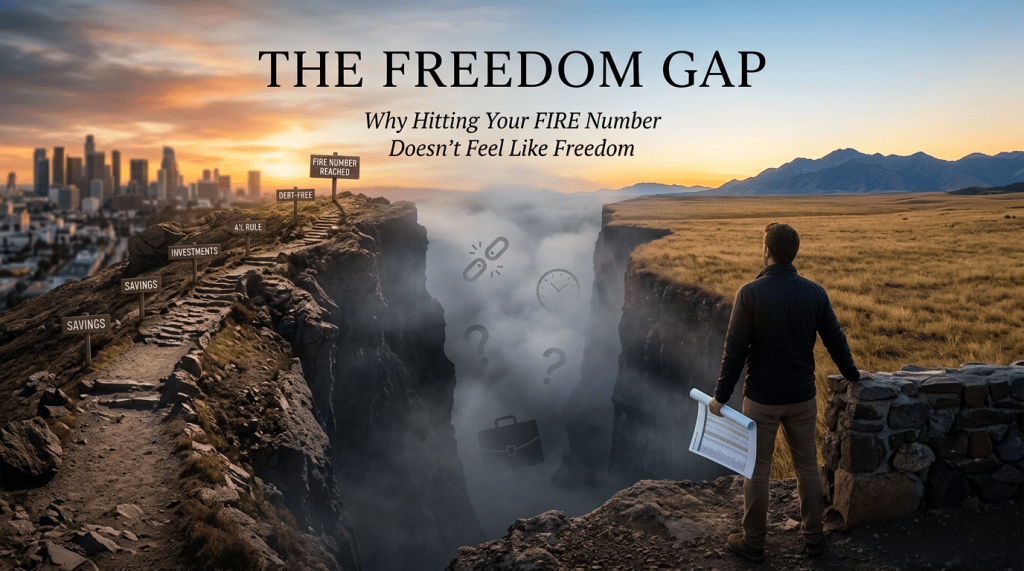
This is the Freedom Gap: the distance between reaching financial independence and actually feeling free.
It is more common than anyone admits. And it is more important to understand than almost anything else in the FIRE conversation, because if you don’t understand it before you get there, it will blindside you completely.
Why the Number Was Never the Real Goal
Let’s start with an honest examination of what the FIRE number actually represents.
Your FIRE number is a mathematical construct. It’s the portfolio size at which your investment returns, assuming a conservative withdrawal rate, can theoretically sustain your expenses indefinitely without you needing to earn another dollar. It’s a threshold of financial sufficiency.
That’s it. That’s all it is.
But somewhere along the decade-long journey to reach it, most people unconsciously load the number with enormous psychological weight. The number stops being a financial milestone and starts being a proxy for everything else they want: autonomy, identity, purpose, peace, belonging, validation.
The number becomes the answer to questions it was never designed to answer.
“When I hit my number, I’ll finally feel secure”. But security is a feeling, not a figure.
“When I hit my number, I’ll have time for what matters”. But time without direction doesn’t automatically fill with meaning.
“When I hit my number, I’ll be free”. But freedom from something is not the same as freedom for something.
This is the first layer of the Freedom Gap. The number solves the financial problem. It was never equipped to solve the existential one.
The Identity Excavation
Here is something that doesn’t appear in any FIRE calculator: for most people, work isn’t just income. It’s identity.
Work provides structure. It provides social connection. It provides a sense of competence and progress. It provides a ready answer to the question “what do you do?” that carries implicit status and belonging. It provides a framework for how time is organized, how days have rhythm, and how effort produces visible results.
When you leave work, whether at 35 or 55, all of that disappears simultaneously.
This is not a small thing. Identity doesn’t dissolve cleanly the moment you submit your resignation. It lingers. It looks for somewhere to attach. And in the absence of a clear answer to “who am I now that I’m not my job”, it generates anxiety, restlessness, and a quiet but persistent feeling that something is wrong.
Many FIRE reachees describe the first months after leaving work as strangely uncomfortable. They feel unproductive despite having complete freedom. They feel guilty for resting. They feel directionless despite having total autonomy. They feel isolated despite having more time for relationships.
These are not signs of ingratitude or weakness. They are the predictable consequences of removing a structure that organized your identity for years, possibly decades, without replacing it with anything.
The FIRE journey is excellent at building a financial portfolio. It is far less focused on building an identity portfolio to fill the space that work leaves behind.
The Hedonic Treadmill Doesn’t Stop
Behavioral economics has a concept called the hedonic treadmill: the observed tendency of humans to return to a relatively stable level of happiness despite major positive or negative life changes.
You get a raise. You feel happy. Then you adapt. The raise becomes the new normal. You need another raise to feel the same happiness.
You buy a house. You feel happy. Then you adapt. The house becomes the new normal.
You hit your FIRE number. You feel happy. Then you adapt.
The treadmill doesn’t stop at financial independence. The anticipatory pleasure of the goal, the imagined freedom, the projected relief, is always more intense than the actual experience of achieving it. This is a feature of human psychology, not a bug in your planning.
Research on lottery winners confirms this at the extreme end. Within 18 months of winning, most report returning to roughly their pre-lottery baseline of happiness. The external change was massive. The internal change was temporary.
This doesn’t mean FIRE isn’t worth pursuing. It absolutely is. But it means pursuing it with the expectation that arriving will feel as good as you’ve imagined it will is a setup for disappointment. The gap between imagined arrival and actual arrival is a core component of the Freedom Gap.
The Structure Collapse
Humans are not designed for unstructured time. We think we are. We spend years fantasizing about having “nothing to do”. But give most people two weeks of genuine, completely unstructured time and observe what happens.
Day one is usually wonderful. Day three starts to feel slightly strange. Day seven, most people are restless, reaching for their phones, looking for projects, manufacturing urgency where none exists.
We are wired for purpose, challenge, and progress. These are not luxuries. They are biological needs. The psychological literature on flourishing, from Martin Seligman’s PERMA model to Viktor Frankl’s logotherapy to Mihaly Csikszentmihalyi’s research on flow, consistently identifies meaning and engagement as non-negotiable components of human wellbeing.
Financial independence removes the financial coercion from your working life. It does not automatically install meaning, challenge, or engagement in its place. That work is entirely separate. And it is work that most FIRE pursuers haven’t done because they were understandably focused on the financial work for so long.
The structure collapse after FIRE is often what triggers the identity crisis. Without the imposed structure of work, you suddenly have to design your own. And designing a meaningful life from scratch, with no external pressure and no deadline, is far harder than it sounds.
The Comparison Problem Inverts
During the accumulation phase, FIRE practitioners typically develop a useful psychological superpower: immunity to keeping up with the Joneses. You stop caring that your colleague drives a newer car. You stop feeling the pull of the bigger house. Your comparison set shrinks to your past self and your future vision.
But after FIRE, the comparison problem doesn’t disappear. It inverts.
Now the comparisons run in the opposite direction. Your peers are still building careers, earning promotions, gaining status, contributing to visible projects. And you’re… what exactly? Traveling? Reading? Walking? These activities sound wonderful in theory. In practice, when surrounded by high-achieving peers who are still in full career acceleration, they can feel uncomfortably close to irrelevance.
This is particularly acute for people who reached FIRE in their 30s or early 40s. You’re biologically and cognitively at your peak. You have more energy, clarity, and capability than you’ll have at 65. And you’re “retired”. The word itself carries a cultural weight that doesn’t fit. You’re not retired. You’re liberated. But the language hasn’t caught up. And until your internal narrative catches up, the social friction is real.
The Relationship Recalibration
FIRE rarely happens in a social vacuum. You have friends, family, a partner perhaps, a social ecosystem built over years. And most of that ecosystem was built around shared context: shared work stress, shared financial anxieties, shared weekend complaints about Monday morning.
When you exit that context, relationships shift in unexpected ways.
Some friends don’t know how to relate to your new life. Some feel a subtle envy that creates distance. Some simply disappear, because more of the relationship than you realized was built on shared context rather than genuine connection. Meanwhile, you’re trying to build new relationships with people who share your new life, which takes time, effort, and the willingness to be a beginner again socially.
Your relationship with your partner, if you have one, also changes. Suddenly you are both navigating dramatically increased togetherness without the natural break that work provides. Roles that were clear become ambiguous. Expectations that were implicit become urgent. The relationship that survived a decade of FIRE accumulation now has to survive FIRE itself, which is a different test entirely.
None of this is insurmountable. But none of it appears on the FIRE spreadsheet.
Closing the Freedom Gap
Understanding the Freedom Gap is not an argument against pursuing FIRE. It’s an argument for pursuing it more completely.
Financial independence is necessary but not sufficient. It solves the money problem, which is a real and significant problem worth solving. But it leaves several other problems untouched, problems that require their own dedicated attention, ideally before you arrive.
Here is how to close the gap.
Design the Life Before You Leave the Job
Don’t wait until after you’ve left work to figure out what you’re building toward. The question “what will I do with my freedom?” needs serious, sustained attention years before you hit your number. Not activities. Architecture. What does a meaningful day look like? What problems do you want to engage with? What relationships do you want to deepen? What skills do you want to develop? What contribution do you want to make?
The more clearly you can answer these questions before you arrive, the narrower the Freedom Gap.
Build Identity Outside Work Now
If your entire identity is housed in your professional role, FIRE will feel like eviction. Start now, while still employed, to invest in identities that aren’t tied to income. A serious pursuit. A creative practice. A community you contribute to. A physical discipline. A learning project. These need to be substantial enough to carry real identity weight, not hobbies but pillars.
Embrace the Transition as Its Own Phase
The period immediately after hitting your FIRE number is not early retirement. It’s a transition phase, and transitions have their own rules. Give yourself explicit permission to feel disoriented. Don’t mistake the disorientation for failure. Expect a recalibration period of six to twelve months where the new life is being built rather than lived.
Rebuild Structure Deliberately
Freedom without structure is not freedom. It’s entropy. Design a weekly architecture that includes challenge, contribution, learning, movement, and connection. Not rigidly, but intentionally. The structure you build for yourself should be lighter and more flexible than work imposed, but it needs to exist.
Separate Financial Freedom from Life Meaning
FIRE gets you out of financial coercion. It does not hand you a meaningful life. Those are separate projects. The sooner you treat them as separate, each deserving serious thought and active design, the sooner you’ll close the gap between financial independence and genuine freedom.
The Gap is the Work
Here’s the reframe that changes everything.
The Freedom Gap isn’t a sign that you did FIRE wrong. It isn’t evidence that the journey wasn’t worth it. It isn’t a reason to go back to work or to conclude that financial independence is overrated.
It’s simply the next layer of the project.
FIRE is not the end of the work. It’s the beginning of the most important work: designing a life that is genuinely yours. Not inherited from your employer, not structured by financial necessity, not shaped by what other people expect of you.
That work is harder than saving and investing. It requires a different kind of courage. Not the courage to defer gratification, but the courage to define what you actually want when there are no external constraints forcing the answer.
Most people never get the chance to do this work. Financial independence gives you that chance.
The Freedom Gap is the space between the life you escaped and the life you’re building. It’s uncomfortable by design. And crossing it is the point.
Hitting your FIRE number is the end of one story. The Freedom Gap is the beginning of a better one. The only question is how deliberately you choose to write it.
Related Reading
If this post resonated, these related posts will deepen your thinking:
- Life After Financial Independence: How to Navigate the Identity Crisis When Work No Longer Defines You
- The Psychology of Enough: How to Redefine Wealth Beyond Money
- Why Financial Independence Is Really About Slack (Not Early Retirement)
- The Optionality Playbook: Why Financial Independence Is About Better Choices, Not Early Retirement
- Escaping Golden Handcuffs: When to Pivot to FIRE
- Financial Independence Without Extremes: A Sustainable Approach to FIRE
- Financial Independence is a Skill, Not a Number
- The Boring Middle of FIRE: How to Stay Consistent While Compounding Works


Leave a comment