You’ve read 50 book summaries this year. You feel productive. You feel well-read. But ask yourself: can you recall five key ideas from any of them right now?
If the answer is no, you’re not alone. And the problem isn’t your memory. It’s the medium.
The Rise of the Summary Culture
We live in an era of intellectual fast food.
Blinkist. Shortform. YouTube explainers. Twitter threads that promise to distill 300 pages into 12 tweets. The pitch is seductive: why spend 10 hours reading a book when you can get the “key takeaways” in 15 minutes?
On the surface, it sounds efficient. It sounds like optimization. It sounds like something a smart, time-conscious person would do.
And that’s exactly why it’s dangerous.
Because book summaries don’t just fail to replace reading. They actively create an illusion of knowledge that prevents you from doing the real cognitive work that changes how you think, decide, and live.
Let me explain why.
The Illusion of Learning
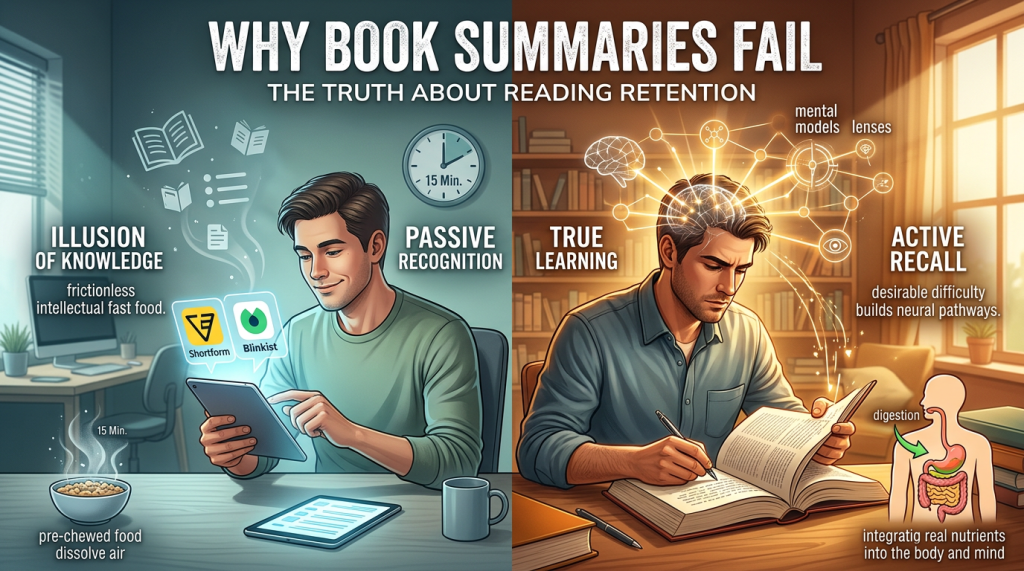
There’s a well-documented phenomenon in cognitive science called the illusion of fluency. It works like this: when information feels easy to process, your brain assumes it has been learned. Smooth text. Clean bullet points. Familiar concepts presented in digestible bites. Your brain says, “Got it. I know this”.
But you don’t.
What actually happened is that you recognized the information. You didn’t encode it. Recognition and recall are fundamentally different cognitive processes. Recognition is passive. It says, “I’ve seen this before.” Recall is active. It says, “I can retrieve this, use it, and apply it in a new context.”
Book summaries are engineered for recognition. They strip away the friction, the narrative, the examples, the context, and the argumentation. They hand you the conclusion without the journey. And your brain, being the efficiency machine it is, files it under “known” and moves on.
The result? You walk away feeling informed. But when life presents you with a situation where that knowledge would be useful, there’s nothing there. The shelf is empty. The file is corrupt.
You consumed the information. But you never metabolized it.
Why Friction Is the Point
Here’s something counterintuitive: the parts of a book that feel slow, redundant, or even boring are often the parts doing the most important work.
When an author spends three pages on a single example, your brain is being forced to sit with an idea. To turn it over. To connect it to what you already know. When you struggle through a dense paragraph and have to re-read it twice, that struggle is literally building neural pathways.
Cognitive scientists call this desirable difficulty. The harder your brain works to process information, the deeper and more durable the encoding. It’s the same principle behind why handwriting notes beats typing, why testing yourself beats re-reading, and why teaching a concept cements it more than hearing it.
Book summaries eliminate desirable difficulty entirely.
They take a 300-page argument and reduce it to a frictionless list. No struggle. No confusion. No “wait, I need to think about that”. Just smooth, clean, effortless consumption.
And effortless consumption produces effortless forgetting.
Think of it this way. If you’re trying to build muscle, you don’t lift the lightest weight possible for the shortest time. You need resistance. You need tension. You need the rep to be hard enough that your body is forced to adapt.
Reading works the same way. The cognitive “weight” of a full book, the length, the complexity, the occasional boredom, is what forces your brain to adapt, reorganize, and grow. A summary is like watching someone else lift the weight and then telling yourself you got stronger.
The Context Problem
Books are not collections of ideas. They are arguments.
A great non-fiction book doesn’t just present conclusions. It builds a case. It introduces a problem, examines evidence, considers counterarguments, tells stories, provides nuance, and then arrives at a synthesis. The conclusion only makes sense, only has weight, because of everything that came before it.
When you read a summary, you get the conclusion without the case. You get the “what” without the “why” or “how”. And without the underlying reasoning, the idea has no roots. It can’t withstand scrutiny. It can’t be applied flexibly to new situations. It’s just a floating factoid that sounds smart at a dinner party but collapses under the first follow-up question.
Consider a book like Nassim Taleb’s Antifragile. A summary might tell you: “Some systems benefit from disorder”. That’s the takeaway. But reading the full book gives you dozens of examples across biology, finance, medicine, and philosophy. It gives you mental models. It gives you the vocabulary to see antifragility in your own life, in your health routine, in your FIRE (Financial Independence, Retire Early) strategy, in your travel decisions.
The summary gives you a label. The book gives you a lens.
And lenses are what change behavior. Labels don’t.
The Dopamine Trap
There’s another insidious problem with summaries: they feel productive.
Every time you finish a 15-minute summary, you get a small dopamine hit. Done. Another book “read”. Your Goodreads counter goes up. Your mental tally of “books consumed this year” grows. You feel like you’re learning at an accelerated rate.
But this is the same trap that makes people confuse being busy with being effective. Quantity of input is not quality of output. Reading 50 summaries and retaining nothing is objectively worse than reading 5 full books and deeply integrating their ideas into your thinking and behavior.
The dopamine hit of “finishing” a summary is actually training your brain to prefer shallow engagement. It’s conditioning you to seek completion over comprehension. And over time, this erodes your ability to sit with long, complex material, which is the very skill that separates deep thinkers from surface-level consumers.
You’re not building a knowledge base. You’re building an addiction to the feeling of learning without the substance of it.
What Actually Drives Retention
If summaries don’t work, what does? Decades of cognitive science point to a few clear principles.
1. Elaborative Encoding
This means connecting new information to what you already know. When you read a full book, this happens naturally. You think, “This reminds me of…” or “This contradicts what I read in…” or “I experienced something like this when…” These connections are the hooks that make information stick.
Summaries don’t give your brain enough material to form these connections. The ideas are too compressed, too isolated, too clean.
2. Spaced Repetition
Retention improves dramatically when you revisit ideas over time. A book you read over two weeks naturally creates spaced exposure. You think about yesterday’s chapter while reading today’s. You sleep on ideas. You let them marinate.
A 15-minute summary is a single exposure. One and done. By tomorrow, the forgetting curve has already erased most of it.
3. Active Processing
Highlighting, writing marginalia, arguing with the author in your head, stopping to think, journaling about a chapter, explaining an idea to someone else. These are forms of active processing, and they are the single strongest predictor of long-term retention.
Summaries encourage passive consumption. You scroll. You nod. You move on. There’s no space for active engagement because there’s no substance to engage with.
4. Emotional Engagement
We remember what moves us. A powerful story in chapter seven. A metaphor that stopped you cold. A moment where you felt the author was speaking directly to your life. These emotional markers act as memory anchors.
Summaries strip out narrative, emotion, and story. They keep the skeleton and discard the flesh. But it’s the flesh that makes ideas memorable.
The Pre-Chewed Food Metaphor
Here’s the analogy that makes this click.
Think of a book summary as pre-chewed food. Someone else has done the chewing, the breaking down, the processing. They hand you something soft and easy to swallow.
But digestion doesn’t work that way. Your body, like your brain, needs to do its own processing to extract nutrients. The mechanical act of chewing triggers enzymes. The process of breaking down food is part of how nutrients get absorbed.
When someone else chews your food, you might swallow it, but you won’t absorb much. And over time, your jaw muscles atrophy. You lose the ability to chew at all.
This is what happens with chronic summary consumption. You lose the ability to read deeply. Your attention span shortens. Complex arguments start to feel “too long”. You become cognitively dependent on someone else’s processing.
You’ve outsourced your thinking. And thinking, unlike money, cannot be outsourced without losing the benefit entirely.
When Summaries Are Actually Useful
I’m not saying summaries have zero value. They do, but only in specific, limited contexts.
As a preview: Reading a summary before reading the full book can actually help. It creates a cognitive scaffold, a framework that helps you organize information as you encounter it. Think of it as reading the table of contents in detail.
As a filter: Summaries can help you decide whether a book is worth your time. If the summary’s core argument doesn’t interest you, you’ve saved yourself 10 hours. That’s genuine efficiency.
As a refresher: If you’ve already read the full book and want to revisit the key ideas months later, a summary can serve as a memory trigger. But only because the deep encoding already happened.
The problem isn’t summaries themselves. It’s using summaries as a replacement for reading. It’s treating the map as if it were the territory.
A Better Approach to Reading
If you genuinely want to retain what you read and turn books into lasting change, here’s a simple framework.
Read fewer books, but read them fully. Five deeply read books per year will transform your thinking more than 50 summaries. Quality of engagement beats quantity of exposure every single time.
Read with a pen. Write in the margins. Underline. Argue. Ask questions. The physical act of marking a book forces active processing and creates a personal layer of meaning.
Let books breathe. Don’t rush to the next one. Spend a few days after finishing a book just thinking about it. Journal about it. Talk about it. Let the ideas settle before you bury them under new input.
Re-read the greats. A book that changed your thinking deserves a second read. You’ll notice different things because you’ve changed since the first reading. This is where compound learning happens.
Apply before you consume more. Before picking up the next book, ask: “What did I change in my life because of the last one?” If the answer is nothing, you don’t need more books. You need more action.
The Compound Effect of Deep Reading
Here’s what most people miss: reading deeply isn’t slower. It’s faster.
When you deeply encode ideas from five books, those ideas become permanent mental models. They become lenses you carry forever. Every new book you read after that is easier to integrate because you have more hooks to hang new information on. Your comprehension accelerates. Your retention improves. Your ability to synthesize across domains, health, finance, travel, psychology, grows exponentially.
This is the compound effect of deep reading. Like compound interest in your FIRE portfolio, the returns are back-loaded. The first few deeply read books feel slow. By book 20, you’re making connections most people never see.
Summaries don’t compound. They’re isolated deposits that evaporate. Deep reading builds an intellectual portfolio that grows forever.
The Bottom Line
Book summaries feel like learning. But feeling is not the same as doing.
Real learning requires friction. It requires time. It requires struggle, confusion, boredom, and breakthrough. It requires you to do the cognitive work yourself, not outsource it to someone with a bullet-point template.
The next time you’re tempted to “read” a book in 15 minutes, ask yourself: am I learning, or am I performing the ritual of learning? Am I building knowledge, or am I collecting the appearance of it?
Your brain doesn’t need more information. It needs deeper engagement with less.
Read fewer books. Read them fully. Think about them longer. And watch how your thinking, your decisions, and your life begin to change in ways that no summary could ever deliver.
The best investment you can make isn’t in more books. It’s in reading the ones you have more carefully.
Related Reading
If this post resonated, you’ll find these related posts valuable:
- Cognitive Friction: Why Some Books Change Your Thinking (and Others Don’t)
- How to Read Critically: Why Disagreeing With Books Makes You a Smarter Reader
- The Reading Afterlife: What to Do After You Finish a Book to Remember and Apply It
- How to Remember More of What You Learn (Using the Forgetting Curve)
- Why Smart Readers Still Don’t Change: How to Apply What You Read
- How to Turn What You Read Into Real Behavior Change (That Actually Sticks)
- Idea Carrying Capacity: How Many Concepts Can You Actually Use at Once?
- The Compound Effect of Reading: How 20 Minutes a Day Changes a Life


Leave a comment