There’s a quiet rebellion happening among serious learners.
In a world obsessed with Kindle libraries, read-it-later apps, and AI-generated summaries, a growing number of thoughtful people are doing something almost contrarian: they’re going back to paper.
Not out of nostalgia. Not because they hate technology. But because they’ve noticed something that science is now confirming — reading on paper changes how you think, remember, and apply what you learn.
I noticed it myself a few years ago. I had hundreds of highlights across my Kindle library. Dozens of saved articles in Instapaper. Notes scattered across Notion databases. And yet, when someone asked me about a book I’d “read” six months earlier, I could barely recall the core argument — let alone explain how it changed my thinking.
Then I picked up a physical copy of the same book. I read it slowly. I wrote in the margins. I dog-eared pages. And something shifted. The ideas stuck. Not because I tried harder. But because the medium itself changed how my brain engaged with the material.
This isn’t just my experience. It’s backed by a growing body of research. And if you care about learning — truly learning, not just consuming — it’s worth understanding why paper still wins.
The Science: What Happens When You Read on Paper vs Screens
The most cited research on this topic comes from a 2014 study by Anne Mangen at the University of Stavanger in Norway. She gave two groups of readers the same short story — one group on a Kindle, the other on paper. Afterward, the paper readers scored significantly higher on plot reconstruction and chronological ordering of events.
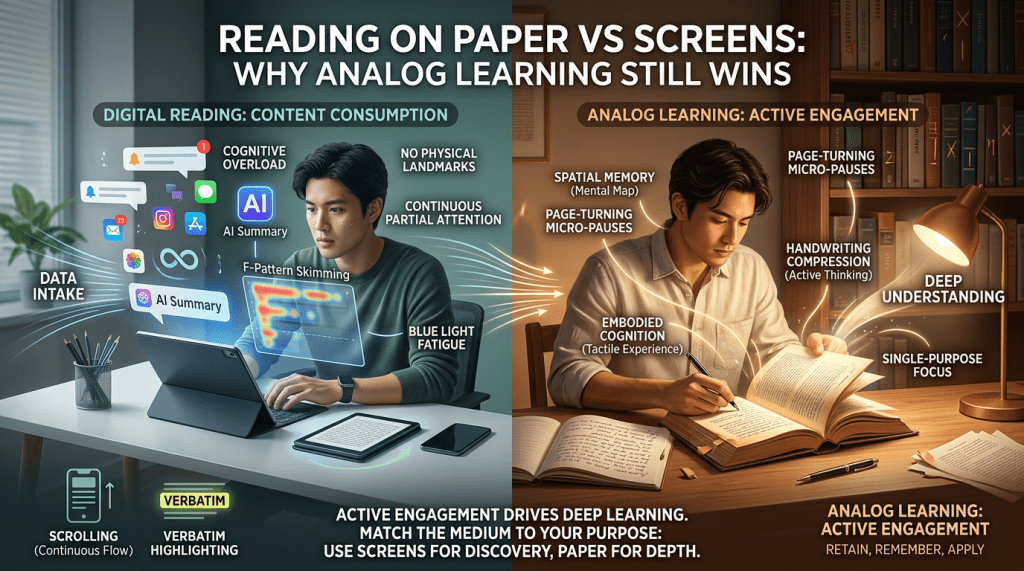
Why? Mangen’s explanation centers on something called spatial memory. When you read a physical book, your brain creates a mental map of the text. You remember that a key idea was near the top of a left-hand page, about a third of the way through. You can feel how much of the book remains. Your fingers, your eyes, and your spatial awareness all work together to anchor the information in your memory.
On a screen, that spatial context collapses. Every page looks the same. There’s no thickness to gauge progress. No physical landmark to anchor a concept. The text becomes a stream — and streams are harder to remember than landscapes.
A 2018 meta-analysis published in Educational Research Review examined 54 studies with over 170,000 participants. The conclusion was clear: reading on paper led to better comprehension than reading on screens, particularly for informational (non-fiction) texts and when readers were under time pressure.
This isn’t a small effect. And it’s not limited to one age group or one type of content. The pattern is consistent: paper readers understand more, remember more, and integrate more of what they read.
Why Screens Sabotage Deep Reading
It’s not just about spatial memory. Screens introduce a cluster of subtle problems that, together, degrade the quality of your reading.
1. Cognitive Overload from the Medium Itself
A screen is never just a reading device. It’s also a notification center, a browser, a messaging platform, and an infinite scroll machine. Even when you turn off notifications, your brain knows what the device can do. This creates what researchers call continuous partial attention — a low-grade cognitive tax that runs in the background while you read.
Paper doesn’t have this problem. A book is a single-purpose object. When you pick one up, your brain receives an unambiguous signal: we are reading now. That clarity of purpose matters more than most people realize.
2. The Scroll vs. the Turn
Scrolling is a fundamentally different motor action than turning a page. Page-turning creates micro-pauses — tiny moments of transition that give your brain space to process what it just absorbed. Scrolling, by contrast, creates a continuous flow that encourages skimming.
Research from the Nielsen Norman Group has shown that people read in an F-pattern on screens — scanning the first few lines, then skimming down the left side. On paper, reading patterns are more linear and complete. You’re more likely to read every word, follow the author’s full argument, and sit with a paragraph before moving on.
3. Blue Light and Eye Fatigue
This one is physiological. Screens emit blue light that suppresses melatonin production, strains the eyes, and triggers fatigue faster than reflected light from paper. If you’re reading at night — which many of us do — screen reading actively disrupts the sleep that consolidates what you’ve learned.
Paper books, especially in warm lamplight, don’t carry this cost. You can read for longer, with less fatigue, and your sleep quality remains intact.
The Handwriting Advantage: Why Writing by Hand Compounds Learning
The paper advantage extends beyond reading. It includes how you take notes.
A landmark 2014 study by Mueller and Oppenheimer — often called The Pen Is Mightier Than The Keyboard — found that students who took handwritten notes outperformed laptop note-takers on conceptual understanding, even though laptop users captured more words.
The reason is simple but powerful: handwriting forces compression. You can’t write as fast as you can type, so your brain has to do real-time processing — deciding what matters, summarizing, paraphrasing. That act of compression is learning.
Typing, by contrast, encourages verbatim transcription. The words pass from ear to fingers without engaging the deeper processing networks. You feel productive, but you’re functioning more like a court reporter than a learner.
When I shifted from digital highlighting to writing margin notes by hand, the change was immediate. I started arguing with authors in the margins. I started connecting ideas across chapters. I started thinking while reading, rather than passively absorbing.
This is the real unlock: paper forces active engagement. And active engagement is the single strongest predictor of retention and application.
The Tactile Dimension: Why Your Body Helps You Learn
There’s a concept in cognitive science called embodied cognition — the idea that thinking isn’t just something that happens in your brain. Your body participates. The weight of a book in your hands, the texture of the pages, the act of physically turning them — these aren’t irrelevant details. They’re part of how your brain encodes and retrieves information.
Think about it: you can probably remember the feel of certain books. The thick, creamy pages of a hardcover you loved. The flimsy paperback you read on a beach. The coffee stain on page 47. These sensory details create richer memory traces — more hooks for your brain to grab when trying to recall an idea later.
Digital reading strips away this sensory layer. The experience of reading on a Kindle is identical whether you’re reading Marcus Aurelius or a celebrity memoir. Every book feels the same. And when every book feels the same, every book is easier to forget.
When Screens Do Win (And How to Use Them Wisely)
I’m not arguing that you should abandon digital reading entirely. Screens have real advantages:
- Portability: Carrying 50 books on a single device matters, especially for travelers
- Searchability: Finding a specific passage is instant on a Kindle
- Accessibility: Adjustable font sizes, built-in dictionaries, and text-to-speech serve real needs
- Discovery: Digital platforms make it easy to sample, preview, and explore widely
The key is to match the medium to the purpose.
Here’s a simple framework I use:
| Purpose | Best Medium |
|---|---|
| Deep reading for retention | Paper |
| Exploring a new topic broadly | Screen / ebook |
| Rereading a favorite book | Paper |
| Reference lookup | Screen |
| Reading before bed | Paper (always) |
| Travel reading | Screen for convenience, paper for depth |
| Note-taking and reflection | Paper (handwritten) |
The principle is straightforward: use screens for discovery and convenience, use paper for depth and retention.
Building a Paper-First Learning System
If you want to shift toward analog learning without going full Luddite, here’s a practical system that works:
Step 1: Buy Physical Copies of Books That Matter
Not every book deserves a physical copy. But books you want to deeply understand, reference repeatedly, or be changed by — those should be on paper. Think of it as an investment in comprehension, not just a purchase.
Step 2: Read with a Pen, Not a Highlighter
Highlighting is passive. Writing is active. In the margins, write:
- Your reactions (“This contradicts what Taleb says”)
- Questions (“But what about X?”)
- Connections (“Links to the compounding idea in Chapter 2”)
- One-line summaries of key paragraphs
This transforms reading from consumption into conversation.
Step 3: Keep a Paper Reading Journal
After each reading session, spend 5 minutes writing — by hand — the key ideas in your own words. Don’t copy. Translate. This is where the Mueller and Oppenheimer effect kicks in: the compression forces understanding.
Step 4: Create a Physical “Active Shelf”
Keep your current reads and recent finishes visible. Not in a digital library you never open — on a shelf you see every day. Physical visibility creates mental availability. You’ll revisit ideas more often, recommend books more naturally, and build connections between books more intuitively.
Step 5: Schedule Analog Reading Time
Block time specifically for paper reading — ideally in the morning or early evening, away from screens. Even 30 minutes of focused paper reading will outperform two hours of distracted screen reading in terms of retention and insight.
The Deeper Argument: Analog as Resistance
There’s a philosophical dimension here that goes beyond retention scores.
We live in an environment designed to fragment attention. Every app, every platform, every notification is competing for a slice of your cognitive bandwidth. In this context, choosing paper isn’t just a learning strategy — it’s an act of resistance.
When you sit down with a physical book, you’re making a statement: this hour belongs to one thing. You’re training the capacity for sustained attention that modern life is systematically eroding. You’re choosing depth over breadth, understanding over exposure, thinking over scrolling.
This matters beyond reading. The ability to focus deeply on one thing for an extended period is becoming the scarcest — and most valuable — cognitive skill of our time. Paper reading is one of the simplest ways to train it.
The Compound Effect of Paper Learning
Like most things worth doing, the benefits of analog learning compound over time.
In the first week, you might not notice much difference. But over months and years, paper readers build something that screen readers often don’t: a personal intellectual infrastructure. A shelf of marked-up books. A journal of connected ideas. A physical record of how their thinking has evolved.
This infrastructure becomes a thinking tool in itself. When you’re wrestling with a new problem, you can pull a book off the shelf and find your own marginalia — your past self in conversation with an author. That’s not something a Kindle highlight can replicate.
Over time, this creates a flywheel: better reading leads to better thinking, which leads to better questions, which leads to better book selection, which leads to even better reading. The medium isn’t neutral in this process. Paper, with its physicality, its friction, and its demands on your attention, is the better engine for this flywheel.
A Final Thought: The Medium is the Message
Marshall McLuhan famously said, “The medium is the message”. He meant that the channel through which information arrives shapes the information itself — how it’s received, processed, and understood.
Reading on a screen says: this is content to be consumed.
Reading on paper says: this is an idea to be engaged with.
The difference is subtle. But over a lifetime of reading, it’s the difference between someone who has read a thousand books and someone who has been changed by a hundred.
Choose paper. Not for every read. But for every read that matters.
Related Reading
If this post resonated, you might also enjoy these:
- The Compound Effect of Reading: How 20 Minutes a Day Changes a Life — Why small, consistent reading sessions create outsized results over time.
- How to Read Critically: Why Disagreeing With Books Makes You a Smarter Reader — A framework for active reading that transforms passive consumption into genuine thinking.
- Cognitive Friction: Why Some Books Change Your Thinking (and Others Don’t) — What separates books that challenge you from books that merely confirm what you already believe.
- How to Turn What You Read Into Real Behavior Change (That Actually Sticks) — Closing the gap between reading and doing.
- The Reading Afterlife: What to Do After You Finish a Book to Remember and Apply It — A practical post-reading system for retention and application.
- Cognitive Nutrition: Why Information Quality Matters More Than Quantity — Why curating what you read matters as much as how you read it.
- How to Build a Second Brain with What You Read (No Apps Needed) — An analog-friendly system for organizing and retrieving what you learn.
- Digital Posture: How Screens Reshape Your Body (and How to Fix It Fast) — The physical cost of screen-based living and simple corrections.
If you enjoyed this, consider sharing it with a fellow reader who’s drowning in digital highlights but struggling to remember what they’ve read. Sometimes the simplest upgrade is the oldest one.


Leave a comment