Most people think travel changes what you see.
What it really changes is what you notice.
A different city, country, language, climate, or social rhythm does more than provide novelty. It quietly alters your perception, assumptions, emotional state, habits, priorities, and even your sense of identity. The effect is subtle at first. Then one day you return home and realize your mind no longer fits the same way it used to.
This is one of the most underestimated benefits of spending time in unfamiliar environments.
Not because travel magically makes people wiser. Often it doesn’t. Plenty of people move through twenty countries without changing internally at all. But when you spend enough time outside familiar patterns — especially slowly and intentionally — your thinking starts reorganizing itself.
You begin questioning things that previously felt invisible.
Why do people in one city walk more slowly?
Why does your stress level change in certain places?
Why do some cultures prioritize community while others optimize convenience?
Why does your energy improve when your environment changes?
Why do some places make you feel expansive while others make you feel contracted?
New environments expose the hidden architecture of your mind.
And once you see it, you can’t fully unsee it.
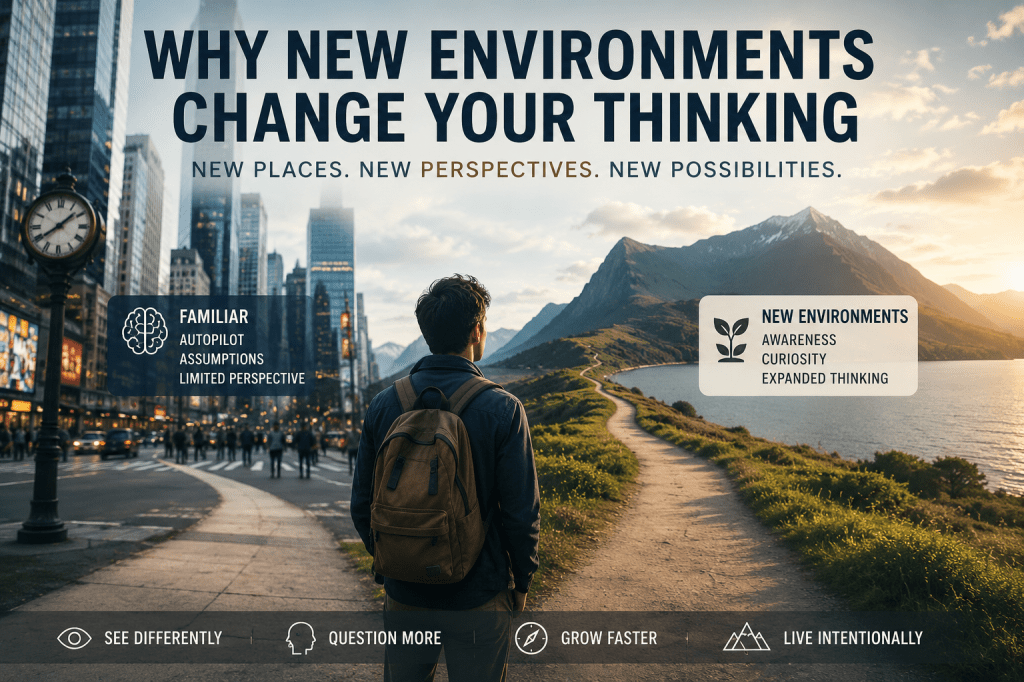
Your Brain Automates Familiar Environments
The human brain is fundamentally predictive.
Once you spend enough time in the same environment, your nervous system starts conserving energy by automating perception. You stop consciously noticing most things around you because your brain already knows what to expect.
The same commute.
The same grocery store.
The same social expectations.
The same routines.
The same conversations.
The same problems.
Familiarity creates efficiency. But it also creates blindness.
You stop examining your habits because they become normal. You stop questioning your environment because it becomes background noise. Your assumptions harden into default settings.
This is one reason people often feel mentally stagnant without understanding why.
Their environment stopped generating friction.
And friction matters because friction forces awareness.
The moment you enter a new environment, prediction errors appear everywhere. Suddenly your brain has to pay attention again.
You notice:
- how people interact
- how public spaces are designed
- how work culture differs
- how food affects your body
- how your energy changes
- how silence feels
- how time is experienced differently
Novelty increases cognitive engagement. Your perception sharpens because your brain can no longer operate entirely on autopilot.
This is why even short trips often feel psychologically longer than routine weeks at home. Your brain records more detail when environments are unfamiliar.
New environments increase the density of conscious experience.
Environment Shapes Identity More Than Most People Realize
People like to think identity is internally constructed.
In reality, much of it is environmental.
Your routines, opinions, stress levels, ambitions, and even personality traits are heavily influenced by the systems surrounding you.
The city you live in affects:
- how much you walk
- how late you stay awake
- how much money you spend
- how social you become
- how often you experience nature
- how ambitious you feel
- how distracted you are
- how healthy your habits become
Your environment silently trains behavior.
A person living in a walkable city behaves differently from someone dependent on cars. Someone surrounded by consumer culture thinks differently from someone living in a minimalist environment. A calm coastal town affects the nervous system differently than a high-intensity financial district.
What feels like “personality” is often adaptation.
This becomes obvious once you spend enough time in different places.
You may discover:
- you are calmer than you thought
- or more anxious than you realized
- more introverted in certain environments
- more creative in others
- more disciplined when surrounded by slower rhythms
- more energized when nature is accessible
The environment acts like a mirror that reveals hidden traits.
Many people spend their entire lives assuming their current emotional baseline is their permanent personality, when in reality it may simply be environmental conditioning.
Changing environments exposes that possibility.
New Places Interrupt Automatic Thinking
Most thinking is repetitive.
People recycle the same concerns, narratives, assumptions, and mental loops for years because their surroundings constantly reinforce them.
New environments disrupt this reinforcement cycle.
When familiar inputs disappear, your thinking becomes less rigid.
You are no longer anchored to:
- your usual social role
- your professional identity
- your routine stressors
- your existing reputation
- your habitual schedule
This creates psychological space.
Space matters because insight rarely emerges during constant cognitive compression. It appears when the mind has enough distance to reorganize itself.
This is one reason long walks in unfamiliar cities often trigger reflection. Your mind becomes more associative and open-ended when environmental patterns shift.
Many people experience some version of this during travel:
- sudden clarity about relationships
- new career perspectives
- creative ideas
- reassessment of priorities
- recognition of unhealthy habits
- awareness of burnout
- a desire for simplicity
The environment didn’t “create” those insights. It created the conditions where suppressed thoughts could finally surface.
Modern life often overloads attention so heavily that people lose access to deeper reflection.
New environments weaken that overload temporarily.
Different Cultures Reveal That “Normal” Is Relative
One of the most powerful cognitive effects of travel is realizing how arbitrary many social norms are.
What feels obvious in one culture feels strange in another.
Some countries prioritize efficiency.
Others prioritize leisure.
Some reward individualism.
Others emphasize collective responsibility.
Some normalize overwork.
Others protect personal time aggressively.
The moment you experience multiple systems, you stop assuming your own system is inevitable.
This expands thinking dramatically.
You begin recognizing that many “rules” are actually conventions.
This applies to:
- career expectations
- retirement timelines
- housing choices
- family structure
- productivity
- consumption
- aging
- education
- health
- work-life balance
Someone raised in one environment may believe:
- success requires exhaustion
- expensive living is unavoidable
- commuting is normal
- work defines identity
- consumption equals progress
Then they spend time elsewhere and realize millions of people organize life differently.
That realization creates optionality.
And optionality changes thinking.
Once you understand that lifestyles are constructed rather than fixed, you become more willing to redesign your own life intentionally.
Novelty Enhances Neuroplasticity
There is also a biological dimension to environmental change.
Novel experiences stimulate neuroplasticity — the brain’s ability to adapt and reorganize itself.
When environments become too repetitive, the brain shifts toward efficiency and energy conservation. This is useful for survival, but it can reduce cognitive flexibility over time.
New experiences challenge existing mental maps.
Learning unfamiliar transportation systems, navigating different social norms, hearing another language, adapting to new routines — all of this increases cognitive engagement.
Research consistently shows that novelty, complexity, and environmental stimulation support brain health and adaptability.
This helps explain why people often feel mentally “alive” while exploring unfamiliar places.
The brain is working differently.
Even simple changes matter:
- different walking routes
- exposure to nature
- altered schedules
- new sensory inputs
- varied conversations
- changing climates
Your cognition responds to environmental diversity.
This is one reason highly repetitive lifestyles can feel mentally flattening after enough years. The brain craves both stability and stimulation. Too much sameness reduces psychological vitality.
New environments restore some of that cognitive elasticity.
Solitude in Unfamiliar Places Changes Self-Perception
Traveling alone introduces another layer entirely.
Without familiar social reinforcement, identity becomes more flexible.
At home, people constantly mirror your existing role back to you:
- employee
- parent
- friend
- spouse
- specialist
- introvert
- achiever
In unfamiliar environments, much of that disappears temporarily.
You are less defined by history.
This can feel uncomfortable at first. But it can also become psychologically liberating.
Many people discover new dimensions of themselves while traveling alone because they are no longer performing their usual identity continuously.
They become:
- more observant
- more adaptable
- more self-reliant
- more comfortable with uncertainty
- more open socially
- more reflective
Solitude amplifies environmental awareness.
Without constant conversation and familiar routines, your attention starts expanding outward again. You notice architecture, body language, sound, pace, weather, mood, and social energy more intensely.
You also become more aware of your own mind.
That awareness often leads to reevaluation.
Not because travel automatically transforms people, but because unfamiliarity weakens habitual identity structures long enough for reflection to occur.
Some Environments Drain You. Others Restore You.
Most people underestimate the energetic effect of physical environments.
But environments influence:
- stress hormones
- attention
- sleep quality
- movement
- mood
- focus
- emotional regulation
Some places create constant nervous system activation:
- noise
- crowding
- overstimulation
- aggressive pace
- digital overload
- long commutes
- visual clutter
Others create regulation:
- walkability
- nature
- slower social rhythms
- sunlight
- quiet
- spaciousness
- lower cognitive load
After enough exposure, your body starts responding differently.
This is why some people suddenly sleep better while traveling. Or feel calmer. Or regain motivation. Or experience creative breakthroughs.
The environment changed the physiological baseline.
Modern urban life often normalizes chronic overstimulation to such an extent that people forget what a regulated nervous system feels like.
Then they spend time somewhere slower and realize:
“I haven’t actually relaxed in years.”
That realization alone can permanently alter priorities.
New Environments Increase Humility
Exposure to different environments also weakens intellectual arrogance.
The more cultures, lifestyles, climates, and social systems you encounter, the harder it becomes to believe there is only one correct way to live.
You realize:
- intelligent people exist everywhere
- happiness looks different across cultures
- success is context-dependent
- your assumptions are incomplete
- your preferences are partly conditioned
This produces cognitive humility.
And cognitive humility improves thinking.
Rigid thinkers usually lack environmental exposure. Their worldview formed inside one system and remained largely unchallenged.
Broader exposure creates nuance.
You stop asking:
“What is the best way to live?”
And start asking:
“What tradeoffs does each lifestyle create?”
That is a much more sophisticated question.
Travel Alone Is Not Enough
Of course, simply changing locations is not automatically transformative.
People can carry the same mental patterns everywhere.
Some individuals travel constantly while remaining psychologically unchanged because they never slow down enough to reflect.
Movement alone does not create awareness.
Attention does.
A person rushing through ten countries collecting photos may experience less cognitive change than someone spending one quiet month walking through a single unfamiliar neighborhood intentionally.
Depth matters more than distance.
The environments that change thinking most are usually those that:
- disrupt routine
- slow perception
- increase observation
- reduce distraction
- encourage reflection
- expose alternative lifestyles
- create enough stillness for integration
This is why slow travel often has deeper psychological effects than hyper-optimized tourism.
Your nervous system needs time to absorb environmental differences.
The Goal Is Not Escape — It’s Perspective
Many people initially use travel as avoidance.
Escape from stress.
Escape from work.
Escape from identity.
Escape from routine.
But eventually mature travel becomes less about escape and more about perspective.
The goal is not to permanently reject home. It is to see home more clearly.
Distance reveals invisible assumptions.
After enough time away, you may return noticing:
- how rushed your old schedule feels
- how noisy your environment is
- how many possessions you accumulated unnecessarily
- how little sunlight you get
- how digitally fragmented your attention became
- how much your social environment affects your behavior
You begin editing your life more consciously.
Not because another country is magically superior, but because comparison created awareness.
That awareness becomes a form of freedom.
Environmental Flexibility Is a Modern Superpower
In the past, most humans spent their entire lives near where they were born.
Today, more people can choose environments intentionally:
- where to live
- where to work
- where to recover
- where to think
- where to create
- where to age
This is an extraordinary advantage.
Because once you understand how deeply environments affect thinking, energy, and behavior, you stop treating location as a purely logistical decision.
You start treating it as cognitive infrastructure.
The right environment can improve:
- health
- focus
- creativity
- financial flexibility
- emotional regulation
- relationships
- learning
- long-term happiness
And the wrong environment can quietly degrade all of them.
This does not mean everyone should become nomadic.
But it does mean everyone benefits from periodically disrupting environmental autopilot.
Sometimes the biggest transformation comes not from changing yourself directly, but from changing the systems surrounding you.
Final Thoughts
New environments change your thinking because they interrupt unconscious patterns.
They force awareness.
They expose assumptions.
They increase cognitive flexibility.
They reveal alternative ways of living.
They alter emotional and physiological states.
They create enough distance for reflection.
Most importantly, they remind you that many parts of your life are more flexible than they appear.
The way you work.
The way you spend.
The way you move.
The way you think.
The way you define success.
The way you structure your days.
Familiar environments make current reality feel inevitable.
New environments remind you it isn’t.
Related Reading
If you enjoyed this essay, you may also like:
- Why Some Cities Recharge You (and Others Drain You): The Hidden Energy Cost of Urban Living
- The Return on Travel: How Travel Builds Skills, Perspective, and Long-Term Value
- Travel Optionality: How to Stay Location-Independent Without Feeling Rootless
- Lifestyle Prototyping: How to Test-Drive a New Life Before You Commit
- Why Getting Lost Improves Memory, Creativity, and Thinking
- Travel as a Personal MBA: What the Road Teaches That Classrooms Don’t
- Mental Carry-On: How to Learn From Travel (Not Just Visit Places)
- Why Repeating Destinations Beats Chasing New Ones: The Case for Slow Travel


Leave a Reply