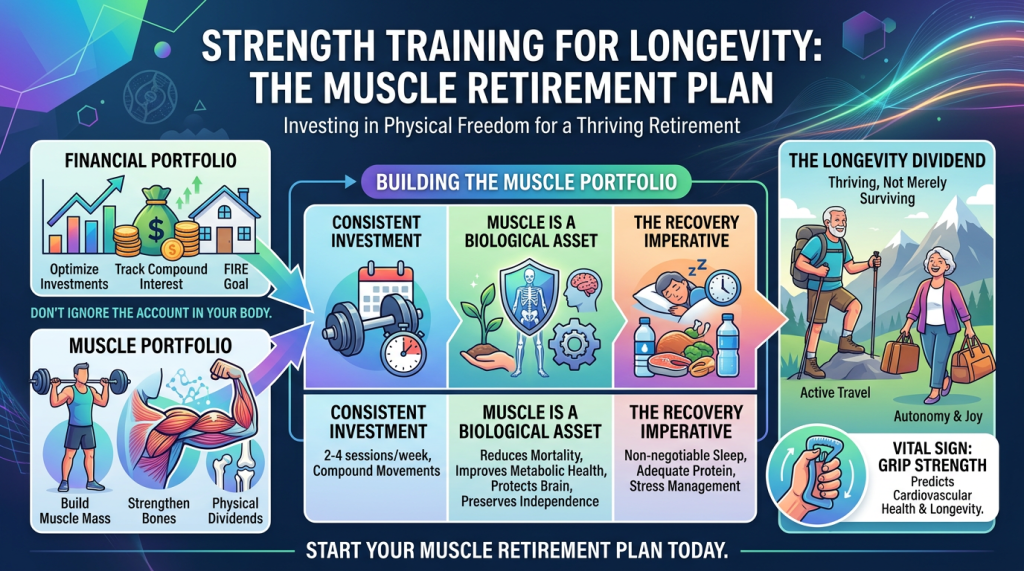
You obsess over your investment portfolio. You track compound interest, optimize expense ratios, and stress-test your withdrawal rate. But there’s one retirement account most people completely ignore — the one made of muscle.
It doesn’t live in a brokerage. It doesn’t pay dividends in dollars. But it compounds quietly, protects against catastrophic loss, and determines whether your retirement is spent thriving or merely surviving.
This is the Muscle Retirement Plan.
The Account You’re Not Funding
Here’s an uncomfortable truth most FIRE (Financial Independence, Retire Early) enthusiasts never consider.
You could hit your number. You could retire at 45 with a perfectly optimized portfolio, a paid-off home, and a 3.5% withdrawal rate stress-tested against every historical market crash.
And none of it matters if your body breaks down.
Financial independence gives you time. But muscle gives you the ability to use that time. Without it, early retirement becomes early decline — a slow erosion of mobility, energy, independence, and quality of life.
Most people don’t think about this because muscle loss is invisible in your 30s and 40s. It doesn’t show up on a balance sheet. There’s no app that tracks it. But it’s happening right now, silently, like inflation eating away at a savings account that earns zero interest.
The difference is this: you can’t dollar-cost-average your way back into muscle at 70. The earlier you start investing, the greater the compounding effect. Sound familiar?
Sarcopenia: The Silent Retirement Killer
Starting around age 30, the average adult loses 3–8% of muscle mass per decade. After 60, that rate accelerates dramatically. This process has a clinical name: sarcopenia.
Sarcopenia is the muscular equivalent of running out of money in retirement. Except instead of cutting expenses, you’re cutting capability. First, it’s the inability to carry groceries without fatigue. Then it’s difficulty climbing stairs. Eventually, it’s a fall — and a fall after 65 is one of the leading causes of hospitalization, loss of independence, and death.
Consider the numbers:
- 1 in 3 adults over 65 falls each year
- Hip fractures in the elderly carry a 20–30% mortality rate within one year
- Loss of muscle mass is directly linked to insulin resistance, metabolic disease, cognitive decline, and depression
This isn’t a fitness problem. It’s a longevity problem. And like most longevity problems, the solution isn’t dramatic intervention later — it’s consistent, boring investment now.
If you’re familiar with the FIRE concept of “the boring middle” — the long, unglamorous stretch where you simply keep investing and let compounding do its work — then you already understand how strength training for longevity works. It’s the same game, played with a barbell instead of an index fund.
Muscle is a Longevity Asset
Let’s reframe how you think about muscle. It’s not about aesthetics. It’s not about lifting heavy for ego. Muscle is a biological asset class — and one of the most protective ones you can hold.
Here’s what the research says:
1. Muscle Mass Reduces All-Cause Mortality
A 2022 meta-analysis published in the British Journal of Sports Medicine found that 30–60 minutes of strength training per week was associated with a 10–20% reduction in all-cause mortality, including cancer, cardiovascular disease, and diabetes.
You wouldn’t ignore an investment that reduced your risk of financial ruin by 20%. Don’t ignore this one either.
2. Muscle Improves Metabolic Health
Skeletal muscle is the largest site of glucose disposal in the body. More muscle means better insulin sensitivity, more stable blood sugar, and lower risk of type 2 diabetes. Think of it as metabolic armor.
3. Muscle Protects Against Falls and Fractures
Strength training doesn’t just build muscle — it strengthens bones, tendons, and connective tissue. This is your structural insurance. The stronger your frame, the more resilient you are against the physical shocks that derail aging bodies.
4. Muscle Supports Cognitive Function
Emerging research links resistance training to improved memory, executive function, and reduced risk of dementia. Your brain benefits from what your body lifts. The mechanism isn’t fully understood, but the correlation is strong and growing.
5. Muscle Preserves Independence
This is the one that matters most. Independence — physical, logistical, emotional — is the whole point of FIRE. Muscle is what lets you travel at 70, play with grandchildren at 75, and live without assisted care at 80.
Financial independence without physical independence is a hollow victory.
The Compound Interest of Strength
In finance, compound interest is the most powerful force because returns build on returns. Strength works the same way.
When you train consistently in your 30s and 40s, you’re not just building muscle for today. You’re building a buffer — a reserve that your future self will draw from when biology starts pulling in the other direction.
Consider two people at age 65:
- Person A started strength training at 35. They trained 3 times a week, consistently, for 30 years. They enter their 60s with a high baseline of muscle mass, bone density, and functional strength.
- Person B never trained. They were “active” — they walked, maybe did some yoga — but never loaded their muscles against resistance. They enter their 60s with a low baseline and declining fast.
Both may have the same net worth. But Person A has decades more functional life ahead. They can hike, travel, carry their own bags, recover from illness faster, and live without help.
Person B? They’re one fall away from a nursing home.
This is the muscle gap — and like the wealth gap, it widens with time. The earlier you start investing, the harder it is to lose.
How Much Strength Training Do You Actually Need?
Here’s the good news: the dose required for longevity is surprisingly modest. You don’t need to train like a bodybuilder. You don’t need to spend two hours in a gym. You need consistency, progressive overload, and a focus on functional movements.
The Minimum Effective Dose
Research suggests the longevity sweet spot is:
- 2–4 sessions per week
- 30–45 minutes per session
- Focus on compound movements (squat, hinge, push, pull, carry)
- Progressive overload (gradually increasing weight or difficulty over time)
That’s it. That’s the investment.
The Longevity Lift Checklist
If you want a simple framework, build your training around these movement patterns:
| Movement Pattern | Example Exercise | Why It Matters |
|---|---|---|
| Squat | Goblet squat, barbell squat | Leg strength, mobility, fall prevention |
| Hinge | Deadlift, kettlebell swing | Posterior chain, back health, bone density |
| Push | Push-up, overhead press | Upper body strength, shoulder health |
| Pull | Row, pull-up | Posture, grip strength, back resilience |
| Carry | Farmer’s walk, suitcase carry | Core stability, grip, real-world function |
| Single-leg | Lunge, step-up | Balance, coordination, injury prevention |
You don’t need variety. You need repetition with gradual progression. Just like investing, the strategy that works is the one you stick with for decades.
Grip Strength: The Vital Sign You’re Ignoring
If there’s one single metric that predicts longevity better than almost any other physical marker, it’s grip strength.
Multiple large-scale studies — including the famous Prospective Urban Rural Epidemiology (PURE) study of over 140,000 adults — have found that grip strength is a stronger predictor of cardiovascular death than systolic blood pressure.
Read that again.
Your ability to squeeze a dynamometer tells researchers more about your mortality risk than the number on a blood pressure cuff.
Why? Because grip strength is a proxy for total body strength, muscle mass, and neuromuscular integrity. It’s a single data point that reflects the health of the entire system.
How to improve it:
- Deadlifts and rows (heavy pulling movements)
- Farmer’s walks (carry heavy things for distance)
- Dead hangs from a pull-up bar (aim for 60 seconds)
- Towel hangs and fat-grip training
Think of grip strength as your portfolio health score. If it’s declining, everything else is probably declining too.
The Recovery Imperative
Here’s where the financial metaphor gets even more precise.
In investing, you don’t just accumulate — you also manage risk. You rebalance. You diversify. You protect against downside.
In strength training, recovery is your risk management.
Training tears muscle fibers down. Recovery builds them back stronger. Without adequate recovery, you don’t grow — you break. And after 35, recovery takes longer. This isn’t a weakness. It’s biology.
Recovery essentials:
- Sleep: 7–9 hours. Non-negotiable. This is when growth hormone peaks and tissue repair happens.
- Protein: Aim for 1.6–2.2g per kg of bodyweight daily. Protein is the raw material of muscle. Underfunding protein is like underfunding your 401(k).
- Rest days: 2–3 per week minimum. More isn’t always better. Consistency over intensity.
- Stress management: Chronic stress elevates cortisol, which is catabolic — it literally breaks muscle down. Meditation, walks in nature, and breathing exercises aren’t luxuries. They’re portfolio protection.
The people who get injured, burn out, or quit training almost always make the same mistake: they over-invest in intensity and under-invest in recovery. Don’t be that investor.
A Simple Strength Plan for Long-Term Health
You don’t need a complicated program. You need a sustainable one. Here’s a minimalist framework that will serve you for decades.
The 3-Day Longevity Strength Template
Day 1 — Lower Body Focus
- Goblet squat or barbell squat — 3 sets of 8
- Romanian deadlift — 3 sets of 8
- Walking lunge — 2 sets of 10 each leg
- Dead hang — 2 sets, max hold
Day 2 — Upper Body Focus
- Push-up or overhead press — 3 sets of 8
- Dumbbell row or pull-up — 3 sets of 8
- Farmer’s walk — 3 sets of 40 meters
- Plank — 2 sets of 45 seconds
Day 3 — Full Body + Mobility
- Kettlebell swing — 3 sets of 15
- Step-ups — 3 sets of 8 each leg
- Face pulls or band pull-aparts — 3 sets of 15
- 10-minute mobility flow (hips, thoracic spine, ankles)
Total time commitment: ~2.5 hours per week.
That’s less time than most people spend scrolling social media in a single day. And unlike scrolling, this investment compounds.
Training for the Life You Want — Not the Body You Want
The fitness industry sells aesthetics. Six-pack abs. Beach bodies. Before-and-after transformations.
But if you’re pursuing FIRE, you already know that conventional goals are often the wrong goals. You’re not optimizing for what society tells you to want. You’re optimizing for freedom.
Apply that same thinking to your body.
Don’t train to look good at 40. Train to function at 70. Train so you can hike volcanoes in retirement. Train so you can carry your own luggage across five countries. Train so you never need someone else to help you off the floor.
The question isn’t “How much can I lift?”
The question is “What do I want my body to be capable of in 30 years?”
Then work backward. Just like a FIRE plan.
The Bottom Line
You wouldn’t retire without a financial plan. Don’t age without a physical one.
Muscle is the most undervalued asset in the longevity portfolio. It protects against disease, preserves independence, strengthens bones, sharpens cognition, and compounds over decades of consistent investment.
You don’t need to become a gym rat. You don’t need to lift heavy. You need to lift consistently, recover intelligently, and think in decades.
Start with 3 days a week. Master the basic movements. Add weight slowly. Prioritize sleep and protein. Show up again next week.
That’s the Muscle Retirement Plan.
It won’t make you rich. But it will make sure you’re strong enough, mobile enough, and resilient enough to actually enjoy the wealth you’ve built.
Because what’s the point of financial freedom if your body can’t cash the check?
Related Reading
If this resonated, you’ll find these posts valuable:
- Training for the Life You Want at 60: Strength Training for Longevity (Not Just Looks)
- Why Grip Strength Predicts Longevity (And How to Improve It)
- Why You Need More Rest Days After 40 (Not More Intensity)
- How to Train After 30: A Complete Guide to Strength, Mobility, and Longevity
- Recovery is a Skill: Why It Doesn’t Happen Automatically (And How to Improve It)
- How to Build a Fitness Practice (Not Just a Workout Routine)
- The Minimum Effective Longevity Habits: What Actually Improves Healthspan
- Zone 2 Cardio Explained: The Boring Workout That Boosts Longevity and Adds Years to Your Life


Leave a Reply