Reading 50 books a year means nothing if you can’t remember 50 ideas from them. Here’s how to slow down, retain more, and actually change how you think.
The Productivity Trap of Reading
There’s a quiet competition among smart, ambitious people. It doesn’t happen in gyms or boardrooms. It happens on bookshelves, Goodreads profiles, and “Books I Read This Year” blog posts.
The metric? Books per year.
Somewhere along the way, reading became a productivity game. We started treating books like tasks to complete, pages like miles to log, and finishing a book like crossing a finish line. The faster you read, the more you consume. The more you consume, the smarter you must be.
Except that’s not how learning works.
Think about it honestly. Of the last ten books you read, how many can you summarize in three sentences right now, without checking your notes? How many changed a decision you made? How many shifted how you see the world?
If you’re like most people, including most very smart people, the answer is uncomfortable. Maybe one. Maybe none.
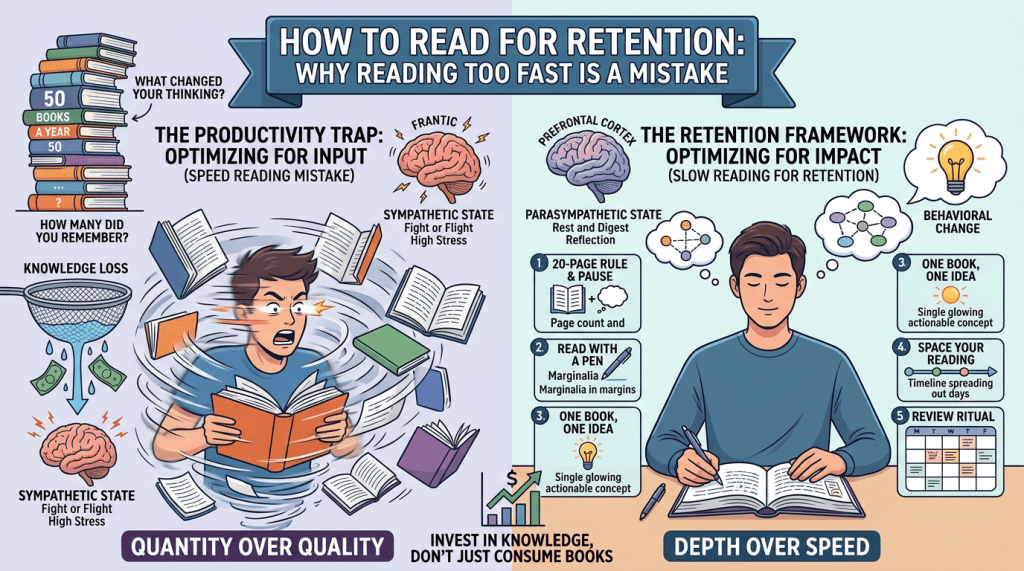
This isn’t a knowledge problem. It’s a speed problem. We read too fast to retain, too fast to reflect, and too fast to let ideas actually land. We’re optimizing for the wrong variable. We’re measuring input when we should be measuring impact.
The real question isn’t how many books did you read?
It’s how many books read you?
Why Speed Feels Productive (But Isn’t)
Speed reading has been glamorized for decades. There are apps, courses, and YouTube videos promising you can read 1,000 words per minute with “full comprehension.” The appeal is obvious. In a world drowning in information, reading faster feels like a superpower.
But here’s the problem. Speed and comprehension aren’t friends. They’re rivals.
Research in cognitive psychology consistently shows that as reading speed increases, comprehension decreases. A landmark study published in Psychological Science in the Public Interest reviewed decades of speed reading claims and concluded that there is a fundamental trade-off between speed and understanding. You can read fast, or you can read deep. You cannot reliably do both.
Your brain isn’t a scanner. It’s a processor. When you read quickly, your eyes move across words, your inner voice might even narrate them, but your prefrontal cortex, the part responsible for critical thinking, pattern recognition, and meaning-making, doesn’t get enough time to do its job.
Think of it like eating. You can eat a meal in three minutes or thirty minutes. The calories are the same. But your body digests, absorbs, and signals satiety very differently in each case. Fast eating leads to overeating and poor absorption. Fast reading leads to overconsuming and poor retention.
You finish the book. You feel productive. But the knowledge passes through you like water through a sieve.
The Nervous System Connection Most Readers Miss
Here’s something rarely discussed in reading advice: your physiological state while reading determines how much you retain.
When you’re rushing through a book, scanning for key points, skipping paragraphs, and mentally racing to the next chapter, your nervous system is in a mild sympathetic state. That’s the “fight or flight” mode. It’s the same state you’re in when you’re clearing your inbox, scrolling through social media, or multitasking at work.
In this state, your brain is optimized for detection, not reflection. You’re good at finding facts, spotting keywords, and identifying novelty. But you’re terrible at integrating new ideas with existing knowledge, making lateral connections, and forming lasting memories.
Deep comprehension requires the opposite: a parasympathetic state. That’s the “rest and digest” mode. It’s when your prefrontal cortex has the bandwidth to actually think about what you’re reading. To question it. To connect it. To let it simmer.
This is why you often have your best ideas about a book after you put it down. In the shower. On a walk. While cooking. Your nervous system has finally downshifted, and your brain can process what it absorbed.
The implication is significant. If you want to read for retention, you don’t just need to read slower. You need to read calmer. The environment matters. The pace matters. Your breathing matters.
Reading isn’t just an intellectual activity. It’s a physiological one.
The Real Cost of Reading Too Fast
Let’s quantify the waste.
Say you read 30 books a year. Each book takes roughly 6 hours. That’s 180 hours of reading annually, nearly five full work weeks.
Now, if you retain and apply ideas from only two or three of those books, your effective ROI on 180 hours is roughly 12–18 hours of value from 180 hours of input. That’s a 90% waste rate.
No investor would accept a 90% loss. No athlete would train 180 hours and expect only 18 hours of improvement. But readers accept this without question because the “loss” is invisible. You don’t see what you forgot. You only see the finished book on your shelf.
The cost isn’t just time. It’s also opportunity cost. Every book you speed through is a book you could have read deeply, a book that could have genuinely changed your thinking, your habits, or your decisions. Instead, it becomes a vague memory. A title you recognize but can’t discuss.
Smart people are especially vulnerable here because they read complex material, the kind that requires slow processing, at the same speed they read articles and emails. A blog post and a book by Nassim Taleb demand fundamentally different reading speeds. Treating them the same is like running a sprint and a marathon at the same pace. One of them will suffer.
The Slow Reading Framework: How to Read for Retention
Reading for retention isn’t about reading less. It’s about reading differently. Here’s a practical framework you can start using today.
1. The 20-Page Rule
Instead of reading for time (“I’ll read for an hour”) or for completion (“I’ll finish this chapter”), read for depth. Read 20 pages. Then stop.
Not because you’re tired. Not because you’re done. But because 20 pages is roughly the amount of material your brain can meaningfully process in one sitting without losing the thread.
After those 20 pages, spend 5–10 minutes doing nothing. No phone. No next chapter. Just think. What stood out? What surprised you? What do you disagree with?
This pause is where retention happens. It’s the space between consumption and comprehension. Most readers skip it entirely.
2. Read With a Pen, Not Just Your Eyes
Marginalia, the act of writing in the margins of your books, is one of the oldest and most effective retention techniques. It forces you to engage actively rather than passively.
When you underline a sentence, you’re telling your brain this matters. When you write a question in the margin, you’re creating a hook for your memory. When you argue with the author in pencil, you’re doing the deepest form of reading: critical engagement.
You can’t speed read and annotate simultaneously. The pen is a natural brake pedal.
If you read on a Kindle, use the highlight and note features. But know that physical writing, the motor act of forming letters, has been shown to enhance memory encoding more than typing or digital highlighting. There is a reason analog learning still wins.
3. The “One Book, One Idea” Rule
Here’s a counterintuitive truth: you don’t need to retain everything from a book. You need to retain one thing that changes your behavior.
Before you start a book, ask yourself: What am I hoping to learn or solve? This gives your brain a filter, a reason to pay attention to certain ideas and let others go.
After you finish, ask: What is the single most important idea from this book, and how will I apply it this week?
One book, one actionable idea. Over a year, that’s 20–30 genuine behavioral changes. That’s not a reading habit. That’s a thinking transformation.
4. Space Your Reading
Cognitive science has a name for this: the spacing effect. Information is retained better when exposure is spread out over time rather than crammed into a single session.
Instead of reading a book cover to cover in three days, read it over two to three weeks. Intersperse it with other activities. Let your subconscious work on the ideas between sessions.
This feels slower. It feels inefficient. But it’s how long-term memory actually forms. Your hippocampus needs time to consolidate information, to move it from short-term storage to long-term retrieval. Cramming a book in a weekend is the intellectual equivalent of an all-nighter before an exam. You might pass, but you won’t remember anything by Tuesday.
5. Build a Review Ritual
The forgetting curve, first identified by Hermann Ebbinghaus in the 1880s, shows that we forget roughly 70% of new information within 24 hours unless we actively review it.
This means the most important reading you do isn’t the first read. It’s the re-engagement afterward.
Build a simple weekly ritual. Every Sunday, spend 15 minutes reviewing your highlights, margin notes, or reading journal from the past week. Re-read the passages that struck you. Ask yourself whether any of those ideas have shown up in your life.
This 15-minute ritual will do more for your retention than reading an extra five books per year.
Reading as Investment, Not Consumption
There’s a useful analogy from the FIRE (Financial Independence, Retire Early) world here.
In personal finance, there’s a difference between spending and investing. Spending is consumption: you buy something, use it, and it’s gone. Investing is allocation: you put resources somewhere expecting a compounding return over time.
Most people spend their reading time. They consume books. They finish them. The experience is gone.
The goal is to invest your reading time. To put attention into a book expecting that the ideas will compound, that they’ll connect with other ideas, influence future decisions, and generate returns for years.
A book you read deeply at 32 and still reference at 45 has delivered a 13-year return. A book you speed-read at 32 and forgot by 33 has delivered nothing.
Compounding works in knowledge the same way it works in money. But only if you retain the principal.
When Speed Is Appropriate
This isn’t an argument against all fast reading. Speed has its place.
News articles, industry updates, emails, and most online content are designed for fast consumption. They’re informational, not transformational. Skim them. Extract what you need. Move on.
The distinction is between reading for information and reading for formation. Information changes what you know. Formation changes how you think.
Most books worth reading, the ones that challenge your assumptions, introduce new mental models, or force you to reconsider your worldview, are formation books. They deserve slow, deliberate engagement.
A good rule of thumb: if a book is worth buying, it’s worth reading slowly. If it’s not worth reading slowly, it might not be worth reading at all.
A Challenge for This Week
If you’ve read this far, here’s a practical challenge.
Pick one book you’re currently reading. For the next seven days, read only 20 pages per day. After each session, close the book, sit quietly for five minutes, and write down one idea that stood out. Just one. In a notebook, on a sticky note, anywhere physical.
At the end of the week, you’ll have seven ideas from roughly 140 pages. Look at those seven ideas. Chances are, you’ll remember more from those 140 slow pages than from the last three books you finished at full speed.
That’s the paradox of slow reading. You cover less ground, but you own more of it.
The Bottom Line
Reading fast is easy. Reading deep is a skill.
In a culture that celebrates volume, choosing depth is a quiet act of rebellion. It means accepting that you’ll read fewer books. It means sitting with discomfort when your to-be-read pile grows. It means measuring your reading life not by titles completed but by ideas retained, connections made, and behaviors changed.
The smartest readers aren’t the fastest. They’re the ones who let books change them.
Slow down. Read less. Remember more.
That’s the real competitive advantage.
Related Reading
If this post resonated, you’ll find these earlier posts useful:
- Why Book Summaries Fail: The Truth About Reading Retention
- How to Read Critically: Why Disagreeing With Books Makes You a Smarter Reader
- Cognitive Friction: Why Some Books Change Your Thinking (and Others Don’t)
- The Reading Afterlife: What to Do After You Finish a Book to Remember and Apply It
- How to Remember More of What You Learn (Using the Forgetting Curve)
- Marginalia Magic: How Writing in Books Improves Comprehension and Critical Thinking
- The Compound Effect of Reading: How 20 Minutes a Day Changes a Life
- Why Smart Readers Still Don’t Change: How to Apply What You Read


Leave a Reply