In 2008, the S&P 500 dropped 38% in a single year.
Millions of investors panic-sold. They watched their portfolios collapse, decided they couldn’t take any more, and moved to cash. They told themselves they’d get back in when things stabilized.
Most of them didn’t. Or they got back in late — after the recovery had already happened — locking in their losses and missing the rebound.
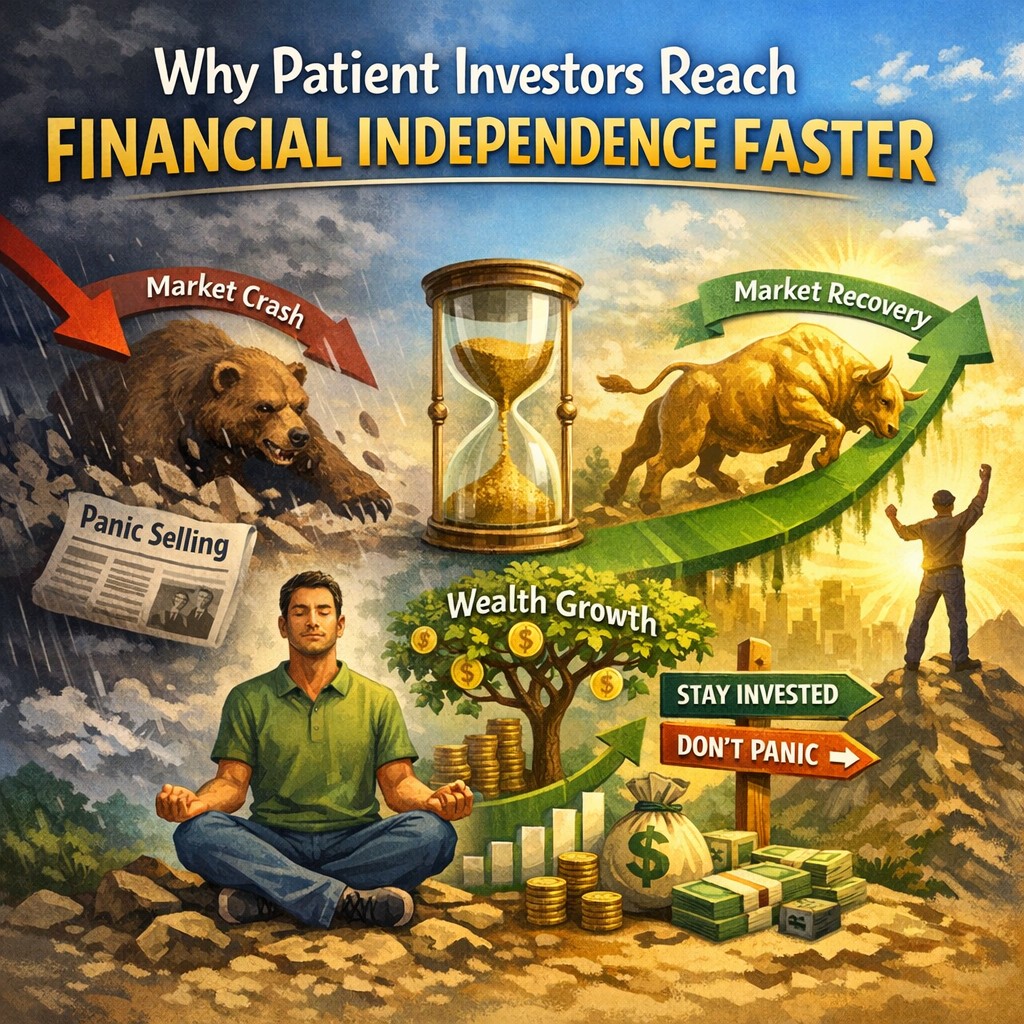
The investors who did nothing? Who held their index funds through the collapse, through the fear, through the headlines screaming financial apocalypse?
They didn’t just recover. They compounded.
By 2013, the market had fully recovered and surpassed its pre-crash highs. By 2020, those same “do nothing” investors had seen their portfolios multiply several times over from the 2008 lows.
The best investment decision of the last two decades wasn’t a clever stock pick, a perfectly timed trade, or a sophisticated hedging strategy.
It was patience.
And patience, it turns out, is the most underrated accelerator on the path to financial independence.
The Counterintuitive Truth About Building Wealth
Most people approach investing like they approach their career: more effort, more activity, more optimization should produce better results.
So they monitor their portfolio daily. They adjust their allocations quarterly. They move money in response to economic news. They chase sectors that performed well last year. They read predictions about where the market is heading and position themselves accordingly.
All of this activity feels productive. It feels like being a responsible, engaged investor.
But here’s what the data consistently shows: the more actively most investors manage their portfolios, the worse their returns.
A landmark study by behavioral finance researchers Brad Barber and Terrance Odean analyzed the trading records of 66,000 households over a seven-year period. Their finding was stark: the most active traders earned returns 6.5 percentage points lower annually than the least active traders. Both groups owned essentially the same assets. The difference was entirely behavioral — how often they traded, how they responded to market movements, how much they let emotion drive decisions.
Six and a half percentage points annually. Compounded over a 20 or 30-year wealth-building journey, that gap doesn’t just slow your path to financial independence. It fundamentally changes whether you get there at all.
The investors who reached financial independence fastest weren’t the most sophisticated. They weren’t the most active. They weren’t the most informed about macroeconomic trends or Federal Reserve policy.
They were the most patient.
Why the Human Brain Is Wired Against Long-Term Investing
Before judging the panic-sellers and the active traders, it’s worth understanding why intelligent people consistently make these decisions.
Your brain wasn’t designed for long-term investing. It was designed for survival in an environment where threats were immediate, resources were scarce, and inaction in the face of danger was genuinely deadly.
Several cognitive biases make patient investing psychologically unnatural:
Loss Aversion
Psychologists Daniel Kahneman and Amos Tversky established that losses feel approximately twice as painful as equivalent gains feel pleasurable. Losing $10,000 hurts roughly twice as much as gaining $10,000 feels good.
In investing terms: watching your portfolio drop $50,000 creates roughly twice the psychological pain of watching it gain $50,000. This asymmetry makes holding through downturns feel genuinely agonizing — not because you’re weak, but because your brain is functioning exactly as it evolved to function.
Recency Bias
Your brain places disproportionate weight on recent events when predicting the future. After a market crash, your brain extrapolates the crash forward: things are falling, therefore things will continue to fall. After a bull market, it extrapolates growth: things are rising, therefore they will continue to rise.
This is why investors buy high (after markets have risen and optimism is abundant) and sell low (after markets have fallen and fear is dominant). Recency bias makes the wrong move feel like the obvious move at exactly the wrong moment.
Action Bias
Humans have a deep-seated preference for action over inaction, even when inaction is objectively superior. In experiments, soccer goalkeepers who dived to one side during penalty kicks performed worse than those who stayed in the center — but staying in the center felt wrong, felt passive, felt like not trying.
Investors feel the same pressure. When markets are volatile, doing nothing feels irresponsible. Surely you should do something. Adjust something. Protect something. The pressure to act — even when acting is precisely the wrong response — is almost overwhelming.
Understanding these biases doesn’t eliminate them. But it creates the crucial gap between feeling the impulse and acting on it. That gap is where patient investors live. And that gap is where wealth compounds.
The Mathematics of Patience: Why Time Beats Tactics
Let’s make the case for patience in numbers, because the mathematics are more compelling than any argument about mindset.
The Compounding Curve
Albert Einstein allegedly called compound interest the eighth wonder of the world. Whether he said it or not, the principle is real and its implications for patient investors are extraordinary.
Consider two investors, both starting with $50,000 and contributing $1,000 per month:
- Investor A stays fully invested through every market cycle, earning the market’s historical average of approximately 10% annually
- Investor B moves to cash during the two worst years of each decade (missing those recoveries), earning 6% annually as a result
After 30 years:
- Investor A: approximately $2.27 million
- Investor B: approximately $1.01 million
Same starting capital. Same monthly contributions. Same 30-year timeline.
The difference — $1.26 million — is entirely the cost of impatience.
The Cost of Missing the Best Days
JP Morgan Asset Management publishes a regular analysis of what happens when investors miss the market’s best trading days. The numbers are consistently sobering.
Over a 20-year period (2003–2022), a fully invested portfolio in the S&P 500 returned approximately 9.8% annually.
Miss the 10 best days over that 20-year period? Your return drops to 5.6% annually.
Miss the 20 best days? 2.0% annually.
Miss the 30 best days? You’re actually negative: -0.4% annually.
Here’s the critical detail: the best days in markets almost always occur during or immediately after the worst periods. The biggest single-day gains in market history have clustered around crashes and recessions — exactly the moments when frightened investors are most likely to be sitting in cash, waiting for things to “settle down.”
Patient investors capture these days automatically, simply by staying invested. Impatient investors miss them precisely because they acted on their fear at the worst possible moment.
The FIRE Acceleration Effect: Why Patience Compounds Differently
For people pursuing financial independence specifically, patience doesn’t just improve returns. It accelerates the entire trajectory in ways that simple return calculations don’t fully capture.
The Savings Rate Multiplier
FIRE (Financial Independence, Retire Early) is fundamentally driven by savings rate, not investment returns. The percentage of your income you save determines how quickly you accumulate the assets needed for financial independence, far more than whether you earn 8% or 10% annually.
Patient investors tend to have higher savings rates — not because they earn more, but because they’re less reactive to financial anxiety.
Anxious investors spend more. Financial stress triggers compensatory spending — lifestyle purchases that temporarily relieve anxiety. The investor who panics during a market downturn is also more likely to make impulsive purchases, delay savings contributions, or make expensive financial decisions driven by fear rather than strategy.
The patient investor, psychologically steady through market cycles, tends to maintain their savings rate consistently — including during downturns, when contributions at depressed prices are actually most valuable.
The Sequence of Returns Advantage
For investors in the accumulation phase — saving toward FIRE rather than withdrawing from it — market downturns followed by recoveries are mathematically beneficial, provided you stay invested and keep contributing.
When markets drop 30% and you continue making regular contributions, you’re buying additional shares at 30% discount. When the recovery arrives, those discounted shares participate fully in the rebound. Your dollar-cost averaging during the downturn becomes a significant return accelerator.
This only works if you stay invested. The investor who moves to cash during the downturn misses both the discounted purchase opportunity and the recovery.
Patience, in the accumulation phase, is not just emotionally superior. It’s mathematically superior.
The Friction Cost of Activity
Every investment decision carries costs — sometimes visible, often hidden.
Visible costs: trading fees, transaction costs, tax events triggered by selling.
Hidden costs: the time spent monitoring, researching, and worrying. The cognitive load of active management. The decision fatigue from constant portfolio evaluation. The opportunity cost of mental energy that could have been directed toward income growth, skill development, or the life you’re actually trying to build.
Patient investors — particularly those using low-cost index funds held for decades — minimize both categories of cost simultaneously. They free up capital through lower fees. They free up cognitive resources through lower management overhead.
That freed cognitive energy, directed toward career development, side income, skill building, or simply living with less financial anxiety, compounds in its own way.
What Patient Investors Actually Do
Patience isn’t passivity. It’s not ignorance or indifference. It’s a deliberate, active choice to trust a process and resist the constant pressure to deviate from it.
Here’s what genuinely patient investors do differently:
They Automate Everything They Can
The fewer decisions you make about your investments, the fewer opportunities for emotion to influence those decisions. Automatic contributions on payday. Automatic rebalancing annually or semi-annually. Dividends automatically reinvested.
Automation turns patience from a daily discipline into a structural default. You don’t need willpower if the system doesn’t require a decision.
They Define Their Strategy in Writing Before They Need It
Smart investors write down their game plan before the market gets crazy.
When things are calm, they decide on things like how to split their money, when to shift investments, and how much to add. Later, when the market drops or spikes and panic sets in, they don’t have to guess what to do—they just follow the rules they already wrote.
It’s like making a grocery list before you go to the store on an empty stomach. Making your choices when you’re thinking clearly stops you from buying junk you don’t need when you’re tempted.
They Deliberately Reduce Financial News Consumption
This sounds counterintuitive. Shouldn’t informed investors consume more financial information?
The research suggests otherwise. Most financial news is designed to create urgency — to make you feel that something is happening right now that requires your immediate attention and action. This urgency is commercially valuable for media companies. It is almost never valuable for long-term investors.
Patient investors set information boundaries. They check their portfolios quarterly, not daily. They read annual reports and long-term analyses, not daily market commentary. They understand that most financial news is noise — and that treating it as signal is expensive.
They Focus on What They Can Control
Market returns are not controllable. Economic cycles are not controllable. Interest rate decisions, geopolitical events, and corporate earnings surprises are not controllable.
Savings rate? Controllable. Expense ratio of your funds? Controllable. Asset allocation? Controllable. Tax efficiency of your account structure? Controllable. Time in the market? Controllable.
Patient investors direct their energy toward the controllable variables — optimizing savings rate, minimizing costs, maintaining appropriate allocation — and accept the uncontrollable variables with equanimity.
This isn’t resignation. It’s a sophisticated understanding of where leverage actually exists in long-term wealth building.
They Reframe Downturns as Opportunities
This is easier said than done, but it’s a genuine cognitive shift that separates patient investors from anxious ones.
A market downturn, for an investor in the accumulation phase, is a sale. Assets that were priced at $100 are now available for $70. Every contribution made at those depressed prices buys more ownership of the same underlying assets.
Patient investors train themselves to feel mild excitement during downturns — not because they enjoy watching their portfolio value drop, but because they understand intellectually that the drop represents opportunity. That reframe doesn’t eliminate the emotional discomfort of watching numbers fall. But it provides a competing narrative strong enough to prevent panic-driven decisions.
The Personality of the Patient Investor
Financial independence requires a particular relationship with time — one that most consumer culture actively works against.
We live in an environment optimized for immediacy. Same-day delivery. Instant streaming. Real-time notifications. The entire architecture of modern life is designed to compress delay and eliminate waiting.
Long-term investing requires the opposite: the ability to delay gratification for years, sometimes decades, in pursuit of a future payoff that feels abstract and distant while the present discomfort is immediate and visceral.
The investors who build this capacity — who develop what psychologists call “future self continuity,” a strong sense of connection to and concern for their future selves — consistently outperform those who don’t.
They make different decisions not because they have better information, but because they have a different relationship with time.
They understand that financial independence isn’t built in moments of brilliant tactical insight. It’s built in years of consistent, undramatic, patient execution.
It’s built by people who stay the course when everything feels like it’s falling apart.
It’s built by people who understand that in investing, as in so many things, the most powerful thing you can do is often the hardest:
Nothing.
The Patience Dividend
Here’s the final truth about patient investing and financial independence:
The investors who reach FIRE aren’t the ones who found the best stocks, timed the market correctly, or discovered some tactical edge that others missed.
They’re the ones who picked a simple, low-cost strategy — typically broad index funds across global markets — and held it through every storm. Through crashes and corrections, through recessions and recoveries, through moments of genuine fear and the constant temptation to do something different.
Their edge wasn’t intelligence. It wasn’t information. It wasn’t sophistication.
It was the willingness to be boring for a very long time.
That willingness — to stay the course, to trust the process, to resist the constant pressure to react — is the patience premium. And it pays more reliably, more consistently, and more generously than any other investment strategy available to ordinary investors.
You don’t need to be the smartest investor in the room.
You just need to be the calmest.
Related Reading
If this resonated, you might enjoy these:
- The Boring Middle of FIRE: How to Stay Consistent While Compounding Works
- The First $100K Is the Hardest: Why Reaching $100,000 Changes Your Financial Freedom
- Why FIRE Progress Feels Slow (And What to Do About It)
- The 80/20 of FIRE: Tiny Financial Tweaks That Create Outsized Results
- Halfway to FIRE: Why the First 50% Is Harder Than the Second
- Why Financial Independence Is Really About Slack (Not Early Retirement)
- Financial Independence is a Skill, Not a Number
- Time vs Money: Which One Compounds Faster for Long-Term Freedom?


Leave a Reply