Most travel budgets fail not because people spend too much — but because they’re tracking the wrong things.
You’ve probably tried to budget for travel before.
Maybe you downloaded a tracking app. Maybe you kept a spreadsheet. Maybe you told yourself you’d log every coffee, every taxi, every museum ticket — and stayed disciplined for about four days before the whole system quietly collapsed under the weight of actually trying to enjoy your trip.
Or maybe you went the other direction entirely. No budget at all. Just a vague sense of “I’ll be careful” that dissolved somewhere between the third market visit and the spontaneous cooking class you couldn’t say no to.
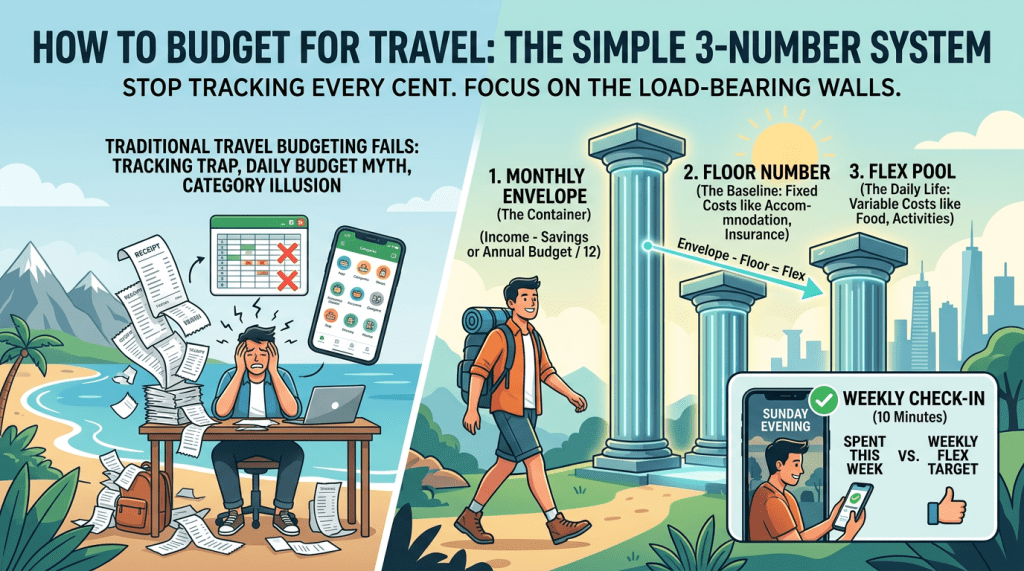
Both approaches fail for the same reason: they treat travel budgeting like accounting when it should be treated like architecture.
Accounting tracks everything that happened. Architecture designs a structure that works regardless of every individual detail. You don’t need to know the weight of every brick to build a house that stands. You need to understand the load-bearing walls.
In travel budgeting, there are exactly three load-bearing walls. Three numbers that, if you get them right, make everything else — every coffee, every taxi, every spontaneous detour — essentially irrelevant.
I call this the 3-Number System. It’s the simplest approach to travel budgeting I’ve ever found. It requires no apps, no daily tracking, and no willpower. Just three numbers, checked occasionally, that tell you everything you need to know about whether your travel finances are on track.
This post explains what those three numbers are, how to calculate them, and how to use them in practice — whether you’re planning a two-week trip, a three-month slow travel stint, or a fully location-independent life.
Why Traditional Travel Budgeting Fails
Before we build the system, it’s worth understanding why conventional approaches consistently break down.
The tracking trap.
Most budgeting advice tells you to track every expense. This works beautifully in theory and collapses in practice. Travel introduces constant friction — foreign currencies, split bills, cash transactions, markets with no receipts — that makes granular tracking exhausting. When the system becomes a burden, people abandon it entirely. Then they have no budget at all.
The category illusion.
Many travelers budget by category: accommodation $X, food $Y, transport $Z, activities $A. The problem is that these categories bleed into each other constantly. You cook more and spend less on food but more on accommodation with a kitchen. You walk everywhere and spend less on transport but more on comfortable shoes and longer accommodation stays. Rigid categories fight against the natural fluidity of travel.
The daily budget myth.
“I’ll spend $100 a day” is the most common travel budget in existence — and one of the least useful. Travel expenses don’t distribute evenly across days. Your arrival day is expensive. Your hiking day is cheap. Your travel day between cities costs three times your normal daily rate. Averaging across days creates a false sense of control that breaks down the moment reality stops cooperating.
The missing macro view.
Even diligent daily trackers often lose sight of the big picture. They know they spent $47 yesterday but have no clear sense of whether they’re on track for the month, the trip, or their annual travel budget. Micro-tracking without macro-awareness is like watching your feet while walking and never looking at the horizon.
The 3-Number System solves all four problems by focusing your attention exactly where it belongs: on the numbers that actually determine whether your travel finances work.
The 3-Number System: An Overview
The three numbers are:
- Your Monthly Envelope — the total amount available to spend each month
- Your Floor Number — your non-negotiable monthly baseline (fixed costs)
- Your Flex Pool — what remains for everything else
That’s it.
You calculate these three numbers before you travel, review them once a week, and adjust your behavior at the monthly level rather than the daily one. No daily logging. No category anxiety. No app required.
Let’s build each number.
Number 1: Your Monthly Envelope
This is the total amount of money available for your travel life each month. It’s your single most important number because everything else flows from it.
How to calculate it:
If you’re still working remotely or have income streams, your Monthly Envelope is straightforward:
Monthly Envelope = Monthly Income − Monthly Savings Target
If you’re drawing from savings or a FIRE portfolio:
Monthly Envelope = Annual Travel Budget ÷ 12
If you’re using a combination — portfolio withdrawals plus some freelance income — add them together after accounting for your savings or investment contributions.
What the Monthly Envelope represents:
Not a ceiling you must stay under at all costs. A container — the defined space within which your travel life operates. You’re not optimizing every dollar. You’re simply agreeing that your spending lives inside this container.
Setting it honestly:
Most people underestimate their Monthly Envelope needs on their first extended trip. They budget for the idealized version of their travel life, not the actual one.
A useful calibration: take your estimate and add 15–20%. Not because you’ll definitely spend it, but because the first time you travel in a new region, your cost model is always slightly wrong. Building in a margin means a single expensive week doesn’t blow your entire framework.
Example:
You have $3,000 per month available for your travel life.
Monthly Envelope = $3,000
Number 2: Your Floor Number
This is the minimum amount you spend every month regardless of what you do, where you go, or how frugal you try to be. It’s your baseline — the fixed layer of your travel expenses.
What typically belongs in your Floor Number:
- Accommodation (if you have a recurring monthly rental or base)
- Health insurance premiums
- Phone plan or SIM costs
- Subscriptions you maintain while traveling (VPN, cloud storage, streaming)
- Debt payments or fixed financial obligations back home
- Storage unit if you’ve kept belongings at home
- Any regular transfers (family support, loan repayments)
What does NOT belong in your Floor Number:
Food, activities, transport between cities, shopping, experiences. These vary. They belong in Number 3.
How to calculate it:
List every expense that will occur whether you’re having an active adventure week or sitting in a café doing nothing. Add them up. That’s your Floor Number.
Why this number matters:
Your Floor Number is what you owe every month before you’ve made a single interesting decision. Knowing it precisely changes how you evaluate destinations, accommodation choices, and lifestyle trade-offs.
If your Floor Number is high — say, $1,800 of your $3,000 envelope — you have limited Flex Pool and need to be selective. If your Floor Number is low — say, $800 — you have abundant flexibility and can be spontaneous without financial anxiety.
The single most powerful lever for improving your travel finances isn’t spending less on coffee. It’s reducing your Floor Number — usually by negotiating better accommodation rates for longer stays, eliminating unnecessary subscriptions, or choosing destinations where your fixed costs are lower.
Example:
- Monthly accommodation (one-month rental): $900
- Health insurance: $150
- Phone plan: $40
- Subscriptions: $60
- Storage unit at home: $80
Floor Number = $1,230
Number 3: Your Flex Pool
This is the number that runs your daily life.
Flex Pool = Monthly Envelope − Floor Number
In our example: $3,000 − $1,230 = $1,770 per month
Your Flex Pool covers everything that’s discretionary and variable:
- Food and drink (groceries, restaurants, cafés)
- Local transport (taxis, metro, buses, bikes)
- Activities, experiences, and entrance fees
- Day trips or short overnight excursions
- Shopping (clothing, gear, souvenirs)
- Unexpected costs (medical, repairs, rebooking fees)
How to use your Flex Pool:
Divide it by four. That gives you a rough weekly spending target.
$1,770 ÷ 4 = approximately $440 per week
This is your only tracking number for day-to-day life. Not a daily budget. Not a category breakdown. Just a weekly pulse check.
Once a week look at what you’ve spent and compare it to your weekly Flex Pool allocation. That’s your entire budgeting practice for the week.
If you’ve spent $380 in a given week, you’re running comfortably.
If you’ve spent $620, you know next week should be quieter.
If you’ve consistently spent $600+ for three weeks running, your Monthly Envelope needs revisiting — either you raise it, reduce your Floor Number, or adjust your travel style.
That’s the whole system.
The Weekly Check-In: Your Only Required Practice
The 3-Number System requires exactly one habit: a weekly check-in that takes less than ten minutes.
Here’s the format:
Sunday Evening Review
- Open your bank app or card statement
- Add up what you spent this week (exclude Floor Number expenses — those are already accounted for)
- Compare to your weekly Flex Pool allocation
- Note whether you’re ahead, on track, or behind
- Adjust next week’s behavior accordingly if needed
No spreadsheet required. No categories. No receipt photography. Just one number compared against one target.
The power of weekly rather than daily reviews is that it smooths the natural variance of travel. A big-spend Thursday (boat trip, nice dinner) balanced against a quiet Tuesday (groceries, walking, home cooking) looks perfectly healthy at the weekly level — even though it would trigger anxiety in a daily tracking system.
Travel is lumpy. Weekly reviews respect that reality.
How the System Adapts Across Travel Styles
One of the strongest features of the 3-Number System is how naturally it adapts to different travel contexts.
Short trips (1–3 weeks):
Calculate a trip envelope rather than a monthly one. Divide it into weekly allocations. The same three numbers apply, just compressed into a shorter timeframe. Your Floor Number for a short trip includes flights, accommodation pre-bookings, and any fixed costs. Your Flex Pool is everything else.
Slow travel (1–3 months per location):
This is where the system shines. Monthly envelopes align perfectly with monthly rentals. Your Floor Number is very stable. Your Flex Pool is consistent. Weekly check-ins become a low-effort habit that runs almost on autopilot.
Full-time nomadic living:
The system becomes your financial operating system. Your Monthly Envelope comes from your income or portfolio. Your Floor Number shifts slightly as you move between destinations (accommodation costs vary, insurance may change). Your Flex Pool adjusts accordingly. The framework stays constant even as the numbers change.
Geoarbitrage scenarios:
The 3-Number System makes geoarbitrage concrete and calculable. Moving from a high-cost city to a lower-cost destination shows up immediately in your Floor Number — usually through dramatically reduced accommodation costs. You can model the financial impact of different locations simply by recalculating your Floor Number for each one and seeing how it affects your Flex Pool.
Common Adjustments and Edge Cases
What about big irregular expenses?
Travel between cities, flights, visa fees, gear purchases. These are real costs that don’t fit neatly into a monthly envelope.
Two approaches work well:
Option 1: The Transport Reserve.
Set aside a fixed monthly amount — say, $200 — specifically for travel between destinations. Treat it as part of your Floor Number even though it varies. Build it into your envelope from the start.
Option 2: The Annual Buffer.
Calculate your expected annual big-ticket travel costs (flights, major trips, gear), divide by 12, and add that monthly figure to your Floor Number. This smooths irregular costs across the year.
What about months with unusually high costs?
They happen. A medical expense. A gear replacement. A flight you didn’t plan for.
The system handles this gracefully because you’re operating at the monthly level. One expensive month is simply noted, not catastrophized. If it happens consistently, it signals that your Monthly Envelope needs adjusting — not that the system is broken.
What about traveling with a partner?
Calculate shared expenses (accommodation, joint activities, shared meals) as a single line in your Floor Number and Flex Pool respectively. Each person maintains their own discretionary spending within the Flex Pool. The system scales cleanly to two people.
Why 3 Numbers Work When 30 Categories Don’t
There’s a cognitive science principle at work here: decision fatigue and monitoring fatigue are real.
Every category you track is a decision point. Every daily budget check is a small act of willpower. Multiply these across weeks and months, and the cognitive burden of running a complex budget system actually degrades the quality of your financial decisions — and your enjoyment of travel.
The 3-Number System reduces your entire financial life to three reference points and one weekly habit. It fits in your working memory without effort. It doesn’t require discipline to maintain — just occasional awareness.
The best budget is the one you actually use. And the one you’ll actually use is the simplest one that still gives you meaningful control.
Three numbers. One weekly check. That’s enough.
Building Your 3-Number System: Start Here
Before your next trip or the start of next month, do this:
Step 1: Calculate your Monthly Envelope.
What’s the total you have available for your travel life this month? Income minus savings, or portfolio withdrawal divided by 12.
Step 2: List and total your Floor Number.
Every fixed, non-negotiable cost. Add them up. This is your committed spend before any decisions are made.
Step 3: Calculate your Flex Pool.
Envelope minus Floor. Divide by four for your weekly allocation.
Step 4: Set a Sunday reminder.
Ten minutes, once a week. Check your variable spending against your weekly Flex Pool target. That’s your entire ongoing practice.
Step 5: Review monthly.
At the end of each month, ask: was my Monthly Envelope right? Did my Floor Number shift? Do I need to adjust? One monthly recalibration keeps the system accurate without becoming a project.
The Deeper Point About Travel and Money
Here’s what I’ve learned after years of slow travel and location-independent living:
Financial stress while traveling almost never comes from spending too much on individual things. It comes from not knowing whether you’re on track — from the ambient anxiety of undefined limits and unmeasured progress.
The 3-Number System doesn’t just manage your money. It eliminates that ambient anxiety by replacing vague worry with clear awareness. You know your envelope. You know your floor. You know your flex. You check once a week.
That clarity doesn’t constrain your travel. It liberates it.
When you know you have $440 of Flex Pool this week and you’ve spent $180 by Thursday, you can say yes to the spontaneous boat trip without guilt, without mental arithmetic, without the nagging feeling that you’re being irresponsible.
The goal was never to spend as little as possible. The goal was always to spend with confidence — to know that the life you’re building on the road is financially sustainable, month after month, destination after destination.
Three numbers make that possible.
Related Reading
If this post resonated, here are related articles from the archive worth exploring next:
- How to Budget Without Tracking Every Expense: Simple Money Management That Actually Works
- Geoarbitrage 101: Living Well for Less Around the World
- Slow Travel: Why Staying Longer Saves Money and Creates Richer Experiences
- The Geography of FIRE: Best Countries for Early Retirement and Geoarbitrage
- How Long to Stay in One Place While Traveling: Why 3 Months Changes Everything
- Digital Minimalism for Nomads: How to Unplug and Work
- Using Travel to Improve Your Financial Understanding
- Time Arbitrage: How Flexible Schedules Help You Save More, Spend Less, and Build Wealth


Leave a comment