Most people travel in bursts – a week here, a long weekend there, maybe a big trip once a year. They return home exhausted, overstimulated, and already dreading Monday. The photos look great. The growth? Minimal.
What if you designed an entire year of travel — not as a series of disconnected vacations, but as a single, intentional system built around who you’re becoming?
This isn’t about quitting your job or selling everything. It’s about treating your travel year the way you’d treat a portfolio: diversified, balanced, and optimized for long-term returns.
The Problem with Random Trips
Most travel is reactive. A friend suggests Lisbon. A flight deal pops up to Bangkok. You haven’t taken time off in months, so you book something — anything — just to escape.
The result is what I call tourism by default: trips chosen based on convenience, price, or social pressure rather than intention. You visit places without a reason beyond “it looked nice on Instagram.” You come home with photos but no shift in perspective. No new skill. No deeper understanding of yourself.
And worse, random trips tend to cluster around the same pattern. You rush to see everything. You eat out every meal. You sleep poorly. You return more depleted than when you left.
This is the travel equivalent of impulse spending. It feels good in the moment, but it doesn’t compound into anything meaningful.
A designed travel year is different. It treats movement as a tool — for learning, recovery, connection, and growth. Every trip has a role. Every destination serves a purpose. And the year, taken as a whole, becomes one of the most transformative chapters of your life.
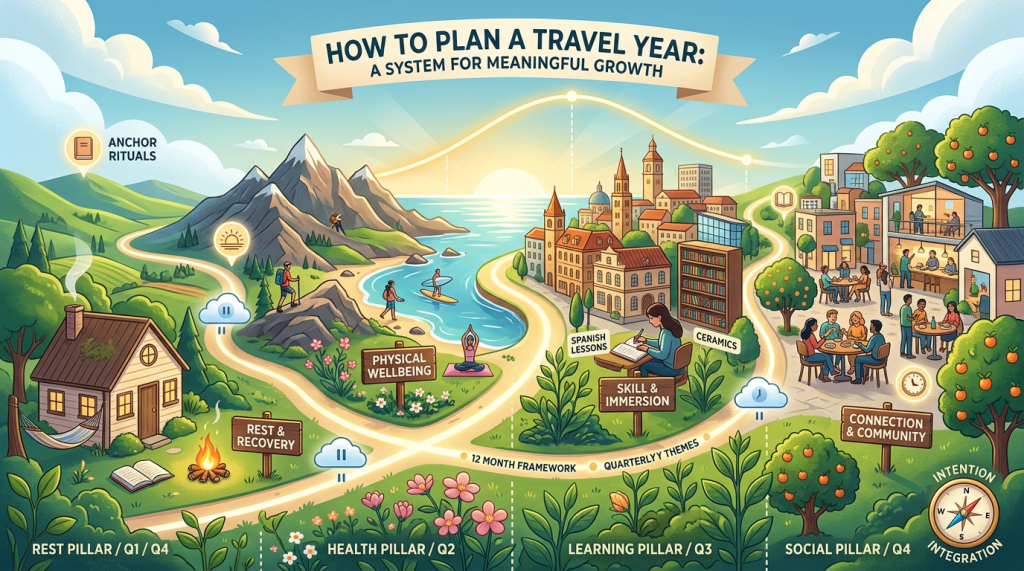
What a “Travel Year” Actually Means
Let me be clear: a travel year doesn’t mean traveling for 365 days straight. That’s a fast track to burnout, decision fatigue, and a life that feels like a never-ending airport terminal.
A travel year is a 12-month framework where every trip — whether it’s a weekend drive, a month abroad, or a quarter in a new city — is part of a larger design. Some months you move. Some months you stay. The magic is in the architecture.
Think of it as four chapters, roughly one per quarter. Each chapter serves a different function. Together, they create a balanced year that stretches you without breaking you.
This works whether you’re a digital nomad, a remote worker with flexible leave, someone on a sabbatical, or even someone with a traditional job who wants to be more intentional with their 20–30 days of annual travel.
The Four Pillars of a Travel Year
Every meaningful travel year is built on four pillars. You don’t need to hit all four in every trip — but across the full year, each one should get dedicated time.
1. The Learning Pillar
This is travel designed around acquiring something — a language, a skill, a craft, or a deeper understanding of a subject. It’s the opposite of sightseeing. It’s immersion.
Examples:
- Three months in Mexico City to study Spanish through daily conversation and local classes.
- A month in Japan studying martial arts, ceramics, or tea culture.
- Two weeks in a European city attending a writing residency or workshop.
- A slow month in a university town, visiting libraries and attending public lectures.
The Learning Pillar works best with longer stays — ideally four weeks or more. Language acquisition, cultural understanding, and skill development all require repetition and routine. You can’t learn anything meaningful in a five-day trip.
This is where your travel overlaps with your reading, your intellectual goals, and your long-term curiosity. Choose destinations where you can learn something you can’t learn at home.
2. The Health Pillar
Travel can either destroy your health or dramatically improve it. The Health Pillar ensures at least one chapter of your year is built around physical restoration, movement, and well-being.
Examples:
- A month in Bali or Thailand focused on surfing, yoga, or Muay Thai.
- A hiking-centered trip through Patagonia, the Alps, or the Camino de Santiago.
- A quiet month in a mountain or coastal town with daily walks, swimming, and clean eating.
- A wellness-oriented stay focused on sleep optimization, cold exposure, and recovery.
The Health Pillar is especially powerful when paired with geoarbitrage. High-quality wellness experiences — massage, fresh food, outdoor training — are often far cheaper in Southeast Asia, Central America, or Southern Europe than in major Western cities.
This pillar also serves as a reset. If you’ve been grinding through a high-output quarter, a health-focused trip acts as active recovery for your body and nervous system.
3. The Social Pillar
One of the hidden costs of location independence is loneliness. The Social Pillar counteracts this by building deliberate connection into your travel year.
Examples:
- Visiting old friends or family you haven’t seen in months.
- Attending a conference, retreat, or community gathering in your field.
- Spending a month in a coliving space designed for remote workers or creatives.
- Revisiting a city where you already have a social circle.
The Social Pillar is the most underrated. People design trips around places but rarely around people. Yet the deepest travel memories are almost always relational — the dinner conversation in Porto, the hiking buddy in Colorado, the local who invited you to a family meal.
Build at least one trip per year around a person or a community, not a destination.
4. The Rest Pillar
This is the pillar most ambitious travelers skip — and the one that makes the entire system sustainable.
The Rest Pillar is a chapter of your year dedicated to stillness, slowness, and doing less. It’s not laziness. It’s strategic recovery.
Examples:
- A month in a quiet rural town with no agenda beyond reading, cooking, and walking.
- Returning to your home base for an extended period of grounding and routine.
- A cabin or countryside stay with limited connectivity and no social obligations.
- A familiar, comfortable city where you don’t need to “figure anything out.”
The Rest Pillar prevents the most common failure mode of long-term travel: the slow erosion of energy that turns adventure into obligation. Without rest built into the system, even the most exciting travel year becomes a grind by month eight.
Rest is what allows the other three pillars to work. Learning requires a rested mind. Health requires recovery. Connection requires emotional bandwidth. Rest is the foundation.
Designing Your Year: The Practical Framework
Now that you understand the four pillars, here’s how to actually design your travel year.
Step 1: Define Your Theme
Every good travel year has a loose theme — a thread that connects the chapters. This isn’t a rigid plan. It’s a compass.
Ask yourself: What do I want this year to be about?
Examples:
- “This is my year of language and culture” → prioritize immersive stays in Spanish- or Portuguese-speaking countries.
- “This is my year of physical reinvention” → build trips around movement, outdoor challenge, and health.
- “This is my year of creative input” → visit cities with strong arts, literature, or music scenes.
- “This is my rebuilding year” → emphasize rest, familiar places, and low-stimulation environments.
Your theme helps you say no. When a random opportunity pops up that doesn’t fit, the theme gives you a filter.
Step 2: Map the Four Quarters
Divide your year into four roughly equal blocks. Assign each block a primary pillar.
Example layout:
- Q1 (Jan–Mar): Rest Pillar → Home base or a quiet familiar city. Recharge, plan, set intentions.
- Q2 (Apr–Jun): Learning Pillar → Three months in a new country. Language immersion or skill acquisition.
- Q3 (Jul–Sep): Health Pillar → Outdoor-focused travel. Hiking, swimming, training in nature.
- Q4 (Oct–Dec): Social Pillar → Visit friends, attend a conference, coliving in a community-oriented city.
This is a template, not a rulebook. Adjust based on weather, visa windows, budget cycles, and personal energy patterns. The point is to ensure each pillar gets at least one dedicated chapter.
Step 3: Set Your Budget by Quarter
Instead of budgeting per trip, budget per quarter. This aligns your spending with your pillar priorities.
A rough allocation might look like:
- Rest Quarter: Low cost. Familiar location, home cooking, minimal activities. Budget: 30–40% below your monthly average.
- Learning Quarter: Moderate cost. Tuition, classes, or workshops plus longer-term accommodation. Budget: Near your monthly average.
- Health Quarter: Variable. Could be cheap (hiking, outdoor training) or moderate (retreats, wellness programs). Budget: Near or slightly above average.
- Social Quarter: Highest cost. Flights to visit people, conference tickets, dining out, coliving fees. Budget: 20–30% above average.
This quarterly budgeting approach smooths out the financial spikes that make travel feel expensive. It also reveals a surprising truth: a designed travel year often costs less than four random vacations because you’re leveraging monthly rental discounts, cooking at home, and spending more time in affordable regions.
Step 4: Build in Buffers
Every travel year needs slack — unscheduled weeks between chapters for transition, laundry, admin, and recalibration.
I recommend building one buffer week between each quarter. This is a week with no plans, no flights, and no obligations. Use it to:
- Reflect on the previous chapter (journal, review photos, process experiences).
- Prepare for the next chapter (research, pack, adjust plans).
- Handle life admin (taxes, appointments, renewals).
- Simply do nothing.
These buffer weeks are the connective tissue of your travel year. Without them, transitions feel rushed and the year blurs into a single, undifferentiated stream of movement.
Step 5: Define Your Anchor Rituals
No matter where you are in the world, certain daily rituals keep you grounded. These are your anchor rituals — small, portable habits that travel with you across every chapter.
Examples:
- A morning walk within the first hour of waking (sunlight, movement, orientation to a new place).
- A daily journal entry (even three sentences).
- A weekly review of what you’ve learned, felt, or noticed.
- A consistent sleep and wake time (within a 30-minute window).
- A daily reading block.
Anchor rituals prevent the disorientation that comes from constant novelty. They give your nervous system a sense of continuity even when everything around you changes. They’re the thread that stitches the chapters together.
The Energy Curve: Why Sequencing Matters
One mistake people make is front-loading intensity. They start the year with a big, ambitious trip — and spend the rest of the year recovering.
A better approach is to sequence your year along an energy curve:
- Start slow. Begin with rest or a familiar place. Build your foundation.
- Ramp up. Move into your learning or health pillar — something immersive but structured.
- Peak. Your most ambitious chapter — new country, new skill, biggest stretch.
- Wind down. End with social connection or rest. Integrate what you’ve experienced.
This mirrors how athletes periodize training: base building, intensification, peak performance, recovery. Your travel year should have the same rhythm.
What You’ll Gain (That Random Travel Never Provides)
A designed travel year delivers compounding returns that isolated trips simply can’t:
- Skill acquisition. Three months in one place builds real competence — in a language, a sport, a craft, or a way of thinking.
- Deeper self-knowledge. Spending extended time in different environments reveals patterns in your energy, preferences, and values that short trips never surface.
- Financial clarity. You’ll learn your true cost of living across different contexts — invaluable data for FIRE planning, geoarbitrage, or lifestyle design.
- Nervous system resilience. Alternating between stimulation and rest trains your body to handle change without chronic stress.
- A portfolio of experiences. Instead of a scattershot collection of destinations, you’ll have a coherent narrative — a year that meant something.
Start Before You’re Ready
You don’t need a sabbatical to design a travel year. You don’t need to be financially independent. You don’t even need to leave your country.
Start with what you have. If you get four weeks of vacation, design those four weeks around the four pillars — one week each. If you’re remote, experiment with one month abroad before committing to a full year. If you’re location-bound, apply the framework to weekend trips and local exploration.
The system scales. What matters isn’t the scope — it’s the intention.
Stop traveling randomly. Start designing a year that moves you — literally and figuratively — toward the person you’re becoming.
Related Reading
If this post resonated, these earlier articles explore the ideas behind it in more depth:
- Why 3 Months Changes Everything: How Long to Stay in One Place While Traveling
- Travel as a Personal MBA: What the Road Teaches That Classrooms Don’t
- How to Avoid Travel Fatigue: Planning Trips Around Your Energy and Circadian Rhythm
- Why Repeating Destinations Beats Chasing New Ones: The Case for Slow Travel
- The Energy Budget of Travel: How to Avoid Travel Fatigue and Explore Without Exhaustion
- Mental Carry-On: How to Learn From Travel (Not Just Visit Places)
- Travel Stacking: How to Combine Learning, Fitness, and Reflection Into Every Trip
- Why Comfort is a Force Multiplier for Long-Term Travel (and Prevents Burnout)


Leave a Reply