You’ve done the hard part. You’ve saved consistently, invested patiently, and watched your net worth climb. And yet, spending money still feels wrong.
Buying the nicer hotel room triggers guilt. Upgrading your flight feels irresponsible. Treating a friend to dinner creates a quiet anxiety that lingers for days. You know intellectually that you can afford it. But something in your chest tightens anyway.
This is one of the most underdiagnosed problems in the FIRE (Financial Independence, Retire Early) community — and in personal finance generally. We spend years learning how to accumulate money, building systems for saving and investing, optimizing every expense. But we never learn how to spend well.
And spending well is a skill. A learnable, practicable, improvable skill. One that, when mastered, doesn’t threaten your financial freedom — it completes it.
This is what mindful spending actually means. Not deprivation with a wellness label. Not guilt-free splurging dressed up as philosophy. But a genuine, intentional relationship with money that lets you use it purposefully — without anxiety, without waste, and without losing the freedom you worked so hard to build.
The Spending Paradox in FIRE Culture
There’s a quiet contradiction at the heart of financial independence culture.
We pursue FIRE to buy freedom — freedom of time, location, choice, and energy. But somewhere along the path, many of us accidentally condition ourselves to be afraid of the very tool that creates that freedom: money leaving our hands.
The frugality muscle gets so strong that it starts working against us. Every purchase becomes a threat. Every enjoyment becomes a betrayal of the mission. The saver identity hardens into something rigid — and what started as discipline becomes a cage of its own making.
This isn’t a character flaw. It’s a natural psychological consequence of prolonged optimization. When you spend years rewarding yourself for not spending, your brain builds a powerful association: spending = danger. And that association doesn’t automatically dissolve the moment you hit your number.
The result? People who are technically financially free but experientially still not free. They’ve escaped the 9-to-5 but can’t enjoy a meal at a nice restaurant without running mental calculations. They’ve built the portfolio but live well below their means out of fear, not intention.
Financial independence without the freedom to spend isn’t independence at all. It’s just a different kind of prison — one with a better balance sheet.
What Mindful Spending Actually Means
Let’s clear up what mindful spending is not.
It’s not a license to spend freely and call it intentional. It’s not the justification for lifestyle inflation dressed up in philosophical language. And it’s not a rejection of frugality or financial discipline.
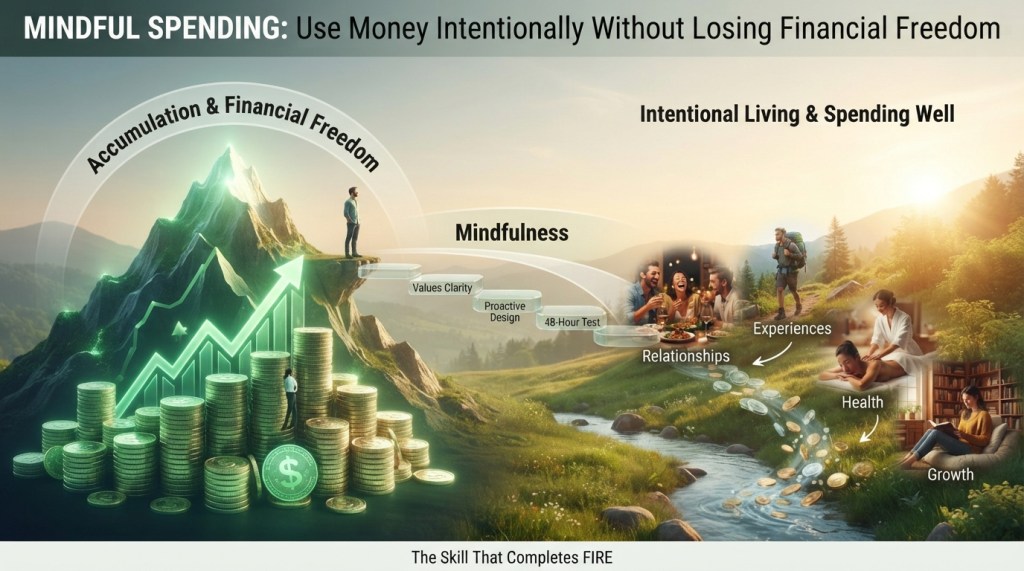
Mindful spending is the practice of aligning your money with your actual values — spending generously on what genuinely matters to you, and eliminating waste on what doesn’t.
The key insight is this: the problem is never the amount you spend. It’s the misalignment.
People feel financial stress not because they spend too much, but because they spend in ways that don’t reflect what they actually care about. They pay for gym memberships they don’t use, subscriptions they’ve forgotten, status purchases that felt exciting for a weekend and hollow for a year. They underspend on experiences that would deeply enrich their lives — travel, connection, health, growth — because those feel indulgent.
Mindful spending flips this. It asks not “How do I spend less?” but “How do I spend better?“
The Four Principles of Mindful Spending
1. Values Clarity Before Spending Decisions
You cannot spend intentionally without knowing what you actually value. And most people — if honest — have never sat down to seriously answer that question.
Not what they think they should value. Not what their social circle signals they should value. What they actually value — what genuinely improves their daily experience of being alive.
For some people, that’s adventure and new experiences. For others, it’s comfort, stability, and beautiful environments. For others still, it’s connection, generosity, and community. Often it’s a combination — and the combination changes across seasons of life.
The practice here is simple but powerful: write down your top five values, then audit your last three months of spending against them.
Look at where your money actually went. Then ask: does this map reflect what I care about? Most people discover a significant gap — money flowing toward low-value habits and away from high-value experiences. That gap is where mindful spending begins.
2. Proactive Spending Design (Not Reactive Restriction)
Traditional budgeting is reactive. You set limits, monitor spending, and feel guilty when you exceed them. It’s a system built around restraint and surveillance — which is why most people find it exhausting and eventually abandon it.
Mindful spending is proactive. Instead of asking “How do I stop myself from spending too much?” it asks “How do I design my spending in advance to reflect my values?”
This is sometimes called a conscious spending plan. The mechanics are simple:
- Fixed essentials: Housing, utilities, insurance, food basics. Pay these first, automate where possible.
- Future self: Savings and investments. Pay this second, before discretionary spending. Automate completely.
- Value-aligned spending: The categories that genuinely enrich your life — travel, health, relationships, learning, experiences. Allocate a deliberate, guilt-free budget here.
- Guilt-free extras: A small buffer for impulse and convenience. Not unlimited, but not zero.
The difference between this and traditional budgeting is philosophical: you’re not restricting yourself. You’re designing a spending life that reflects who you are and what you want. Once the design is in place, everything within it is already approved. Guilt becomes structurally unnecessary.
3. The Time-Delay Test for Discretionary Spending
Not all spending decisions deserve equal deliberation. Routine, low-value purchases don’t need a philosophical framework — they need automation or elimination. But for larger or emotionally charged spending decisions, a simple test dramatically improves quality:
Wait 48 hours before purchasing anything non-essential above a personal threshold (pick a number that feels right — $50, $100, $200).
This isn’t about second-guessing yourself. It’s about separating triggered spending from intentional spending.
Triggered spending is driven by emotion: excitement, stress, social comparison, boredom, FOMO. It feels urgent and compelling in the moment and frequently hollow shortly after. Intentional spending is driven by reflection: this aligns with my values, it will genuinely improve my life, I’ve thought about it and I want it.
The 48-hour gap creates space for the emotion to settle and the intention to clarify. Most triggered purchases evaporate in that window. The ones that survive it are usually worth making — and you’ll make them without guilt because you know they passed the test.
4. The Asymmetry Rule: Spend Up on High-Leverage Categories
One of the most counterintuitive insights in behavioral economics is that people are generally happier spending more on a few high-value things than spreading money evenly across many medium-value things.
This is sometimes called conscious trade-off spending. The idea is to deliberately underspend in categories that don’t affect your quality of life much, and deliberately overspend in categories that have outsized impact on your wellbeing.
For example: if travel is one of your core values, book the better accommodation. Don’t compromise the experience that matters most to you in order to save £20 on a hotel room that will shape your memory of an entire trip. Meanwhile, ruthlessly cut categories you genuinely don’t care about — the streaming services you never watch, the clothes you buy for variety rather than joy, the restaurant meals you have out of habit rather than desire.
The goal isn’t to spend more overall. It’s to concentrate your spending where it actually moves the needle — and strip it away where it doesn’t.
Mindful Spending and Financial Independence: Are They Compatible?
Yes. Unambiguously yes. And not just compatible — they’re synergistic.
Here’s why: the biggest threat to long-term financial independence isn’t overspending. It’s unsustainable underspending that leads to eventual psychological rebellion.
Extreme frugality works mathematically — until it doesn’t emotionally. When people feel chronically deprived, they often overcorrect. The pendulum swings. A period of intense restriction is followed by a period of uncontrolled spending. The discipline collapses precisely because it was built on willpower and deprivation rather than values and intention.
Mindful spending creates a sustainable equilibrium. You spend enough to feel genuinely good about your life. You cut ruthlessly what doesn’t matter. And you maintain the savings discipline that keeps your future self secure — not out of fear, but out of care for the person you’ll be in ten, twenty, thirty years.
This is also where the concept of lifestyle beta becomes useful. In investing, beta measures volatility relative to the market. In lifestyle design, lifestyle beta measures how sensitive your happiness is to your spending level. The goal isn’t to minimize spending — it’s to minimize lifestyle beta. To build a life where your wellbeing doesn’t require constant consumption increases to maintain itself.
Low lifestyle beta people can thrive at a wide range of spending levels. They’ve identified what actually matters to them and built their life around it. They’re not chasing the next upgrade. They’re content — not because they’ve given up, but because they’ve figured out what’s enough.
The Guilt-Free Spending Framework in Practice
Here’s how to put everything above into a practical, repeatable system:
Step 1: Values Audit
Write your top five values. Audit three months of spending against them. Identify the gaps.
Step 2: Design Your Conscious Spending Plan
Allocate your income across the four categories: fixed essentials, future self, value-aligned spending, guilt-free extras. Do this proactively, not reactively.
Step 3: Set Your Time-Delay Threshold
Choose a personal threshold above which you wait 48 hours before purchasing. Stick to it consistently for 60 days until it becomes automatic.
Step 4: Identify Your High-Leverage Categories
Choose two or three spending categories where increased investment genuinely improves your life. Spend generously and deliberately here.
Step 5: Eliminate Low-Value Spending Ruthlessly
Do a subscription audit. Cancel what you don’t use. Identify habitual spending that brings no real joy. Redirect those resources toward your high-leverage categories.
Step 6: Review Quarterly, Not Daily
Mindful spending isn’t about monitoring every transaction. It’s about designing the system well upfront and reviewing it every three months to check alignment. Daily tracking creates anxiety. Quarterly review creates clarity.
When Spending Is the Right Decision
There’s a final reframe worth making explicit — because it’s the one most FIRE-minded people resist the most:
Sometimes, spending is the highest-return investment available.
Spending on your health — quality food, a good mattress, the physiotherapy appointment you’ve been delaying — pays dividends in energy, longevity, and cognitive performance that no index fund can match.
Spending on relationships — the trip to visit an old friend, the dinner where you pick up the bill, the gift that says I was thinking about you — builds social capital and emotional richness that compound quietly over decades.
Spending on experiences — the course that reshapes your thinking, the journey that expands your perspective, the sabbatical that recharges your capacity for work — generates returns in creativity, clarity, and meaning that are genuinely difficult to quantify but impossible to ignore.
The financially independent person who never spends on these things hasn’t won. They’ve just accumulated numbers. The goal was always the life — not the balance sheet that funds it.
Mindful spending is what bridges the two. It’s the practice that turns financial freedom from a spreadsheet achievement into a lived reality.
The Bottom Line
Saving and investing get you to financial independence. Spending well is what makes financial independence worth having.
The skill of spending mindfully — aligning your money with your values, designing your spending proactively, testing your decisions deliberately, and concentrating resources on what genuinely matters — is not a soft, optional add-on to your financial plan. It’s the completion of it.
You’ve already done the hard work of building freedom. Now comes the equally important work of learning to use it.
Spend less than you could. More than you fear. And always, always in the direction of the life you actually want.
Related Reading
If this resonated, these posts will deepen your thinking:
- The Psychology of Enough: How to Redefine Wealth Beyond Money
- The Second-Order Effects of Frugality: When Saving Money Starts to Cost You
- Life After Financial Independence: How to Navigate the Identity Crisis When Work No Longer Defines You
- Why We Buy Things We Don’t Need: The Psychology of Spending Explained
- Lifestyle Inflation Detox: How to Save More and Spend Smarter as You Earn More
- How to Reduce Financial Stress Without Earning More: The Lifestyle Beta Approach
- The Freedom Gap: Why Hitting Your Number Doesn’t Feel Like Freedom
- How to Overcome the Fear of Spending Money: A Mindset Shift


Leave a comment