You finish a chapter. You turn the page. And then it hits you — you have no idea what you just read.
The words passed through your eyes, but nothing landed. You were reading, technically. But your mind was somewhere else entirely — replaying a conversation, drafting an email, wondering what to eat for dinner.
This isn’t a reading problem. It’s an attention problem. And it’s getting worse.
We live in an environment designed to fragment our focus. Notifications, algorithms, infinite feeds — they’ve trained our brains to skim, scroll, and skip. And that training doesn’t stop when we pick up a book. We bring the same scattered attention to the page, and then wonder why we can’t remember what we read last week.
Here’s the uncomfortable truth: most of us have forgotten how to read deeply.
Not because we lack intelligence. Not because we chose the wrong books. But because deep reading is a skill — and like any skill, it atrophies without practice.
The good news? You can rebuild it. And you don’t need a sabbatical, a cabin in the woods, or a new personality. You need a system, a reset, and 30 days.
This is the 30-Day Deep Reading Reset — a structured, weekly system to restore your ability to focus, comprehend, and retain what you read.
Why Deep Reading Is Disappearing
Before we fix the problem, let’s understand it.
Deep reading — the kind where you lose yourself in an argument, wrestle with an idea, or feel a concept physically click into place — requires sustained, uninterrupted attention. It’s a specific cognitive mode. Neuroscientists call it slow thinking — deliberate, effortful, and rich.
But our daily digital environment rewards the opposite. Fast thinking. Surface scanning. Rapid context-switching.
Every time you check your phone between paragraphs, you’re not just interrupting your reading — you’re training your brain to expect interruption. Over time, your attention span shortens. Your tolerance for complexity drops. And books start to feel… harder than they used to.
This isn’t a sign that you’re getting dumber. It’s a sign that your reading muscles have deconditioned.
The 30-Day Deep Reading Reset is designed to reverse that deconditioning — week by week, layer by layer.
How This System Works
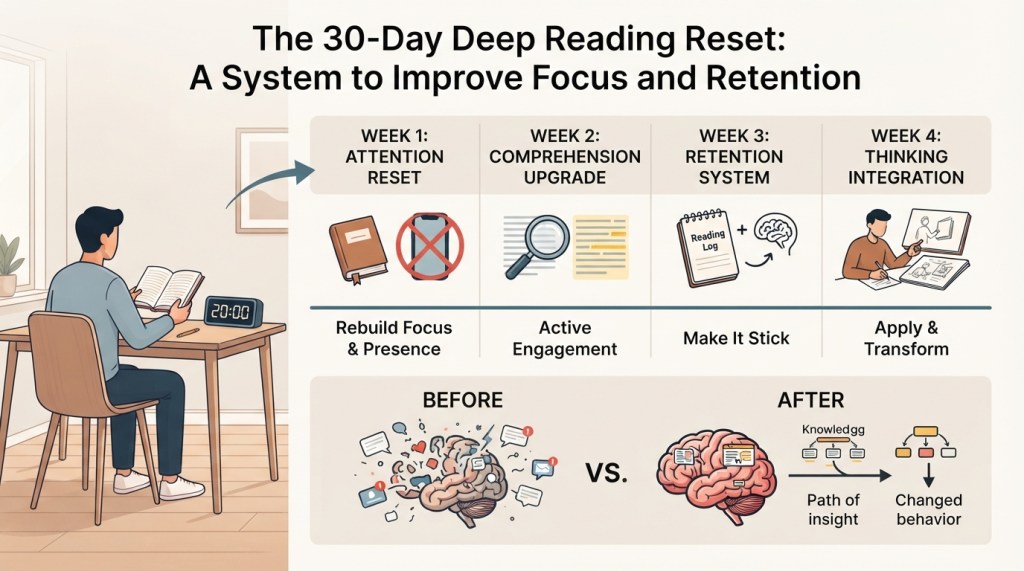
The reset is divided into four weeks, each targeting a different layer of deep reading:
| Week | Focus | Goal |
|---|---|---|
| Week 1 | Attention Reset | Rebuild the ability to focus without distraction |
| Week 2 | Comprehension Upgrade | Read with intention, not speed |
| Week 3 | Retention System | Make what you read stick |
| Week 4 | Thinking Integration | Turn reading into changed thinking and behavior |
Each week builds on the last. By the end of 30 days, you won’t just read more — you’ll read differently.
Daily commitment: 20–30 minutes of focused reading.
That’s it. This isn’t about volume. It’s about depth.
Week 1: The Attention Reset (Days 1–7)
Goal: Rebuild your ability to sustain focus on a single text.
This week is about removing friction and distraction — creating the conditions for deep reading before worrying about what or how you read.
Daily Practice
- Read for 20 minutes without any digital device in the room. Not on silent. Not face-down. Out of the room. Your brain knows it’s there, and even the possibility of a notification splits your attention.
- Read one physical book. If you don’t have one, print a long article. Screens invite skimming. Paper invites presence. This week is about retraining the physical experience of reading.
- Set a timer, but don’t watch it. Use it as a boundary, not a pressure device. When the timer goes off, stop — even mid-paragraph. You’re building a habit, not finishing a book.
- Before each session, write one sentence about what you remember from yesterday’s reading. This creates a micro-retrieval loop. It doesn’t matter if you’re wrong or vague. The act of recalling primes your brain to pay attention today.
What You’re Fixing This Week
You’re detoxing from continuous partial attention — the state where you’re never fully focused on anything because part of your mind is always monitoring something else. By the end of Week 1, you should notice that 20 minutes feels more comfortable. That’s your focus muscle waking up.
End-of-Week Checkpoint
Ask yourself:
- Can I read for 20 minutes without reaching for my phone?
- Do I feel less restless on the page than I did on Day 1?
- Can I recall at least the main idea of yesterday’s reading?
If yes, move to Week 2. If not, repeat Week 1. There’s no shame in that — there’s wisdom in it.
Week 2: The Comprehension Upgrade (Days 8–14)
Goal: Move from passive reading to active engagement.
Most people read like passengers — letting words wash over them, hoping something sticks. This week, you become the driver. You start reading with intention.
Daily Practice
- Increase reading time to 25 minutes.
- Before you begin, write down one question you want the reading to answer. It can be simple: “What’s the author’s main argument?” or “Do I agree with this?” This activates your brain’s filtering system. You read differently when you’re looking for something.
- Mark three passages per session. Underline, highlight, or fold the corner of three moments that strike you — something surprising, confusing, or important. Not more than three. Constraint forces discernment.
- After each session, write a 2–3 sentence summary of what you read. Don’t copy the text. Use your own words. This is the difference between recognition (“I’ve seen this before”) and recall (“I can explain this”). Recall is where comprehension lives.
What You’re Fixing This Week
You’re breaking the passive reading illusion — the feeling that reading = understanding. It doesn’t. Understanding requires engagement: questioning, marking, summarizing. This week, you start reading with the book, not just through it.
End-of-Week Checkpoint
Ask yourself:
- Can I explain what I read today without looking at the book?
- Am I starting to notice the author’s structure and argument?
- Do I have at least a few passages I genuinely found interesting?
Week 3: The Retention System (Days 15–21)
Goal: Make what you read stick beyond the session.
Here’s where most readers fail — not because they don’t understand what they read, but because they never revisit it. Without a system for retention, even the best reading sessions fade within days.
This week introduces a lightweight, sustainable retention practice.
Daily Practice
- Maintain 25-minute focused reading sessions.
- Start each session by reviewing yesterday’s summary and marked passages. Spend 2–3 minutes on this. It feels redundant, but it’s the most powerful retention tool available. You’re leveraging the spacing effect — the cognitive principle that spaced review dramatically improves long-term memory.
- After each session, add one idea to a “Reading Log.” This can be a notebook, a single document, or index cards. Write the idea in your own words, and note why it matters to you. One idea per session. Not ten.
- At the end of the week, review all seven entries. Look for patterns, contradictions, or connections to other things you’ve read or experienced.
What You’re Fixing This Week
You’re solving the forgetting problem. Research shows we forget roughly 70% of what we read within 48 hours — unless we engage in active retrieval. Your Reading Log isn’t busywork. It’s a memory architecture. Over time, it becomes a personalized knowledge base — a record of how your thinking has evolved.
End-of-Week Checkpoint
Ask yourself:
- Can I recall ideas from Day 15 without looking at my notes?
- Is my Reading Log starting to feel like a useful resource?
- Am I beginning to see connections between ideas across sessions?
Week 4: Thinking Integration (Days 22–30)
Goal: Turn reading into changed thinking and behavior.
This is the most important week — and the one most readers never reach. Reading is not complete when you close the book. It’s complete when the book changes how you think, decide, or act.
Daily Practice
- Increase reading time to 30 minutes if comfortable.
- Continue your Reading Log, but add a new column: “Application.” For each idea you log, write one way it could apply to your life, work, or thinking. Even small applications count: “This changes how I think about risk.” or “I want to try this in my morning routine.”
- Choose one idea from the week and act on it. Not five. One. Put it into practice. Test it. See what happens. Reading without application is entertainment. Reading with application is transformation.
- On Day 30, write a one-page reflection. Answer three questions:
- What has changed about how I read?
- What’s the most important idea I encountered this month?
- What will I carry forward into my regular reading practice?
What You’re Fixing This Week
You’re closing the knowledge-action gap — the space between knowing something and doing something about it. Most readers accumulate information without ever converting it into behavior. This week, you practice the conversion. And once you see how it works, you’ll never read the same way again.
End-of-Week Checkpoint
Ask yourself:
- Have I applied at least one idea from this month’s reading?
- Do I feel like I’m reading differently than I was 30 days ago?
- Do I have a system I can sustain beyond this reset?
After the Reset: What to Keep
You don’t need to maintain every practice forever. But here are the non-negotiables to carry forward:
- Read without your phone in reach. This single change is worth more than any reading technique.
- Start each session with a question. Even a vague one. It changes your reading from passive to purposeful.
- Keep a Reading Log. One idea per session, in your own words. Over a year, that’s 300+ curated ideas — a personal intellectual library.
- Review before you read. Spend two minutes revisiting yesterday’s notes. It costs almost nothing and multiplies retention.
- Apply one idea per book. Not every idea. One. Give it a real test in your life.
The Deeper Shift
This reset isn’t really about reading. It’s about reclaiming your attention.
In a world that profits from your distraction, the ability to sit with a single idea for 30 minutes is a radical act. It’s a competitive advantage. It’s a health practice. And over time, it compounds — not just in knowledge, but in clarity, creativity, and calm.
You don’t need to read more books. You need to read fewer books, better.
The 30-Day Deep Reading Reset doesn’t add more to your plate. It changes the way you digest what’s already there.
Start tomorrow. One book. Twenty minutes. No phone.
And see what happens when you remember what you read.
Related Reading
If this resonated, you’ll find these posts valuable:
- How to Read for Retention: Why Reading Too Fast is a Mistake
- The Reading Afterlife: What to Do After You Finish a Book to Remember and Apply It
- Cognitive Friction: Why Some Books Change Your Thinking (and Others Don’t)
- How to Read Critically: Why Disagreeing With Books Makes You a Smarter Reader
- How to Remember More of What You Learn (Using the Forgetting Curve)
- Why Smart Readers Still Don’t Change: How to Apply What You Read
- Reading on Paper vs Screens: Why Analog Learning Still Wins
- The Compound Effect of Reading: How 20 Minutes a Day Changes a Life


Leave a comment