You’ve packed light. One backpack. No checked luggage. You feel proud.
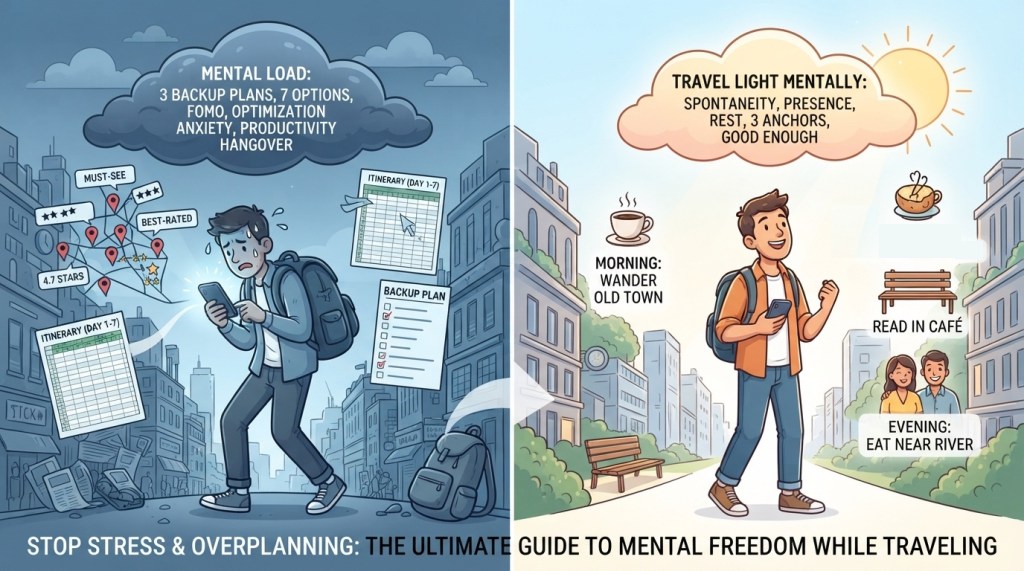
But your mind? Your mind is carrying three backup plans, seven restaurant options, a color-coded itinerary, two contingency hotel bookings, and a low-grade anxiety about whether you’ll miss the “best” version of this trip.
Your suitcase is minimal. Your mental load is maximal.
This is the problem nobody talks about in travel culture. We’ve optimized packing lists down to the gram. We’ve mastered carry-on-only travel. But we haven’t learned how to travel light mentally — to show up in a new place without dragging our need for control, certainty, and optimization along with us.
This blog is about fixing that.
Why We Overplan in the First Place
Let’s start with honesty: overplanning feels productive. It feels responsible. It feels like you’re “making the most” of your trip.
But here’s what’s actually happening.
When you overplan, you’re trying to eliminate uncertainty. And uncertainty is the entire point of travel. You left home to experience something different, something unscripted, something you couldn’t predict. Then you spent 40 hours before departure trying to predict every minute of it.
This isn’t a character flaw. It’s a nervous system response.
Your brain treats unfamiliar environments as mild threats. New language. New currency. New streets. New food. Your prefrontal cortex tries to reduce that threat by planning, researching, and controlling. The more you plan, the safer you feel — temporarily.
But the cost is enormous:
- Decision fatigue before you even arrive. You’ve already made 200 micro-decisions about restaurants, routes, and timing. You land exhausted, not excited.
- Rigidity that kills spontaneity. When everything is scheduled, a surprise invitation from a local or an unexpected detour feels like a disruption, not a gift.
- Comparison with expectation. The more detailed your plan, the more likely reality will fall short. That “best-rated” café wasn’t that special. That “must-see” viewpoint was crowded. Now you’re disappointed — not because the experience was bad, but because it didn’t match the movie you’d already played in your head.
Overplanning doesn’t enhance travel. It replaces it.
You end up experiencing your itinerary instead of the place.
The Mental Packing List: What You’re Carrying Without Realizing
Physical packing lists are easy to audit. You open your bag, you see what’s inside, you remove what you don’t need.
Mental baggage is harder to see. But it’s heavier.
Here’s what most travelers carry without realizing:
1. The Need to Optimize
The belief that there’s a “best” restaurant, a “best” neighborhood, a “best” time to visit a landmark — and that missing it means you’ve failed. This turns every decision into a research project and every meal into a performance review.
2. The Sunk Cost of Research
You spent 6 hours reading reviews and building a Google Maps list with 47 pins. Now you feel obligated to visit them all. Not because you want to, but because you already invested the time. Your research becomes a to-do list you didn’t mean to create.
3. The Fear of Missing Out
Not social media FOMO. Travel FOMO. The anxiety that while you’re sitting in a quiet park, you could be at that market everyone mentioned. While you’re at the market, you could be at that viewpoint. You’re never where you are because you’re always calculating where you should be.
4. The Productivity Hangover
If you come from a high-performance background — especially FIRE (Financial Independence, Retire Early)-minded people who optimize everything — you carry the habit of “making the most” of every hour. Rest feels lazy. Wandering feels wasteful. Sitting in a café without a plan feels like you’re losing time.
5. The Documentation Burden
The quiet pressure to photograph, journal, or post about everything. Not for yourself, but to prove the trip happened. This pulls you out of the moment and into performance mode.
These invisible weights don’t show up in your luggage. But they determine whether you come home rested or drained.
The Traveling Light Mentally Framework
Here’s a practical system to reduce your mental load before, during, and after every trip.
Step 1: Set a Planning Budget (Time-Box Your Research)
This one change will transform your travel experience.
Give yourself a fixed amount of time to plan — and then stop. For most trips, this looks like:
- Weekend trip (2–3 days): 30 minutes of planning. Total.
- One-week trip: 1–2 hours of planning.
- One-month trip: 3–4 hours of planning.
That’s it.
In that window, decide only three things:
- Where you’ll sleep the first night.
- One thing you’d genuinely regret missing.
- How you’ll get from the airport/station to your accommodation.
Everything else? Figure it out when you arrive.
This sounds terrifying if you’re a planner. But here’s the truth: you will figure it out. Humans have been navigating unfamiliar places for thousands of years without Google Maps pins. Your ability to adapt is far stronger than your anxiety gives it credit for.
The magic of travel lives in the unplanned space.
Step 2: Apply the “3 Anchors” Method
A fully open day is sometimes just as stressful as an overplanned one. Complete ambiguity creates its own anxiety.
The solution is what I call the 3 Anchors method:
Each day, choose a maximum of three anchors — loose intentions, not scheduled appointments.
Example:
- Morning: Walk through the old town.
- Afternoon: Find a café and read.
- Evening: Eat somewhere near the river.
That’s it. No times. No reservations. No addresses. Just three directional anchors that give your day shape without giving it rigidity.
The white space between anchors is where travel actually happens. That’s where you stumble into the conversation, the shortcut, the street musician, the meal that becomes the story you tell for years.
Structure without control. Direction without a schedule.
Step 3: Practice the “Good Enough” Principle
Not every meal needs to be the best meal.
Not every neighborhood needs to be the most authentic.
Not every café needs to have 4.7 stars on Google.
When you adopt a “good enough” mindset, you eliminate 80% of decision fatigue instantly. You walk until you see a place that looks decent. You sit down. You order. You enjoy it.
Was it the best restaurant in the city? Who cares. It was the one you found, in the moment, without stress. That makes it better than any optimized choice you agonized over for 30 minutes while standing on a street corner staring at your phone.
“Good enough” isn’t settling. It’s freedom.
Step 4: Build in Intentional White Space
This is the most counterintuitive advice for ambitious travelers: plan empty time.
Block out half-days or full days with absolutely nothing scheduled. No anchors. No intentions. Just time.
This is where your nervous system catches up. This is where you stop performing “traveler” and start actually being in a place. You notice the quality of light. You hear the rhythm of a city. You feel your own energy without an agenda pushing you forward.
White space is not wasted time. It’s the highest-quality travel time you’ll experience.
For every 3 days of active exploration, build in 1 day of nothing. Your future self will thank you.
Step 5: Do a Mental Luggage Check (Daily)
Every evening, spend two minutes asking yourself:
- Am I trying to control tomorrow, or am I open to it?
- Am I chasing an experience because I want it, or because I feel I should?
- Am I present here, or am I already planning the next destination?
These questions are gentle. They’re not meant to create guilt. They’re meant to create awareness.
Most of the time, you’ll catch yourself mid-pattern: “Oh, I just spent 45 minutes researching tomorrow’s lunch. I don’t need to do that.”
Awareness is the first step toward letting go.
What Traveling Light Mentally Actually Feels Like
When you drop the mental weight, travel transforms. Here’s what changes:
Your energy doubles. You stop spending cognitive resources on logistics and start spending them on experience. You arrive at the end of the day tired from walking and exploring — not from deciding and worrying.
You become approachable. People with open schedules and relaxed body language attract conversations. The tightly-scheduled traveler speed-walking to the next pin on their map does not. Some of the best travel experiences come from being available, not from being efficient.
You remember more. Neuroscience confirms this: memories form more strongly when they’re attached to emotion and novelty. Unplanned moments carry both. Overplanned moments carry neither. The surprise alley, the unexpected rainstorm, the café you ducked into without thinking — those become the stories. The researched, reviewed, and optimized restaurant becomes forgettable.
You come home rested. This is the biggest shift. Most people return from vacation needing a vacation. That’s because they spent the entire trip in execution mode — checking things off, staying on schedule, maximizing. When you travel light mentally, you return with more energy than you left with. The trip actually does what it was supposed to do: restore you.
The Paradox of Less Planning, Better Trips
Here’s the counterintuitive truth that experienced travelers eventually discover:
The less you plan, the better your trips become.
Not because planning is bad. But because over-planning crowds out the very thing that makes travel valuable — the unexpected.
The best meal of your life won’t come from a Google search. It’ll come from a local pointing you down a side street. The most meaningful conversation won’t be in a scheduled walking tour. It’ll be with a stranger at a bus stop. The view that takes your breath away won’t be the one with 10,000 Instagram posts. It’ll be the one you found by accident while you were lost.
You can’t plan serendipity. But you can create the conditions for it.
Those conditions are: an open schedule, a calm mind, and the willingness to not know what happens next.
A Challenge Before Your Next Trip
Before your next trip — whether it’s a weekend away or a month abroad — try this:
- Cut your research time in half. Whatever you’d normally spend, halve it.
- Delete half your Google Maps pins. Keep only the ones that genuinely excite you. Be honest.
- Leave one full day completely unplanned. No anchors. No intentions. See what happens.
- Put your phone away for 2 hours each day. No maps. No reviews. Just walk.
You’ll feel uncomfortable at first. That discomfort is your brain adjusting to uncertainty. Let it adjust. On the other side of that discomfort is the trip you actually wanted to take.
Final Thought
Travel isn’t about seeing the most things. It’s about being changed by what you see.
And you can’t be changed if you’re too busy managing logistics to actually be present.
Pack light physically. But more importantly, pack light mentally. Drop the backup plans. Release the need to optimize. Stop trying to have the perfect trip and let yourself have a real one.
The best travelers aren’t the ones who’ve seen the most places. They’re the ones who were actually there when they arrived.
Related Reading
If this resonated, you might enjoy these:
- How to Avoid Travel Fatigue: Planning Trips Around Your Energy and Circadian Rhythm
- Why Rest Days Are the Secret to Better Travel: How Doing Less Helps You Experience More
- Mental Carry-On: How to Learn From Travel (Not Just Visit Places)
- The Energy Budget of Travel: How to Avoid Travel Fatigue and Explore Without Exhaustion
- Why Comfort is a Force Multiplier for Long-Term Travel (and Prevents Burnout)
- How to Travel Full-Time Without Becoming a Professional Tourist (or Burning Out)
- Why Travel in Chapters Works Better Than Checklists
- Minimalist Packing List: The System That Frees Your Mind (Not Just Your Suitcase)


Leave a comment