Every travel blog tells you the same thing: visit Prague in spring, Kyoto during cherry blossom season, the Amalfi Coast in June. The advice is so universal that it has become invisible. You follow it, you arrive, and you spend half your trip standing behind someone else’s selfie stick.
I used to plan my trips the same way. I’d research the “best time to visit” a destination, book flights around peak weather, and then wonder why the experience felt more like a theme park than a place where actual humans lived.
Everything changed when I accidentally visited Lisbon in February.
It was supposed to be a mistake — a scheduling error that put me in Portugal during what every guidebook calls the “worst” month. The weather was overcast. Some restaurants were closed. The tram lines ran on reduced schedules. And yet it became one of the most memorable trips I’ve ever taken. The streets were quiet enough to hear the tiles on the buildings. I had entire museums to myself. A local café owner spent forty minutes explaining the history of his family’s pastéis de nata recipe because he wasn’t drowning in tourists.
That trip taught me something I now treat as a core travel principle: the worst month to visit a place is often the best month to actually experience it.
Here’s why, and how to use off-season travel as a deliberate strategy rather than a scheduling accident.
What “Off-Season” Actually Means (It’s Not Just Winter)
Most people hear “off-season” and picture rain, cold, and closed attractions. That’s a narrow definition that misses the real point.
Off-season is simply the period when tourist demand drops below a destination’s capacity. That can happen for many reasons — weather, school calendars, cultural holidays, or even global events. In Southeast Asia, off-season is the monsoon window (June–September). In the Mediterranean, it’s November through March. In Patagonia, it’s the austral winter (May–August). In Japan, the gap between cherry blossom season and autumn foliage creates a quiet window in late June.
The key insight is that off-season is relative to the destination, not to your calendar. February is off-season for Europe but peak season for Thailand. August is peak for Italy but dead quiet for Dubai. The “worst” month depends entirely on where you’re going and what the tourism industry has decided to optimize for.
And that optimization is exactly what creates your opportunity.
The Cost Advantage Is Bigger Than You Think
Let’s start with the most tangible off-season travel benefit: money.
During peak season, you’re paying a premium for scarcity. Hotels raise rates because they can. Flights cost more because demand outstrips supply. Even restaurant prices creep upward in tourist zones during high season because the customer base shifts from price-sensitive locals to once-in-a-lifetime visitors who won’t comparison shop.
Off-season flips this dynamic entirely.
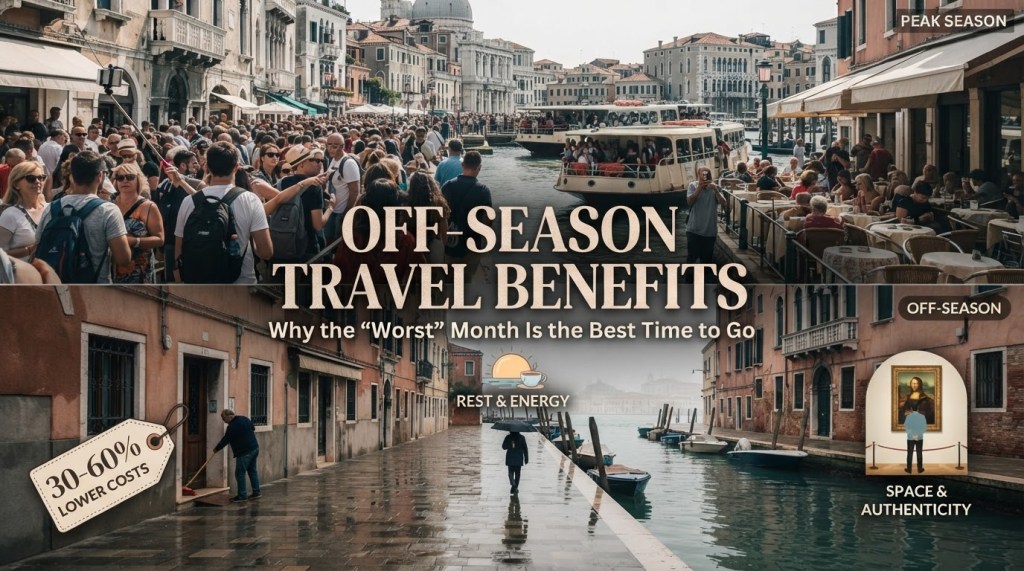
In practical terms, you can expect 30–60% lower accommodation costs in most destinations during their off-season. A boutique hotel in Dubrovnik that charges €250 per night in July might drop to €90 in November. A flight to Athens that costs $800 in June can be found for $350 in January. These aren’t edge cases — they’re the norm.
But the savings extend beyond the obvious line items. Off-season travel reduces what I call friction costs — the small, invisible expenses that accumulate during peak travel. You spend less on surge-priced Ubers because there’s no demand spike. You don’t pay €40 for a skip-the-line ticket because there is no line. You eat at better restaurants for less because they’re competing for the smaller pool of customers rather than turning them away.
If you’re on the path to financial independence, these savings compound in a way that matters. A two-week peak-season trip to Europe might cost $4,000. The same trip in the off-season might cost $2,200. That $1,800 difference, invested annually over a decade, is real money working toward your freedom. Travel doesn’t have to compete with your FIRE (Financial Independence, Retire Early) goals. It can coexist with them — if you’re strategic about timing.
The Crowd Vacuum: Space as the Ultimate Luxury
Cost savings are nice, but the real reason I now default to off-season travel has nothing to do with money. It has to do with space.
Peak-season travel compresses you into shared infrastructure with thousands of other people who had the exact same idea. You wait in lines. You compete for tables. You photograph landmarks through a forest of raised phones. The destination becomes a backdrop for a social performance rather than a place you inhabit.
Off-season travel creates what I think of as a crowd vacuum. The infrastructure is still there — the museums, the trails, the restaurants, the architecture — but the density of bodies occupying it drops dramatically. The result is a fundamentally different experience.
I’ve walked through the Alhambra in Granada in January with fewer than fifty other people in the entire complex. I’ve sat alone in the Uffizi Gallery in Florence on a Tuesday in November, staring at a Botticelli for twenty minutes without someone bumping into my shoulder. I’ve hiked the Cinque Terre trails in February with nothing but the sound of the sea and my own breathing.
These aren’t minor quality-of-life improvements. They’re the difference between visiting a place and being in a place. When you remove the crowd layer, you start noticing details that peak-season tourists literally cannot see because they’re navigating a human obstacle course. You notice the way light hits a building at a particular hour. You notice the rhythm of local life that continues regardless of tourism. You notice your own thoughts, which is arguably the most underrated benefit of travel.
Space is the luxury that money can’t buy during peak season. Off-season gives it to you for free.
The Authenticity Shift: Locals Reclaim Their Cities
Here’s something that rarely gets discussed in travel content: peak season displaces local life.
When a city is flooded with tourists, the local economy reshapes itself around visitor demand. Restaurants switch to English-only menus and raise prices. Shops replace everyday goods with souvenirs. Neighborhoods that were once residential become Airbnb monocultures. Locals retreat to the margins of their own cities, and the version of the place you experience becomes a curated performance designed for consumption.
Off-season reverses this dynamic. When the tourist wave recedes, the city reverts to its default state. The restaurants that survive the quiet months are the ones locals actually eat at. The shops that stay open sell things residents need. The rhythm of daily life — the morning market, the afternoon closure, the evening passeggiata — resumes its natural tempo.
This is when you get the interactions that make travel transformative. The conversation with a shopkeeper who has time to talk. The invitation to a neighborhood event that isn’t listed on any tourism website. The meal at a family-run place that doesn’t have a Google Maps listing because it doesn’t need one.
Authenticity isn’t something you can schedule. But you can create the conditions for it, and the single most reliable condition is showing up when the crowds don’t.
The Energy Advantage: Travel at the Speed of Rest
If you’ve read my writing on travel fatigue and energy management, you know I think of travel as an energy budget, not a time budget. Peak-season travel drains that budget faster than almost any other activity. The heat, the crowds, the sensory overload, the pressure to “see everything” before the window closes — it’s exhausting.
Off-season travel naturally slows the pace. Shorter daylight hours in winter destinations mean you’re not trying to cram fourteen hours of sightseeing into a single day. Cooler temperatures make walking more comfortable and reduce the midday crash that plagues summer travelers. The absence of crowds removes the low-grade stress of navigating packed spaces, which is a bigger cognitive drain than most people realize.
The result is that off-season trips tend to be more restorative than peak-season ones. You return home feeling like you actually took a break rather than like you need a vacation from your vacation.
The Weather Objection (And Why It’s Overblown)
The most common pushback against off-season travel is weather. “But it’ll be cold. But it’ll rain. But the beaches will be closed.”
These are valid concerns, and I won’t pretend that off-season weather is always ideal. But the objection is usually overstated for three reasons.
First, “bad” weather is often just different weather. A rainy afternoon in Kyoto is atmospheric, not ruined. A foggy morning in San Francisco is more interesting than a clear one. Overcast skies in Iceland create dramatic light that photographers actively chase. The idea that travel requires blue skies and 25°C is a marketing construct, not a lived reality.
Second, weather is less predictable than tourism calendars suggest. I’ve experienced scorching heat waves in European “shoulder seasons” and gorgeous sunny weeks in the middle of winter. The peak/off-season binary is a statistical average, not a guarantee. You can get lucky — or unlucky — at any time of year.
Third, indoor experiences don’t have a season. Museums, galleries, thermal baths, cooking classes, bookshops, cafés, concerts, and long dinners are weather-independent. If your travel philosophy centers on culture, learning, and human connection rather than beach days and outdoor festivals, the weather penalty of off-season travel is minimal.
A Simple Framework for Choosing Your Off-Season Window
If you want to start experimenting with off-season travel, here’s the system I use:
- Identify the peak months for your destination using tourism board data (not travel blogs, which tend to parrot each other).
- Move two months in either direction. If peak is June–August, look at April or October. This is the “shoulder-to-off” sweet spot where weather is still tolerable but crowds have thinned significantly.
- Check for local holidays and events. Sometimes an off-season month contains a major festival that temporarily recreates peak conditions. You want to avoid these unless the festival itself is the reason you’re going.
- Accept the trade-offs explicitly. Some attractions will have shorter hours. Some seasonal restaurants will be closed. Acknowledge this upfront so it feels like a choice rather than a disappointment.
- Stay longer. Off-season travel rewards slow travel. When you’re not fighting crowds, you don’t need to rush. Two weeks in an off-season city will give you a deeper experience than three weeks during peak.
The Bottom Line
The travel industry optimizes for volume. It wants everyone in the same place at the same time because that’s when the margins are highest. Your experience is a secondary concern.
Off-season travel is a quiet act of opting out of that system. It saves you money, gives you space, connects you with local life, and protects your energy. It asks you to tolerate imperfect weather in exchange for a version of a place that most tourists will never see.
The “worst” month is only the worst if you measure travel by the standards the industry has set for you. If you measure it by depth, authenticity, and personal growth, the worst month might be the only one worth going.
Related Reading
- Slow Travel: Why Staying Longer Saves Money and Creates Richer Experiences
- Why Repeating Destinations Beats Chasing New Ones: The Case for Slow Travel
- The Energy Budget of Travel: How to Avoid Travel Fatigue and Explore Without Exhaustion
- How to Budget for Travel: The Simple 3-Number System
- Why Rest Days Are the Secret to Better Travel: How Doing Less Helps You Experience More
- Geoarbitrage 101: Living Well for Less Around the World
- Why Comfort is a Force Multiplier for Long-Term Travel (and Prevents Burnout)
- How to Avoid Travel Fatigue: Planning Trips Around Your Energy and Circadian Rhythm


Leave a Reply