There’s a quiet crisis happening inside the bodies of most people reading this. It doesn’t show up on a blood test at your annual checkup. Your doctor probably hasn’t mentioned it. And you won’t feel it — until one day, getting out of a low chair requires a deliberate push off the armrest.
It’s called sarcopenia: the age-related loss of muscle mass. And it starts earlier than you think.
For decades, the public health conversation around protein has been dominated by fear. Too much protein will damage your kidneys. Too much protein is bad for the environment. Too much protein is just unnecessary unless you’re a bodybuilder. Meanwhile, the actual data tells a very different story — one where most adults over 35 are eating far too little protein to protect the muscle, metabolism, and metabolic resilience they’ll need in their 60s, 70s, and beyond.
If you care about longevity — not just living longer, but living capably longer — protein is the most underappreciated lever you have. Here’s why, and exactly how much you need.
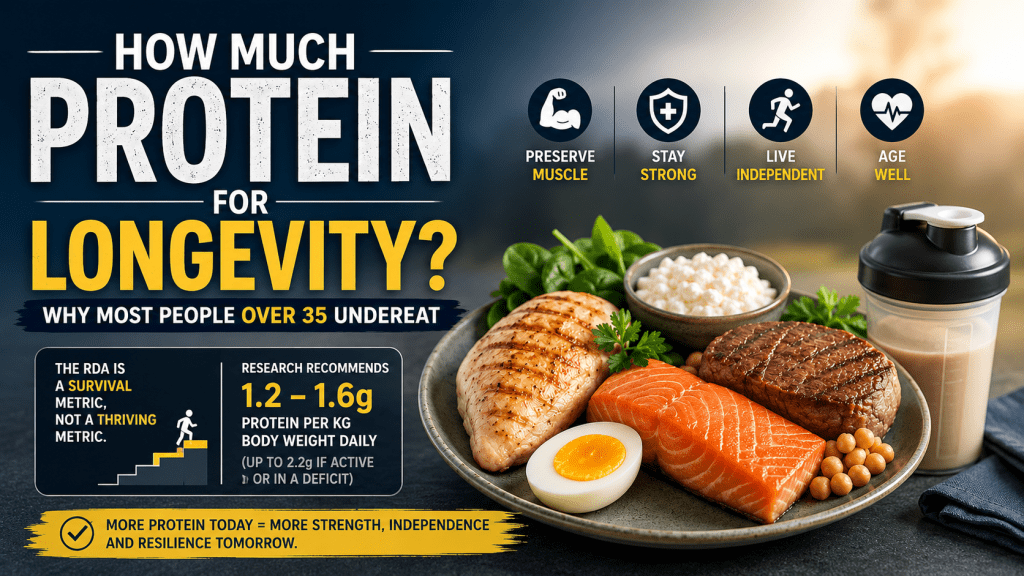
The RDA is a Survival Metric, Not a Thriving Metric
Let’s start with the number most people know: 0.8 grams of protein per kilogram of body weight per day. That’s the Recommended Dietary Allowance (RDA), and it’s the figure printed on government websites, quoted by dietitians, and baked into nutrition labels worldwide.
The problem? The RDA was never designed to optimize health. It was designed to prevent deficiency in the average sedentary adult. It’s the nutritional equivalent of the minimum wage — technically enough to keep you alive, but not enough to build a life on.
A growing body of research, including position stands from the PROT-AGE Study Group and the European Society for Clinical Nutrition and Metabolism (ESPEN), now argues that the RDA is insufficient for older adults. The RDA doesn’t account for anabolic resistance (more on that in a moment), the increased protein needs during illness or recovery, or the muscle preservation required to maintain independence as you age.
Think of the RDA as the floor. For longevity, you want the ceiling.
What Happens to Your Body After 35
Here’s the biological reality that makes protein non-negotiable after your mid-thirties.
Muscle loss begins around age 30 to 35. In your twenties, your body builds muscle almost by accident. You can skip the gym for a month, eat poorly, and bounce back quickly. After 35, the default direction shifts. Without deliberate stimulus and adequate protein, you lose roughly 3–8% of your muscle mass per decade. That rate accelerates sharply after 60.
Anabolic resistance sets in. This is the key concept most people miss. As you age, your muscles become less responsive to the protein you eat. A 25-year-old can eat 20 grams of protein and trigger a robust muscle-building response. A 55-year-old eating the same 20 grams gets a significantly blunted signal. Your muscles essentially develop a higher threshold for activation. You need more protein per meal to achieve the same anabolic effect you got effortlessly in your twenties.
Hormonal changes compound the problem. Declining testosterone in men and estrogen in women both reduce the body’s ability to synthesize new muscle protein. This isn’t a reason to panic — it’s a reason to adjust your inputs.
The result of all three factors is a slow, invisible erosion of the tissue that keeps you metabolically healthy, physically independent, and resilient against falls, fractures, and chronic disease. Muscle isn’t just about looking good at the beach. It’s the organ of longevity.
How Much Protein Do You Actually Need?
So what does the current evidence actually recommend?
For adults over 35 who want to preserve muscle mass and optimize healthspan, the research consensus is converging on 1.2 to 1.6 grams of protein per kilogram of body weight per day. For those who are physically active, strength training regularly, or in a calorie deficit, the upper end can extend to 1.6–2.2 g/kg/day.
To put that in practical terms:
| Body Weight | RDA (0.8 g/kg) | Longevity Target (1.6 g/kg) |
|---|---|---|
| 70 kg (154 lbs) | 56 g/day | 112 g/day |
| 80 kg (176 lbs) | 64 g/day | 128 g/day |
| 90 kg (198 lbs) | 72 g/day | 144 g/day |
Notice the gap. The longevity target is roughly double the RDA. Most people over 35 are eating somewhere near the RDA — or below it — which means they’re chronically under-fueling the very tissue that will determine their quality of life in later decades.
A landmark 2018 study published in the Journal of the American Medical Directors Association found that older adults who consumed the most protein (roughly 1.2 g/kg/day or higher) had 40% less muscle loss over a three-year period compared to those eating the least. That’s not a marginal difference. That’s the difference between walking independently at 80 and needing assistance.
The Protein Timing Myth vs. Reality
You’ve probably heard that protein timing doesn’t matter — that total daily intake is all that counts. This is partially true and partially misleading.
Total daily intake is the most important variable. If you hit your protein target by the end of the day, you’re ahead of most people. But because of anabolic resistance, how you distribute that protein across meals matters more as you age.
Research from Dr. Stuart Phillips’ lab at McMaster University suggests that spreading protein intake across three to four meals, each containing 30–40 grams of high-quality protein, produces a superior muscle protein synthesis response compared to backloading most of your protein at dinner — which is exactly how most people eat.
The typical Western diet looks like this: 10 grams at breakfast (toast and coffee), 15 grams at lunch (a salad with a bit of chicken), and 50 grams at dinner (a large steak). That’s 75 grams total, and only one meal crosses the anabolic threshold. A better distribution would be 35–35–35, which triggers muscle protein synthesis three times instead of once.
You don’t need to obsess over this. But if you’re over 35 and eating a cereal-and-coffee breakfast, you’re leaving significant longevity gains on the table.
Why Most People Over 35 Undereat
If the evidence is this clear, why are so many people falling short? A few reasons:
1. Appetite declines with age. Hormonal shifts, reduced physical activity, and slower digestion all conspire to make you less hungry. You simply don’t feel like eating as much, even though your protein needs have increased.
2. The diet culture hangover. Years of messaging about calorie restriction, intermittent fasting, and “eating clean” have trained many people to view eating less as inherently virtuous. Protein-dense foods are often calorie-dense, which makes them the first thing people cut when they’re trying to “be good”.
3. Convenience bias. Protein requires more planning than carbohydrates. A bagel takes 30 seconds. Grilling chicken or preparing Greek yogurt takes more effort. When life gets busy — and it always gets busier after 35 — protein is the first macronutrient to get sacrificed.
4. Misinformation about kidney health. The persistent myth that high protein intake damages healthy kidneys has been thoroughly debunked in the research literature for people with normal kidney function. Yet it lingers in popular discourse and keeps people eating below their needs.
5. The “I’m not an athlete” fallacy. Most people associate high protein intake with bodybuilders and CrossFit enthusiasts. They don’t realize that a 50-year-old trying to maintain the muscle to carry groceries up a flight of stairs has a proportionally similar protein requirement per kilogram of lean mass.
A Simple Framework to Hit Your Protein Target
You don’t need a food scale or a macro-tracking app to fix this. Here’s a practical framework:
Step 1: Calculate your target. Multiply your body weight in kilograms by 1.6. That’s your daily goal. Round to the nearest 10 for simplicity.
Step 2: Anchor protein at breakfast. This is the single highest-impact change. Replace your carb-heavy breakfast with 30–40 grams of protein. Think eggs and Greek yogurt, a protein smoothie, or cottage cheese with fruit. This one shift alone often closes 50% of the gap.
Step 3: Include a palm-sized protein source at every meal. A palm-sized portion of chicken, fish, tofu, or legumes delivers roughly 25–35 grams of protein. If you do this three times a day, you’re likely at or near your target.
Step 4: Use protein-rich snacks strategically. If you’re still short, a handful of almonds, a hard-boiled egg, or a protein shake in the afternoon can bridge the remaining gap.
Step 5: Prioritize leucine-rich sources. Leucine is the amino acid that acts as the primary trigger for muscle protein synthesis. Animal proteins (eggs, dairy, meat, fish) are naturally high in leucine. If you’re plant-based, combine sources (rice and beans, lentils and quinoa) and consider a leucine supplement to ensure you’re crossing the anabolic threshold per meal.
The Longevity Payoff
Here’s what adequate protein intake actually buys you over a lifetime:
- Preserved muscle mass, which is the strongest physical predictor of independence in old age.
- Better metabolic health, because muscle is the body’s largest glucose sink. More muscle means better blood sugar regulation and lower risk of type 2 diabetes.
- Stronger bones, since protein intake is positively correlated with bone mineral density — a critical factor in preventing hip fractures, one of the most life-altering events in aging.
- Improved immune function, as antibodies and immune cells are built from amino acids.
- Faster recovery from illness, surgery, and injury, all of which become more frequent with age and demand significantly more protein than baseline.
Protein isn’t a supplement. It isn’t a trend. It’s the structural material your body uses to maintain the physical infrastructure that keeps you alive, mobile, and metabolically resilient. Undereating it after 35 is like deferring maintenance on a house you plan to live in for another 40 years.
The Bottom Line
The RDA was designed to prevent deficiency, not to optimize aging. After 35, anabolic resistance, hormonal shifts, and gradual muscle loss mean your protein needs are higher than they were in your twenties — even though your appetite is probably lower.
Aim for 1.2–1.6 g/kg/day, distribute it across three or four meals with at least 30 grams per sitting, and prioritize high-quality sources rich in leucine. You don’t need to eat like a bodybuilder. You need to eat like someone who plans to be strong, capable, and independent at 75.
Your future self will thank you — probably while carrying their own groceries up a flight of stairs without thinking twice.
Related Reading
- Strength Training for Longevity: The Muscle Retirement Plan
- Healthspan vs Lifespan: How to Live Better, Not Just Longer
- How to Train After 30: A Complete Guide to Strength, Mobility, and Longevity
- Why Grip Strength Predicts Longevity (And How to Improve It)
- Metabolic Flexibility: What It Is, Why It Matters, and How to Improve It
- How to Build Healthy Eating Habits That Last (Without the Overwhelm)
- The Minimum Effective Longevity Habits: What Actually Improves Healthspan
- Training for the Life You Want at 60: Strength Training for Longevity (Not Just Looks)


Leave a Reply