For the first two decades of adulthood, fitness is usually about aesthetics or performance. We train to look good in a mirror, to lift heavier than someone else, or to run faster than our past selves. The gym is the temple, the spreadsheet is the scripture, and pain is the proof of progress.
Then you hit 40.
Maybe it’s a knee that doesn’t warm up anymore. Maybe it’s the lower back tweak that lingers for weeks. Or maybe it’s the quiet realization that you’re dreading your workout instead of looking forward to it. The model that served you in your 20s and 30s starts to fracture. The intensity required to see gains feels disproportionate to the recovery cost.
This is the longevity cliff. It’s where most people either double down on intensity and get injured, or they quit entirely and become sedentary.
But there’s a third path. It’s not about abandoning structure, but it is about abandoning the idea that suffering is a prerequisite for health. After 40, the best workout for longevity isn’t always the one that burns the most calories or builds the most muscle. It’s the one you’ll still be doing at 60.
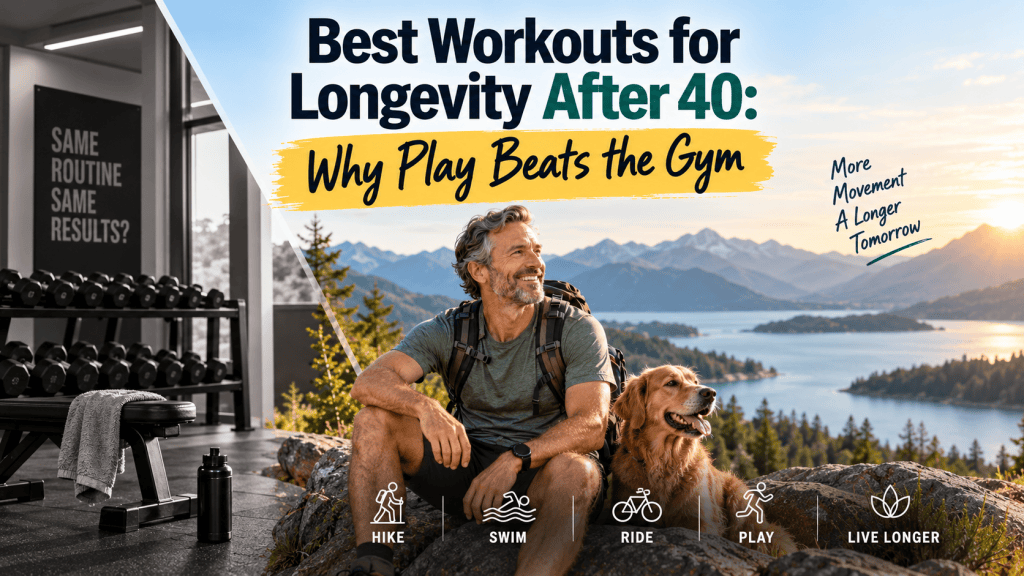
And increasingly, the data suggests that unstructured movement — play — beats the gym for long-term adherence, stress management, and functional health.
The Gym Trap: Why Intensity Backfires After 40
There is nothing inherently wrong with the gym. Weight training is critical for combating sarcopenia (muscle loss), and controlled cardio has its place. But the culture of the gym often works against the biology of aging.
Recovery slows down. In your 20s, you could crush a leg day and be back at it 48 hours later. After 40, connective tissue takes longer to repair, hormonal profiles shift, and systemic fatigue accumulates faster. When you treat your body like it’s still 25, you enter a cycle of micro-injuries that never fully heal.
Cortisol compounds. High-intensity interval training (HIIT) and heavy lifting spike cortisol. In moderation, this is fine. But for many people over 40 who are already managing career stress, financial pressure, and family responsibilities, adding physiological stress on top of psychological stress keeps the nervous system in a sympathetic (fight-or-flight) state. Chronic elevation of cortisol inhibits recovery, disrupts sleep, and encourages visceral fat storage.
Monotony kills adherence. The biggest predictor of longevity isn’t VO2 max or one-rep max; it’s consistency. If you hate the treadmill, you won’t run. If you dread the squat rack, you won’t lift. The gym relies on discipline, and discipline is a finite resource. When life gets hard, discipline is the first thing to go.
This doesn’t mean you stop moving. It means you stop grinding.
Defining Play: Unstructured Movement for Adults
When we say “play”, we aren’t talking about playing tag or joining a rec league (unless you want to). We’re talking about exploratory movement.
Play is movement done for the sake of the experience, not the outcome. It’s hiking a trail without a pace goal. It’s swimming in the ocean instead of counting laps in a pool. It’s learning a martial art, dancing, gardening, or playing with your kids until you’re out of breath.
The physiological difference is subtle but significant. When you play, your movement is variable. You’re not repeating the same sagittal plane motion (like running or cycling) for 45 minutes. You’re twisting, reaching, balancing, and sprinting in bursts. This variability builds resilient joints and robust connective tissue because you’re strengthening stabilizer muscles that machines never touch.
The psychological difference is massive. Play triggers dopamine not through achievement, but through engagement. You’re not waiting for the workout to be over so you can log it in an app. You’re present in the movement. This lowers perceived exertion. You work harder physically but feel less stressed mentally.
The Science of Fun: Adherence as a Biomarker
In longevity research, we obsess over biomarkers like VO2 max, grip strength, and resting heart rate. These matter. But there’s a meta-biomarker that overrides them all: Adherence.
A perfect program you quit after six months is worthless. A mediocre program you follow for twenty years is transformative.
A study published in the Journal of Aging and Physical Activity found that older adults who engaged in “leisure-time physical activity” had lower mortality rates than those who engaged in strictly “exercise-based activity”, even when total energy expenditure was similar. Why? Because leisure activity is sustainable. It doesn’t feel like medicine.
After 40, your goal shifts from adaptation (forcing the body to change) to maintenance (keeping the system running smoothly). Play supports maintenance better than adaptation. It keeps you mobile, keeps your heart rate elevated in zones that matter (Zone 2 and occasional Zone 4), and keeps your nervous system regulated.
The Hybrid Model: Play Plus Minimum Effective Strength
Saying “play beats the gym” isn’t a call to abandon weights entirely. Muscle mass is your retirement plan for physical independence. You cannot play your way into sufficient bone density if you ignore loading completely.
The solution is a hybrid model.
1. Strength as Hygiene (2x Week)
Treat strength training like brushing your teeth. It’s not about getting a pump; it’s about maintenance. Two sessions a week focusing on compound movements (squats, hinges, pushes, pulls) are enough to maintain muscle mass and bone density after 40. Keep the intensity moderate. Leave reps in the tank. Your goal is to stimulate, not annihilate.
2. Play as Fuel (The Rest of the Week)
Fill the remaining days with unstructured movement. This is where you get your cardio, your mobility, and your joy.
- Hiking: Variable terrain builds ankle stability and keeps heart rate in Zone 2.
- Swimming: Zero impact, full body resistance, breath control.
- Martial Arts: Reaction time, coordination, social connection, and bursts of intensity.
- Gardening/Yard Work: Squatting, lifting, carrying loaded objects (farmer’s carries) in unpredictable patterns.
3. Recovery as Priority
In your 20s, recovery happened automatically. After 40, it’s a skill. If you play hard on Saturday, Sunday is for walking and stretching, not another workout. Listen to your joints, not your calendar.
How to Transition from Gym to Play
If you’ve been a gym-goer for 15 years, shifting to play can feel unproductive. You’re conditioned to track metrics. Here’s how to make the switch without feeling like you’re losing progress.
Drop the Wearables (Sometimes)
Stop looking at your watch to see if you’ve hit your calorie burn goal. Wearables turn play into work. Try one day a week where you move without tracking anything. Go for a walk until you feel like stopping. Swim until you feel tired. Relearn internal cues for fatigue instead of external ones.
Change the Environment
The gym is a cue for work. Get outside. The sensory input of nature — uneven ground, wind, sunlight — changes how your body moves and how your brain perceives effort. This is the biophilia effect: nature heals digital overload and reduces the perceived cost of exercise.
Focus on Skill Acquisition
Learning a new movement skill is deeply satisfying for the adult brain. Pick up pickleball, try bouldering, learn to surf, or take a dance class. The focus on learning distracts you from the physical exertion, allowing you to train longer without mental fatigue.
Embrace Social Movement
Loneliness is as deadly as smoking. Gym culture is often isolating (headphones on, eyes forward). Play is often social. Joining a group hike or a casual sports league adds a layer of social connection that boosts longevity independently of the physical movement.
The Longevity Dividend: Healthspan Over Lifespan
The ultimate goal isn’t just to live longer; it’s to live better. This is the difference between lifespan and healthspan.
The gym often optimizes for performance metrics that don’t translate to real life. You might have a big deadlift, but can you get up off the floor without using your hands? Can you carry groceries up three flights of stairs without getting winded? Can you play with your grandkids without throwing out your back?
Play optimizes for capacity. It keeps your range of motion wide, your reaction time sharp, and your energy systems flexible. It prepares you for the unexpected demands of real life, not the predictable demands of a machine.
After 40, you are no longer training for the beach. You are training for the life you want at 60, 70, and 80. That requires a strategy that compounds over decades, not weeks.
The Bottom Line
Intensity has its place, but it is not the default setting for longevity. If your workout leaves you drained, injured, or dreading the next session, it is costing you more than it’s giving you.
Play isn’t a compromise. It’s an upgrade. It’s the realization that movement is a celebration of what your body can do, not a punishment for what you ate.
You don’t need to quit the gym tomorrow. But try swapping one session this week for a hike. Trade the treadmill for a swim. Replace the leg day with a game of tennis. See how you feel the next day. See how you feel in six months.
The best workout is the one that keeps you in the game for the long haul. And often, that looks less like work, and more like play.
Related Reading
- Healthspan vs Lifespan: How to Live Better, Not Just Longer
- Strength Training for Longevity: The Muscle Retirement Plan
- Why You Need More Rest Days After 40 (Not More Intensity)
- Zone 2 Cardio Explained: The Boring Workout That Boosts Longevity and Adds Years to Your Life
- Training for Longevity: How to Exercise for Long-Term Health, Not Just Looks
- Habits That Matter After 40: What Actually Improves Longevity
- Daily Mobility for Joint Health: Small Movements That Pay Off for Decades
- Recovery is a skill: Why it doesn’t happen automatically (and how to improve it)


Leave a Reply