You’re standing at a departure board in a European train station. The flight you could have booked would have deposited you at your destination in ninety minutes — minus the two hours at security, the forty-minute bus to the city center, and the existential dread of a middle seat. Instead, you’re holding a paper ticket for a sleeper carriage that won’t arrive until morning.
And somehow, this is the better choice.
If you’ve been traveling long-term – or planning to – you’ve probably internalized the default logic of modern movement: get there fast, maximize time on the ground, optimize every hour. Flights feel efficient. Trains feel nostalgic. Buses feel like a compromise.
But that logic was designed for two-week vacations, not months on the road. When your travel timeline stretches from days to seasons, the calculus shifts entirely. The journey stops being dead time and starts being the point. And nothing illustrates this shift more clearly than a night train.
Here’s why trading the overhead bin for a sleeping berth might be the single best travel decision you make this year.
The Hidden Cost of Flying Long-Term
Let’s start with the math, because the math is where the illusion breaks.
A two-hour flight between, say, Prague and Budapest seems like a no-brainer. But long-term travelers know the real cost of flying isn’t just the ticket price – it’s the accumulated friction. You wake up early. You drag yourself to an airport on the outskirts of the city. You stand in lines. You sit in a pressurized metal tube. You land, navigate a new transit system, and arrive at your accommodation exhausted, disoriented, and already behind schedule.
Do that once on a ten-day trip and it’s an inconvenience. Do it fifteen times over six months and it becomes a slow leak in your energy, your budget, and your enthusiasm for travel itself.
Flying also fragments your sense of geography. When you hop from city to city by air, places become disconnected dots on a map. You lose the in-between — the rolling farmland that explains why the food changes, the mountain pass that explains the language shift, the gradual transition from one climate to another that no in-flight map animation can replicate.
For short trips, this doesn’t matter. For long-term travel, it erodes the very thing you set out to find: a deeper understanding of the world and your place in it.
What Night Train Travel Actually Looks Like
Before we get into the “why,” let’s ground this in the “what”.
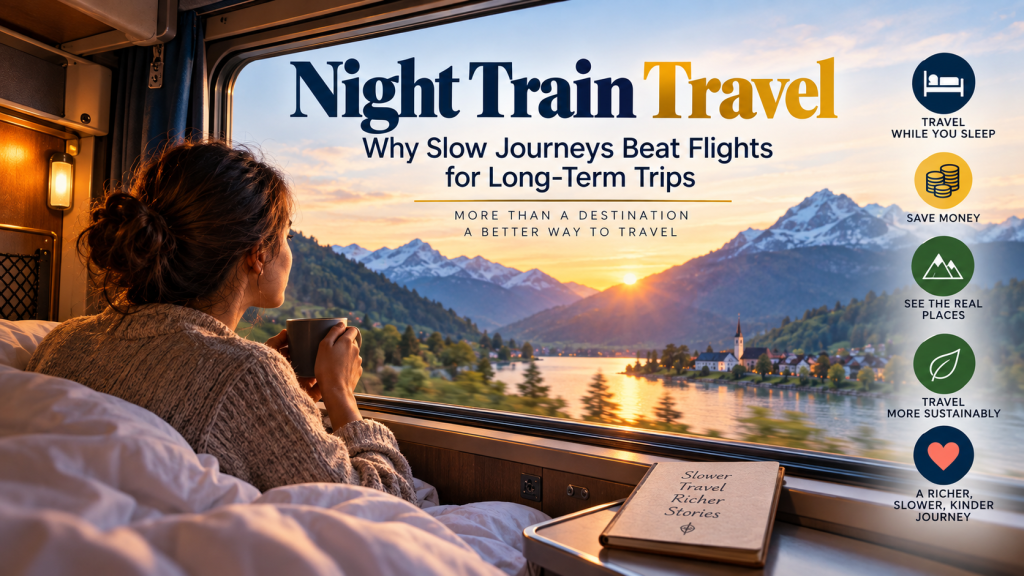
A typical night train journey in Europe, Southeast Asia, or India works like this. You board the train in the early evening — usually between 7 and 10 PM. Your accommodation ranges from a reclining seat (budget) to a shared couchette (mid-range) to a private sleeper cabin with a real bed, fresh linens, and sometimes even a sink (comfort). The train departs, you settle in, and you sleep while the landscape rolls past outside your window.
You wake up the next morning in a new city, often right in the city center. No airport transfer. No lost luggage. No jet lag. You step off the platform and you’re there.
Popular routes include the ÖBB Nightjet network across Europe (Vienna to Rome, Berlin to Paris, Zurich to Amsterdam), the Reunification Express in Vietnam (Hanoi to Ho Chi Minh City), and the legendary Rajdhani Express in India. Each offers a different flavor of the same fundamental experience: movement as rest, transit as transition.
5 Reasons Slow Journeys Beat Flights for Long-Term Trips
1. You Save a Full Day of Travel Fatigue
This is the most practical advantage and the one that compounds the fastest. A flight saves you hours in transit but costs you a full day in recovery. The early wake-up, the airport stress, the dehydration, the disrupted sleep — all of it means you arrive needing a “reset day” whether you admit it or not.
A night train flips this equation. You travel while you sleep. The transit hours overlap with the hours you’d be unconscious anyway. You wake up rested (or at least as rested as any traveler ever is) and you have the entire day ahead of you in a new place. Over a six-month trip, this can save you ten to fifteen full days of lost time — not to mention the cumulative nervous system toll of repeated airport experiences.
2. Your Budget Stretches Further {Hello, FIRE (Financial Independence, Retire Early) Travelers}
Night trains kill two expenses with one ticket: transportation and accommodation. A sleeper berth from Vienna to Venice might cost €50–€90. A flight on the same route, once you add baggage fees, airport transfers, and a night in a hotel near the airport, can easily exceed €150.
For long-term travelers operating on a FIRE-friendly budget, this matters enormously. You’re not just saving money — you’re eliminating an entire category of logistical overhead. Fewer bookings to manage, fewer check-ins to coordinate, fewer “where am I sleeping tonight” decisions to make. That mental bandwidth is worth more than the dollar savings.
3. You Actually See the Geography You’re Crossing
There’s a reason travelers who take overland routes develop a richer understanding of the places they visit. When you fly from Lisbon to Istanbul, you skip everything in between. When you take trains — even night trains where you wake up to a changed landscape — you absorb the gradient. You notice how the architecture shifts, how the vegetation changes, how the light looks different at dawn in a new latitude.
This isn’t romantic fluff. It’s cognitive mapping. Your brain builds a more accurate, more connected model of the world when you experience it as continuous space rather than a series of teleportation events. That model changes how you think, how you write, and how you make decisions long after the trip ends.
4. The Forced Slowdown Improves Your Thinking
Modern travel rewards speed. Night trains reward patience. And patience, it turns out, is one of the most underrated cognitive tools a long-term traveler can develop.
On a night train, you can’t rush. You can’t optimize. You can’t “hack” the experience into a shorter version of itself. You’re in a moving room with limited Wi-Fi, limited distractions, and a window full of darkness that occasionally reveals a lit village or a river crossing. This is one of the few remaining environments where boredom is structurally enforced – and boredom, as any reader or creative thinker knows, is where the best ideas come from.
Use the evening hours to read. Use the morning hours to journal. Let your mind wander in a way that a cramped airplane seat and a glowing seatback screen will never permit.
5. You Build a Different Relationship with Time
This is the deepest reason and the hardest to articulate. Long-term travel, at its best, dissolves the tyranny of the itinerary. You stop counting days and start noticing rhythms. Night trains accelerate this shift because they literally move you through time and space simultaneously. You go to sleep in one country and wake up in another. The transition is seamless, almost dreamlike.
Contrast this with the violence of air travel — the alarms, the sprints through terminals, the jarring re-entry into a new time zone. Flying treats time as an enemy to be defeated. Night trains treat time as a medium to move through. Over months of travel, this distinction reshapes your entire experience. You stop feeling rushed. You stop feeling behind. You start feeling present.
Practical Tips for Your First Night Train
If you’re convinced but nervous, here are a few things I wish I’d known before my first sleeper journey:
Book the couchette, not the seat. The price difference is usually small (€15–€30), and the quality-of-sleep difference is enormous. A flat surface changes everything.
Bring earplugs and an eye mask. Trains are noisy. Tracks clatter, doors slam, and your cabin-mates may snore. Treat the experience like a camping trip, not a hotel stay, and you’ll sleep better than expected.
Eat dinner before you board. Night train dining cars are charming in theory and unreliable in practice. Grab a solid meal at the station and bring snacks and water for the morning.
Secure your belongings. A small combination lock for your bag zipper and a money belt for your passport give you the peace of mind to actually sleep.
Arrive at the station early. Night train platforms can be chaotic, especially in major hubs. Give yourself thirty minutes to find your carriage and settle in before departure.
The Bigger Picture: Travel as a Practice, Not a Checklist
The shift from flights to night trains is really a shift in travel philosophy. It’s the difference between collecting destinations and inhabiting transitions. Between treating movement as a cost to minimize and treating it as an experience to savor.
For long-term travelers — especially those who’ve built their lifestyle around financial independence, intentional living, and personal growth — this alignment matters. You didn’t leave the rat race to recreate its urgency on a different continent. You left to slow down, to think clearly, and to experience the world at a pace that actually lets it in.
A night train won’t solve every travel problem. There will be delays, discomfort, and the occasional questionable smell in the corridor. But there will also be a sunrise over the Alps from your pillow, a conversation with a stranger in a shared compartment, and the quiet satisfaction of arriving somewhere new without having sacrificed a single waking hour to get there.
The journey isn’t the best part of travel because it’s comfortable. It’s the best part because it’s where you actually change.
So next time you’re planning a leg of your trip and your fingers hover over the flight search bar, pause. Check the rail schedule instead. Book the sleeper. Let the train carry you through the night.
You’ll arrive richer than any frequent flyer ever will.
Related Reading
- Slow Travel: Why Staying Longer Saves Money and Creates Richer Experiences
- Why Travel in Chapters Works Better Than Checklists
- How to Avoid Travel Fatigue: Planning Trips Around Your Energy and Circadian Rhythm
- The Energy Budget of Travel: How to Avoid Travel Fatigue and Explore Without Exhaustion
- Comfort-Optimized Travel: Simple Systems That Reduce Stress and Save Time
- Travel Stacking: How to Combine Learning, Fitness, and Reflection Into Every Trip for Personal Growth
- How to Travel Full-Time Without Becoming a Professional Tourist (or Burning Out)
- Why Rest Days Are the Secret to Better Travel: How Doing Less Helps You Experience More
 VD
VD 
Leave a comment