Somewhere around your mid-thirties, a strange thing happens. You eat the same way you ate at twenty-eight — same portions, same foods, same rough calorie count — and your body starts responding differently. The weight creeps up. The afternoon energy crash deepens. Your blood work starts showing numbers your doctor calls “borderline” with a tone that suggests they weren’t borderline last year.
The standard advice is predictable: eat less, move more, count your calories. And for a while, that works. You trim a few hundred calories, you lose a few pounds, and then the plateau hits. You trim more. The plateau holds. You start wondering if your metabolism is broken.
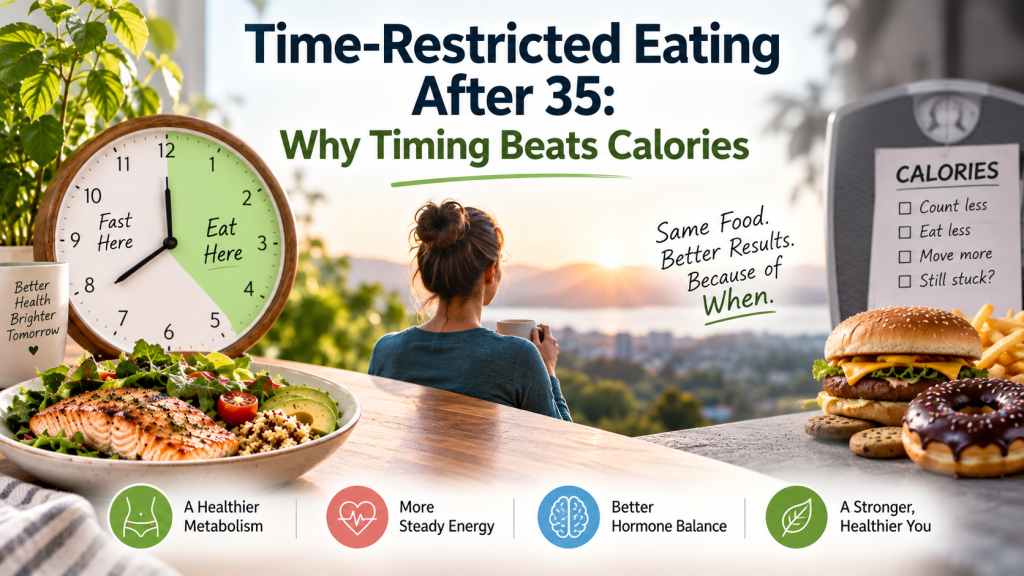
It isn’t broken. It’s shifted. And the lever that moves it isn’t what you eat — it’s when you eat.
Time-restricted eating (TRE), a form of intermittent fasting that focuses on compressing your daily eating window, has emerged as one of the most powerful and least disruptive tools for metabolic health after 35. Not because it magically burns more calories, but because it realigns your eating patterns with the circadian biology your body has been running on for millennia — biology that becomes far less forgiving once you cross the threshold of early middle age.
Here’s why the clock on the wall matters more than the label on the package, and how to use it without turning your life into a fasting experiment.
The Calorie Myth After 35
The “calories in, calories out” model isn’t wrong. It’s incomplete. And after 35, the gap between “technically correct” and “practically useful” widens dramatically.
In your twenties, your body was metabolically flexible. You could eat a large meal at midnight, skip breakfast the next day, graze on snacks at irregular intervals, and your insulin response would snap back to baseline like a rubber band. Your circadian rhythm was robust enough to absorb the chaos without consequence.
After 35, that rubber band loses its elasticity. Insulin sensitivity begins a gradual decline – roughly 1-2% per year after your mid-thirties, according to longitudinal metabolic research. Your pancreas still produces insulin, but your cells become slower to respond. The practical result is that the same 500-calorie meal eaten at 8 PM produces a higher and longer blood sugar spike than the identical meal eaten at noon.
This means calorie counting treats all 500-calorie meals as equal when they are metabolically not. A calorie consumed during your body’s active phase is processed, partitioned, and used. A calorie consumed during your body’s rest phase is more likely to be stored as visceral fat — the deep abdominal fat that drives inflammation, cardiovascular risk, and the metabolic syndrome your doctor is quietly monitoring.
The problem isn’t the calorie. It’s the timestamp.
What Time-Restricted Eating actually is
Before we go further, let’s clear up a common confusion. Time-restricted eating and intermittent fasting are often used interchangeably, but they’re not identical.
Intermittent fasting is the umbrella term. It includes multi-day fasts, alternate-day fasting, the 5:2 protocol, and various other approaches that involve extended periods without food. Many of these are effective but demanding — and frankly unnecessary for most people over 35 who aren’t chasing extreme body composition goals.
Time-restricted eating is a specific, gentler subset of intermittent fasting. It simply means confining all of your daily caloric intake to a consistent window — typically between 8 and 12 hours — and fasting for the remaining hours. The most common protocol is 16:8 (16 hours fasting, 8 hours eating), but the exact ratio matters less than the consistency.
The key mechanism isn’t calorie restriction. Most TRE practitioners end up eating roughly the same number of calories they did before — they just eat them in a tighter window. The benefits come from giving your digestive system, liver, and pancreas a sustained break long enough to complete critical repair processes: autophagy (cellular cleanup), glycogen depletion, and the metabolic shift from glucose burning to fat oxidation.
Think of it less as a diet and more as a scheduling adjustment. You’re not eating less. You’re eating in sync.
Why Timing Matters More After 35
Three biological shifts make TRE disproportionately effective after your mid-thirties:
1. Circadian Insulin Sensitivity Decline
Your body’s ability to process glucose follows a daily rhythm. Insulin sensitivity peaks in the morning and early afternoon, then declines sharply after sunset. In your twenties, this curve was gentle. After 35, it steepens. Eating a large meal at 9 PM at age 40 produces a metabolic response closer to eating at midnight at age 25. Your body is literally less equipped to handle late calories than it used to be.
TRE works with this curve instead of against it. By front-loading your calories earlier in the day and closing your eating window by early evening, you align food intake with your body’s peak metabolic capacity. The same food, the same calories — better outcomes.
2. Growth Hormone and Muscle Preservation
After 35, you lose roughly 3–8% of muscle mass per decade if you’re not actively training. This sarcopenia accelerates metabolic decline because muscle is your primary glucose sink. Fasting periods of 14–16 hours have been shown to increase human growth hormone (HGH) secretion significantly during the overnight repair window, which helps preserve lean mass. You’re not just resting your digestion — you’re signaling your body to protect the tissue that keeps your metabolism running.
3. Inflammation and Gut Rest
Chronic low-grade inflammation — sometimes called “inflammaging” — accelerates after 35 and is a primary driver of metabolic disease, cognitive decline, and accelerated aging. Every time you eat, your immune system mounts a small inflammatory response called postprandial inflammation. When you eat from 7 AM to 11 PM, that inflammatory cycle runs for 16 hours a day. Compressing your eating window to 8–10 hours gives your gut and immune system a sustained recovery period that directly reduces systemic inflammation markers like CRP and IL-6.
The 3 Eating Windows That Work Best After 35
Not all fasting windows are created equal. Here are the three protocols I’ve seen work best for long-term adherence and metabolic results in the 35+ demographic:
Early Time-Restricted Eating (eTRE): 7 AM – 3 PM
This is the gold standard in the research. Studies consistently show that front-loading calories to the morning and early afternoon produces the best improvements in insulin sensitivity, blood pressure, and oxidative stress. The downside? It’s socially difficult. Most people aren’t going to skip dinner with their family or friends on a regular basis. If you can make it work — even four days a week — it delivers the strongest metabolic benefits of any protocol.
Standard 16:8: 12 PM – 8 PM
The most popular and most sustainable option. You skip breakfast, eat lunch at noon, and close your window after dinner at 8. This works well for most people over 35 because it preserves the social ritual of dinner while still providing a 16-hour overnight fast. The trade-off is that you’re eating some calories later in the day when insulin sensitivity is lower, but the overall benefits still significantly outweigh a standard 15-hour grazing pattern.
Seasonal Flexibility: 10-Hour Window, Adjusted Quarterly
This is the approach I recommend for people who find rigid protocols unsustainable. In summer, when days are long and activity is high, you might eat from 8 AM to 6 PM. In winter, you compress to 10 AM to 6 PM. The key is maintaining a minimum 14-hour overnight fast year-round and adjusting the window to match your energy, activity, and social calendar. Consistency within each season matters more than perfection across the year.
Common Mistakes That Sabotage Results
Even a simple protocol can go wrong. Here are the three mistakes I see most often:
Mistake 1: Treating the eating window as a free-for-all. TRE is not permission to eat 3,000 calories of ultra-processed food in eight hours. The timing amplifies the quality of your diet — it doesn’t replace it. If your eating window is filled with refined carbs and seed oils, the fasting window won’t rescue you.
Mistake 2: Fasting too aggressively too soon. Jumping from a 14-hour overnight fast to a 20-hour fast in week one is a recipe for cortisol spikes, muscle loss, and rebound bingeing. Start with a 12-hour window, add 30 minutes per week, and let your body adapt. The goal is metabolic flexibility, not metabolic stress.
Mistake 3: Ignoring protein timing. After 35, protein distribution matters almost as much as total protein intake. If you’re cramming all 120 grams of protein into a four-hour window, you’re wasting much of it. Your body can only utilize roughly 30–40 grams per meal for muscle protein synthesis. Spread your protein across at least two to three meals within your eating window to maximize retention and protect the muscle mass that keeps your metabolism humming.
How to Start Without Overhauling Your Life
The beauty of time-restricted eating is its simplicity. You don’t need a meal plan, a supplement stack, or a food scale. You need a clock.
Start tonight. Finish dinner by 8 PM. Don’t eat anything caloric again until 8 AM. That’s a 12-hour fast — the minimum effective dose. Do this consistently for two weeks. Then push breakfast back by 30 minutes every week until you reach a window that feels natural and sustainable for your lifestyle.
Track how you feel, not just how you look. The first markers to improve are usually energy stability (fewer afternoon crashes), sleep quality (deeper, less fragmented rest), and mental clarity (less brain fog in the morning). The body composition changes come later, but they come — and they tend to stick because you haven’t starved yourself to get there.
The best eating schedule after 35 isn’t the one that looks most impressive on a biohacking podcast. It’s the one you can maintain for decades. Time-restricted eating works because it’s a constraint, not a deprivation. You’re not giving up food. You’re giving your body the one thing it’s been begging for since your metabolism started its quiet midlife shift: time to rest.
Start with the clock. Let the calories sort themselves out.
Related Reading
- Metabolic Flexibility: What It Is, Why It Matters, and How to Improve It
- How Much Protein for Longevity? Why Most People Over 35 Undereat
- Healthspan vs Lifespan: How to Live Better, Not Just Longer
- The Minimum Effective Longevity Habits: What Actually Improves Healthspan
- Habits That Matter After 40: What Actually Improves Longevity
- The Longevity Dividend: Healthy Habits That Boost Both Health and Wealth
- How to Build Healthy Eating Habits That Last (Without the Overwhelm)
- Biohacking Simplicity: Small Habits, Big Health Gains
 VD
VD 
Leave a comment