You sit down at your desk at 10 a.m., coffee in hand, to-do list open, and… nothing. Your thoughts feel like they’re moving through wet concrete. You reread the same email three times. You forget the word for something you used effortlessly yesterday. By noon, you’ve blamed your sleep, your screen time, your age, and your motivation.
But you probably haven’t blamed your lunch.
Here’s the uncomfortable truth that most productivity advice ignores: that mid-morning brain fog might have almost nothing to do with your brain. It might be a message from your gut — literally.
Over the last decade, neuroscience has quietly undergone a revolution. Researchers have mapped a communication network between your digestive system and your brain so extensive, so fast, and so influential that scientists now call the gut your “second brain”. This isn’t a wellness influencer’s metaphor. The enteric nervous system embedded in your gut wall contains over 500 million neurons — more than your spinal cord — and it operates with a startling degree of independence from the brain sitting in your skull.
And if that second brain is inflamed, imbalanced, or overwhelmed, your first brain pays the price in the form of fog, fatigue, and an inability to think clearly.
If you’ve been optimizing your sleep, your morning routine, and your focus rituals but still feel mentally sluggish, this is the missing variable. Let’s fix it.
The Misdiagnosis Problem: Why You’re Treating the Wrong Organ
Brain fog isn’t a medical diagnosis. It’s a symptom — a vague, frustrating cluster of experiences that includes poor concentration, mental fatigue, forgetfulness, and a general feeling that your brain is running on a degraded Wi-Fi signal.
Because the symptom lives in your head, the default assumption is that the cause lives there too. So you reach for the usual suspects: more caffeine, better sleep hygiene, a meditation app, a nootropics stack, blue-light-blocking glasses. And sometimes those help. But when they don’t — when the fog persists despite every optimization you’ve tried — it’s worth asking a different question.
What if the problem isn’t upstream in your brain but downstream in your gut?
The evidence is no longer fringe. A 2023 review in Nature Reviews Gastroenterology & Hepatology confirmed that alterations in gut microbiota composition are directly associated with cognitive dysfunction, including the exact symptoms we casually label “brain fog”. A separate study in Brain, Behavior, and Immunity found that participants who took a targeted probiotic for eight weeks showed measurable improvements in cognitive flexibility and working memory — without changing anything else about their lifestyle.
This isn’t about replacing your current health habits. It’s about recognizing that your digestive system is a co-author of your mental performance, and ignoring it is like trying to fix a software bug by upgrading your monitor.
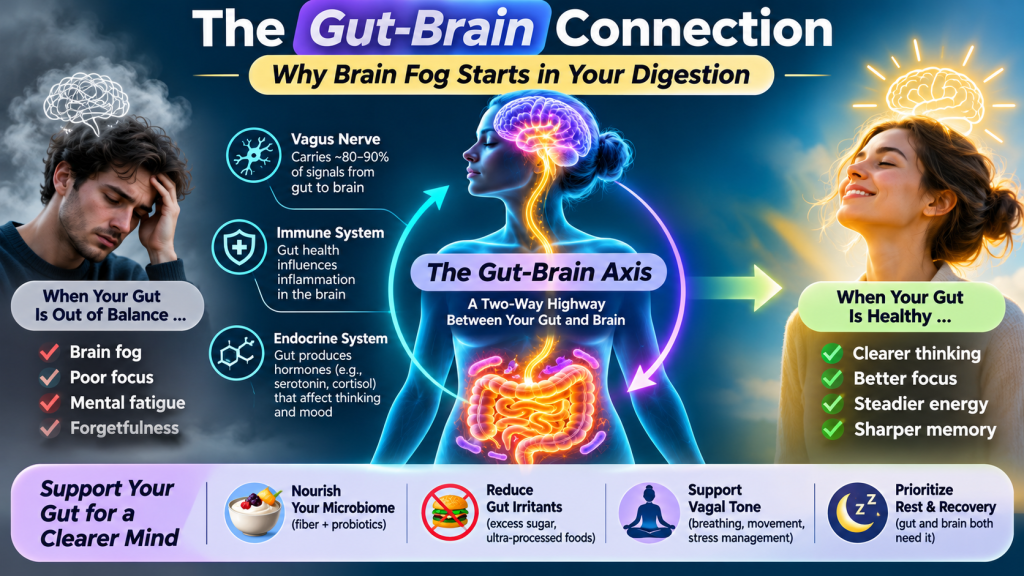
The Gut-Brain Axis: A Two-Way Highway
Your gut and your brain are connected by the vagus nerve — the longest cranial nerve in your body, running from your brainstem down through your chest and into your abdomen. Think of it as a fiber-optic cable carrying real-time data in both directions, 24 hours a day.
Here’s the part most people miss: roughly 80 to 90 percent of the signals traveling along the vagus nerve go from the gut to the brain, not the other way around. Your gut is talking to your brain far more than your brain is talking to your gut.
This means your digestive system isn’t just processing food. It’s generating a constant stream of chemical and electrical signals that influence your mood, your stress response, your energy levels, and your cognitive clarity. When your gut lining is healthy and your microbiome is diverse, those signals are calm and constructive. When your gut is inflamed or your bacterial ecosystem is out of balance, those signals become noise — and your brain interprets that noise as fog.
The gut-brain axis also operates through two other channels beyond the vagus nerve: the immune system and the endocrine system. Your gut houses roughly 70 percent of your body’s immune cells. When those cells detect a threat — whether it’s a food sensitivity, a pathogen, or the metabolic fallout of chronic stress — they release inflammatory cytokines that cross the blood-brain barrier and directly impair neural function. Simultaneously, your gut produces hormones like cortisol and serotonin that modulate brain activity in real time.
Three pathways. One outcome. When your gut is struggling, your thinking suffers.
Three Ways Your Gut Creates Brain Fog
Let’s break down the specific mechanisms so you can identify which one might be affecting you.
1. Vagal Tone Collapse
Your vagus nerve has a “tone” — a measure of how effectively it transmits signals between your gut and your brain. High vagal tone means your nervous system can shift smoothly between alertness and recovery. Low vagal tone means you’re stuck in a low-grade stress state, and your brain can’t allocate resources to deep thinking.
Chronic gut inflammation, a low-fiber diet, and prolonged sitting all suppress vagal tone over time. The result is a brain that feels perpetually tired even after adequate sleep. If your brain fog is worst in the afternoon and accompanied by digestive bloating or a heavy feeling in your stomach, vagal tone is a likely culprit.
2. Systemic Inflammation from a Leaky Gut
Your intestinal lining is only one cell thick — a remarkably fragile barrier between the outside world and your bloodstream. When that barrier becomes permeable, a condition colloquially called “leaky gut”, undigested food particles, bacterial endotoxins, and metabolic waste leak into your circulation. Your immune system responds with a wave of inflammation that doesn’t stay confined to your abdomen. It travels everywhere, including your brain.
Neuroinflammation is one of the most well-documented causes of brain fog in the medical literature. It slows neural signaling, impairs memory formation, and creates the exact mental sluggishness you feel after a heavy, ultra-processed meal. If your fog spikes predictably after eating specific foods — especially gluten, dairy, or anything from a drive-through — inflammation is probably the mechanism at work.
3. Neurotransmitter Disruption
Your gut produces an astonishing 95 percent of your body’s serotonin and roughly 50 percent of its dopamine. These aren’t just “mood chemicals” that make you feel happy. Serotonin regulates cognitive processing speed, and dopamine drives motivation, focus, and working memory. They are the biochemical infrastructure of clear thinking.
When your gut microbiome is depleted — from rounds of antibiotics, chronic psychological stress, or a diet low in fermentable fiber — your neurotransmitter production drops. The result feels identical to burnout: low motivation, poor focus, and a persistent sense that your brain is operating at half capacity. The critical difference is that no amount of willpower, productivity systems, or morning routines will fix a neurotransmitter shortage that originates in your digestive tract.
The Gut-Brain Fog Checklist: 5 Signs Your Fog is Digestive
Not all brain fog is gut-related. Sleep deprivation, chronic stress, and hormonal shifts are real contributors. But if three or more of the following apply to you, your digestive system deserves serious attention before you invest in another focus supplement:
- Your fog worsens after meals, especially within 30 to 90 minutes of eating.
- You experience regular bloating, gas, or irregular bowel movements alongside your cognitive symptoms.
- Your energy crashes in the mid-afternoon regardless of how well you slept the night before.
- You’ve taken multiple rounds of antibiotics in the past five years.
- Your brain fog improves noticeably during fasting or when you simplify your diet to whole foods.
If you checked three or more, the protocol below is your starting point.
The Gut-Clarity Protocol: 5 Habits that Actually Work
This isn’t a 30-day gut cleanse or a restrictive elimination diet you’ll abandon by week two. It’s a set of sustainable, evidence-backed habits that directly address the three mechanisms above. Think of it as the minimum effective dose for gut-brain health.
1. Eat 30 Different Plants Per Week
This is the single most impactful change you can make, and it’s the one most people overlook because it sounds deceptively simple. A landmark analysis from the American Gut Project found that people who consumed 30 or more different plant species per week had significantly more diverse microbiomes — and lower markers of systemic inflammation — than those who ate fewer than 10. Diversity is the metric that matters, not just “eating your vegetables” but actively rotating them. Count herbs, spices, nuts, seeds, legumes, and fermented foods. Thirty sounds intimidating until you realize that a single stir-fry with garlic, ginger, broccoli, bell pepper, sesame seeds, and tamari gets you six.
2. Prioritize Fermented Foods Daily
A 2021 Stanford study published in Cell found that a diet high in fermented foods — kimchi, sauerkraut, kefir, plain yogurt, miso, kombucha — increased microbiome diversity and decreased 19 separate inflammatory markers in just 10 weeks. Aim for two to three small servings per day. This approach is more effective than most probiotic supplements because fermented foods deliver live bacteria alongside the prebiotic fibers those bacteria need to colonize and survive.
3. Stimulate Your Vagus Nerve Every Morning
You don’t need a medical device or an expensive biohacking gadget. The simplest vagus nerve activation techniques are free: splash cold water on your face for 30 seconds, practice slow diaphragmatic breathing with an extended exhale (inhale for 4 counts, exhale for 8), or hum loudly for one minute. Do any one of these before your first meal. You’re essentially telling your gut-brain highway to switch from “fight or flight” to “rest and digest” mode before you ask your digestive system to do its most important work of the day.
4. Stop Eating Three Hours Before Bed
Your gut has its own circadian rhythm, and it matters more than most people realize. When you eat late, your digestive system is forced to work during the window it’s supposed to be performing its nightly repair cycle — rebuilding the intestinal lining, clearing bacterial overgrowth through the migrating motor complex, and resetting immune function. Chronic late eating keeps the gut in a perpetual state of low-grade inflammation that shows up as morning brain fog. The fix is simple: close your eating window at least three hours before sleep. This single habit often resolves unexplained morning fog within two to three weeks.
5. Reduce Ultra-Processed Foods to Below 20 Percent of Calories
You don’t need to eat perfectly. You need to eat mostly real food. Ultra-processed foods — anything with a long ingredient list full of things you wouldn’t find in a home kitchen — damage the gut lining, feed harmful bacterial strains, and trigger the inflammatory cascade that eventually reaches your brain. The 80/20 rule works well here: if 80 percent of your calories come from whole, minimally processed sources, your gut has enough resilience to handle the remaining 20 percent without triggering a fog episode.
The Bottom Line
Brain fog is not a character flaw, a motivation problem, or an inevitable consequence of getting older. In many cases, it’s a signal — a real-time status report from your gut telling you that something in your digestive ecosystem needs attention.
You don’t need a complete dietary overhaul or an expensive supplement stack. You need to treat your gut with the same seriousness you bring to your sleep, your exercise, and your financial planning. The gut-brain connection isn’t a metaphor. It’s anatomy. And once you start working with it instead of ignoring it, the fog lifts faster than you’d expect.
Your brain is only as clear as your gut is calm. Start there.
Related Reading
- How to Optimize Your Nervous System for Better Focus, Performance, and Health
- How to Improve Mental Clarity and Make Better Decisions: Simplify Your Mind
- Metabolic Flexibility: What It Is, Why It Matters, and How to Improve It
- Breathing Exercises for Stress, Focus, and Performance: The Simplest Upgrade for Your Nervous System
- The Sleep Efficiency Blueprint: How to Improve Sleep Quality and Wake Up Rested (Without More Hours)
- Time-Restricted Eating After 35: Why Timing Beats Calories
- How to Build Healthy Eating Habits That Last (Without the Overwhelm)
- Biohacking Simplicity: Small Habits, Big Health Gains
Enjoyed this post?
If this article helped you connect the dots between your gut and your brain, consider supporting my work. I publish deep dives on health, financial independence, books, and travel every week — and your support keeps the coffee flowing (and the brain fog at bay).


Leave a Reply