The Art of Quickly Establishing Roots, Routine, and Belonging Anywhere in the World
There is a predictable emotional arc to arriving in a new city.
For the first seventy-two hours, you ride a wave of pure novelty. Every street corner feels cinematic. Simply buying groceries in a different language or figuring out the metro system gives your brain a subtle hit of dopamine. You feel awake, observant, and fiercely alive.
Then, usually around day five or day ten, the novelty wears off—and the silence sets in.
You wake up in a sterile Airbnb that belongs to someone else. You make coffee in a kitchen where you still have to open three drawers to find a spoon. You open your laptop, answer emails, and finish your deep work. When you finally step outside at 5:00 PM, thousands of people are walking past you — laughing on restaurant patios, rushing home to families, greeting neighbors — and yet you realize you haven’t spoken a single meaningful sentence out loud all day.
You are surrounded by millions of people, yet functionally invisible.
If you travel slowly, work remotely, or relocate to new cities often, this quiet isolation is the single biggest threat to your lifestyle. It isn’t logistics, visas, or budgets that cause location-independent people to burn out; it is the cumulative exhaustion of feeling like a ghost passing through other people’s lives.
Most travelers try to solve this problem the wrong way. They either chase more tourist attractions to distract themselves, or they force themselves to attend loud expat meetups that feel like speed-dating on LinkedIn.
There is a much simpler, quieter, and more effective way to feel at home anywhere in the world. Sociologists call it The Third Place — and learning how to build one is the ultimate skill for turning a strange city into a community.
What is a “Third Place” (and Why Modern Travelers Lose it First)?
In 1989, urban sociologist Ray Oldenburg coined the term “The Third Place” in his landmark book, The Great Good Place.
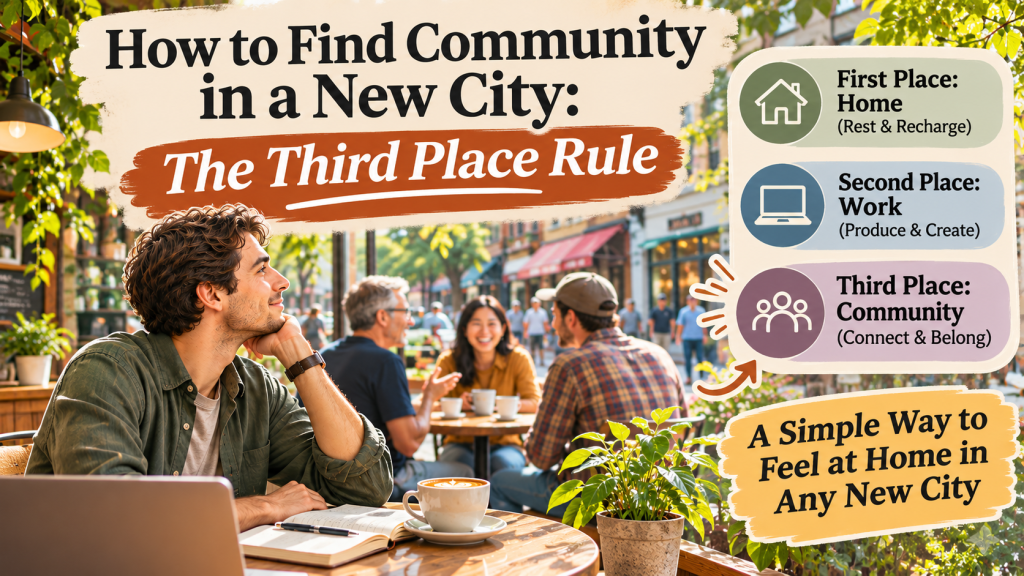
Oldenburg argued that a healthy, grounded human life requires three distinct physical environments to stay balanced:
- The First Place: Your home — the private space where you sleep, recover, and live with family or solo.
- The Second Place: Your workplace — the structured environment where you produce value, solve problems, and earn a living.
- The Third Place: The social anchors of community life — the public or semi-public places where you gather, relax, and interact with people outside of domestic and professional obligations. Think neighborhood cafes, gyms, barber shops, libraries, public plazas, climbing gyms, and local parks.
According to Oldenburg, Third Places are the glue of civil society and personal well-being. They are “levelers” where social status doesn’t matter, conversation is the main activity, the mood is playful or relaxed, and a core group of regulars gives the space its character.
Now, look at what happens when you become a remote worker or slow traveler in a new city: your three places collapse into one.
You sleep in your short-term rental (First Place). Then you walk six feet to the dining table and open your laptop to work (Second Place). And because you don’t know anyone in town, you spend your evening reading or streaming a show on the couch in that exact same apartment.
We can call this One-Place Syndrome. When your home, your office, and your leisure space are all confined inside the same four walls, your nervous system never gets the environmental cues it needs to feel connected to the outside world. You aren’t truly living in Lisbon, Kyoto, or Buenos Aires — you are living inside an apartment that happens to be located in those cities.
To feel rooted in a new city, you don’t need a massive social circle right away. You simply need to reconstruct your Third Place.
The Psychology of Belonging: Why Familiarity Beats “Networking”
When solo travelers or new residents feel lonely in a city, their default instinct is to look for structured social events: digital nomad mixers, language exchanges, or Facebook group meetups.
While these events have their place, they often leave you feeling more drained than when you arrived. Why? Because most traveler meetups suffer from transactional small-talk fatigue. You end up having the exact same conversation five times in two hours:
- “Where are you from?”
- “How long have you been here?”
- “What do you do remotely?”
- “Where are you heading next?”
Because everyone in the room is transient, the brain subtly guards against investing too much emotional energy. It feels like networking, not belonging.
Now compare that to how friendships and community actually formed when you were in school, university, or living in a long-term neighborhood. You didn’t walk up to strangers with a networking pitch. Instead, you bonded through what psychologists call the Mere-Exposure Effect — the phenomenon where repeated, unplanned, low-stakes proximity breeds trust and warmth.
Sociologists point out that human beings don’t just need strong ties (lifelong best friends and family); we also have a biological need for weak ties — the barista who knows your coffee order, the guy who nods at you at the pull-up bars every morning, the fruit vendor who throws an extra tangerine into your bag because you’ve shown up three Tuesdays in a row.
Research by psychologist Gillian Sandstrom has consistently shown that people who have more daily “micro-interactions” with weak ties report significantly higher levels of happiness and a stronger sense of belonging than those who don’t — even when they are introverts.
Why? Because recognition is the antidote to invisibility.
The moment a local barista smiles and starts making your cortado before you even reach the counter, something shifts in your brain. You are no longer an anonymous tourist passing through a movie set. You have been witnessed. You exist in the ecosystem of the neighborhood.
The 4 Archetypes of High-Leverage Third Places Abroad
Not every public venue qualifies as a Third Place. A chaotic Starbucks next to a major train station is a transit hub, not a Third Place. Nobody goes there to linger, and the crowd turns over every fifteen minutes.
When scouting a new city, you are looking for spaces designed for rhythm and repetition. Depending on your personality and interests, here are the four most effective archetypes of Third Places you can establish abroad.
1. The Morning Anchor (The Neighborhood Cafe or Bakery)
The easiest Third Place to establish within 24 hours of landing is a small, independent cafe or bakery within five minutes of your front door.
Look for a spot away from tourist boulevards — ideally one with a counter or small tables where locals stop before work. When you start every morning in the same chair at 8:00 AM with a physical book or notebook, you synchronize your circadian rhythm with the neighborhood. Within four days, the staff will recognize you; within ten days, the other morning regulars will start nodding hello.
2. The Physical Crucible (Gyms, Run Clubs, and Martial Arts Mats)
If you want to bypass the awkwardness of small talk and language barriers entirely, choose a Third Place centered around shared physical effort.
When you suffer through a brutal interval workout with a local run club, problem-solve a bouldering route at a climbing gym, or spar at a Brazilian Jiu-Jitsu academy, camaraderie happens automatically. Endorphins and shared struggle do the social heavy lifting for you. Better yet, fitness communities are remarkably consistent around the world: walk into an independent powerlifting gym or yoga shala in Medellín, Taipei, or Berlin, and you instantly share a common language with everyone inside.
3. The Curiosity Hub (Bookstores, Studios, and Co-Working Spaces)
If you want deeper conversations, anchor yourself in a place that filters for a specific curiosity. This could be an independent bookstore that hosts weekly readings, a ceramics studio where you book a four-week wheel-throwing pass, a chess club in a public park, or a small, community-driven coworking space (avoid the massive corporate chains where everyone wears noise-canceling headphones all day).
4. The Civic Living Room (Plazas, Parks, and Markets)
Sometimes, you don’t even need to talk to anyone to recharge your social battery; you just need to be alone together in a vibrant public space.
Many cultures excel at the outdoor Third Place: the shaded plaza in Spain or Mexico at dusk, the outdoor calisthenics park in Eastern Europe, or the morning wet market in Southeast Asia. Sitting on the same park bench to read for forty-five minutes every afternoon plugs you into the ambient heartbeat of the city without draining an ounce of introvert energy.
The Third Place Protocol: A 5-Rule System for Rootedness in Any City
Knowing the theory of the Third Place is one thing; building one intentionally when you land in an unfamiliar city is a practice.
Whether you are staying in a city for three weeks or three years, use this five-rule system during your first week to establish roots fast.
Rule 1: Trade Variety for Loyalty (Resist the Tourist Urge)
When travelers arrive in a new city, they usually optimize for novelty. If they are in town for fourteen days, they want to try fourteen different top-rated coffee shops and fourteen different restaurants across every neighborhood on their map.
If your goal is tourism, that’s fine. If your goal is belonging, variety is the enemy of community.
You cannot become a regular if you never repeat a location. For your first week in a new city, intentionally sacrifice variety for loyalty. Pick one cafe for your morning coffee, one market for your produce, and one gym or park for your daily movement. Go back to the exact same spots until the friction of ordering or navigating disappears.
Rule 2: Visit a Time Slot, Not Just a Location
A physical place is actually several different communities rotating throughout the day. The people at a neighborhood park or cafe at 7:30 AM are a completely different tribe from the people there at 2:00 PM or 8:00 PM.
If you show up at 8:00 AM on Monday, 11:30 AM on Tuesday, and 4:00 PM on Wednesday, you will see a random assortment of strangers every time.
To trigger the Mere-Exposure Effect, lock in your time slot. Show up at 8:15 AM every single morning. You will quickly discover that cities run on invisible schedules: you’ll see the same dog walkers, the same elderly couple reading the paper, and the same barista working the opening shift. Consistency in time is what turns strangers into familiar faces.
Rule 3: Stay Within a 10-Minute Walk Radius
Do not pick a Third Place that requires a 25-minute subway ride across town just because a blog called it the coolest spot in the city. Any friction between your front door and your Third Place will eventually cause you to skip it on busy or rainy days.
Draw a ten-minute walking circle around your apartment and choose the best available options inside that perimeter. Furthermore, walk the exact same street route to get there. By walking the same three blocks every morning, your Third Place expands to include the street itself — the shopkeepers sweeping the sidewalk, the security guard at the corner building, and the florist setting up displays.
Rule 4: Remove the “Do Not Disturb” Armour
As modern urbanites and remote workers, we have trained ourselves to move through public spaces inside a defensive bubble. We walk with AirPods wedged in our ears, stare down at Google Maps, and immediately pull out our phones the second we sit down at a cafe table or wait in line.
Body language speaks long before you open your mouth. Earbuds and a glowing smartphone screen broadcast a universal message: “Do not interact with me”.
When you enter your chosen Third Place, run a simple experiment for the first fifteen minutes:
- Take your headphones out before you walk through the door.
- Put your phone away in your bag or pocket.
- Bring an analog prop instead — a physical paperback book, a paper journal, or a local newspaper.
A physical book is a social bridge; a laptop or phone is a wall. You will be amazed how often someone asks what you are reading, or how much easier it is to exchange a warm greeting with the person next to you when your eyes aren’t glued to a screen.
Rule 5: Practice the “Micro-Contribution”
Tourists extract experiences from a city; locals contribute energy to it. Even if you are only living in a neighborhood for a month, act like a stakeholder:
- Learn the ritual phrases in the local language: Not just “hello” and “thank you,” but how locals actually say “Have a good shift,” “See you tomorrow,” or “The usual, please.”
- Ask for a hyper-local recommendation—and report back: Ask your barista or gym trainer where they go for lunch nearby. Go eat there, and the next morning, tell them how much you loved it. Nothing builds rapport faster than showing someone you valued their advice.
- Be the easiest customer of their day: Have your payment ready, bus your own table if appropriate, tip generously where customary, and learn the names of the people serving you.
Final Thought: Roots are Built through Rhythm, not Time
We often assume that feeling at home in a place requires years of history, a mortgage, or a childhood spent on its streets.
While deep roots certainly grow stronger over decades, the feeling of groundedness is much more immediate. Your nervous system doesn’t actually measure time in years; it measures safety and belonging through rhythm, familiarity, and recognition.
You can live in a city for five years, commute from your garage to an office cubicle, order everything via delivery apps, and feel like an alien the entire time. Conversely, you can arrive in a foreign city where you barely speak the language, establish two solid Third Places in your first week, and feel genuinely woven into the fabric of the neighborhood by Day 10.
The next time you land somewhere new, resist the urge to immediately conquer the city’s top ten tourist sights. Instead, slow down. Walk three blocks from your front door. Find a chair in the morning sun, leave your phone in your pocket, order a coffee, and come back to that exact same spot tomorrow.
That is how a destination stops being a stopover — and starts becoming a home.
☕ Enjoyed this post?
If this essay gave you a practical framework for your next trip or move, consider supporting my writing! I publish deep dives on slow travel, financial independence (FIRE), longevity, and deliberate reading.
👉 Buy Me a Coffee here — your support helps keep the espresso flowing at my local Third Place and keeps these essays coming.
📚 Related Reading from the Archive
If you enjoyed this piece on travel architecture and community, explore these related articles next:
- How to Build Deep Connections While Traveling: The Social Architecture of Temporary Places
- How Long Should Digital Nomads Stay in One Place? The 4-Week Rule
- Managing Your Social Battery: A Solo Traveler’s Guide to Community
- How to Test Living in a New City: The 30-Day City Experiment Framework
- Why Repeating Destinations Beats Chasing New Ones: The Case for Slow Travel
- How to Travel Full-Time Without Becoming a Professional Tourist (or Burning Out)
- Why Some Cities Recharge You (and Others Drain You): The Hidden Energy Cost of Urban Living
- Travel Optionality: How to Stay Location-Independent Without Feeling Rootless


Leave a Reply