Visual Rest for Knowledge Workers: How Expanding Your Gaze Resets Your Autonomic Nervous System
It is 4:00 PM on a Tuesday. Physically, you have barely moved all day.
You have been sitting in a climate-controlled room, in an ergonomic chair, tapping plastic keys with your fingertips. You haven’t lifted heavy weights, sprinted up a hill, or fled from a predator. By every mechanical definition of energy expenditure, your body has been at rest since breakfast.
And yet, you feel completely fried.
More specifically, you feel wired and tired — that peculiar modern state where your brain feels foggy and depleted, yet your chest feels tight, your jaw is clenched, and an undercurrent of low-grade anxiety hums beneath the surface.
Most knowledge workers — developers, writers, analysts, and designers — assume this exhaustion is purely cognitive. We think we are tired because we made too many decisions, wrote too many lines of code, or sat through too many meetings.
While cognitive load is real, there is a hidden, mechanical driver of your afternoon burnout that almost everyone overlooks: for the last eight hours, you have locked your eyes into a biological threat posture.
By staring at a glowing rectangle eighteen inches from your face all day, you aren’t just straining your eyeballs. You are pulling a hardwired neurological lever that forces your autonomic nervous system into a continuous, low-grade fight-or-flight state.
The good news? That lever works in both directions. By changing how you look at the world around you — a practice neuroscientists call panoramic vision or visual rest — you can manually flip your nervous system out of stress and into recovery in less than two minutes.
Your Eyes Are Not Cameras — They Are Externalized Brain Tissue
To understand why your visual field controls your stress levels, we first need to correct a common anatomical misconception.
We tend to think of our eyes as external webcam peripherals — simple optical lenses that capture light and send a video feed back to the brain for processing.
In reality, your eyes are your brain.
During embryonic development, your retinas and optic nerves grow directly out of the diencephalon (the forebrain). They are the only two pieces of your central nervous system that sit outside the protective vault of your skull.
Because your eyes are literally extensions of your brain tissue, their primary evolutionary job wasn’t to read spreadsheets or admire sunsets. Their job was to scan the environment and tell the rest of your nervous system whether to mobilize energy for action or conserve energy for recovery.
In other words, vision doesn’t just inform your brain about the world; the physical mechanics of how your eyes focus directly dictate your heart rate, your breathing cadence, your cortisol levels, and your emotional state.
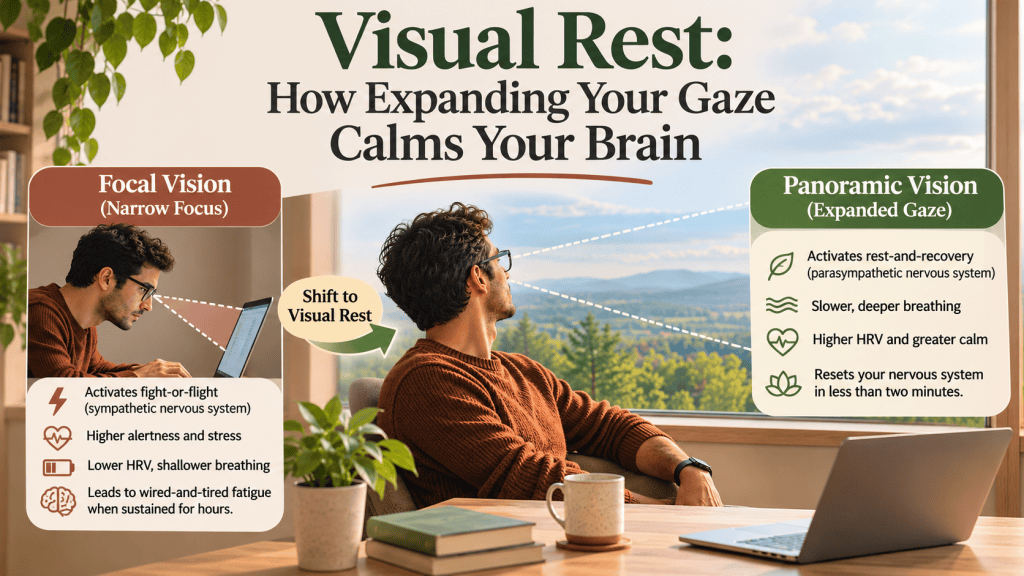
Two Modes of Sight, Two States of Mind
Your visual system operates in two fundamentally different modes, and each mode is hardwired to a different branch of your autonomic nervous system.
1. Focal Vision (The “Sympathetic” Accelerator)
When you focus intently on something close to you — a line of code, a paragraph in a book, a smartphone screen, or a small object in your hand — you are using focal (or foveal) vision.
Mechanically, several things happen at once:
- Your eyeballs rotate slightly inward toward your nose (a process called vergence).
- The tiny ciliary muscles inside your eyes contract to bend the lens and bring the close object into sharp focus.
- Your pupils constrict to increase depth of field, and your blink rate drops by up to 60%.
From an evolutionary standpoint, why would a human narrow their visual field to a tight, razor-sharp cone? Usually for one of two reasons: hunting prey/crafting a tool, or facing an immediate threat.
Because narrow visual focus requires high alertness, focal vision is directly wired to your sympathetic nervous system (your fight-or-flight engine). When you lock your gaze into a narrow focal cone, your brainstem releases neurochemicals like norepinephrine and acetylcholine.
In short bursts — say, 45 to 90 minutes of deep work — this is a superpower. It sharpens your attention and helps you solve complex problems.
The problem is what happens when you hold that narrow focal cone for eight hours straight. Your brain interprets eight hours of unbroken focal vision as eight hours of continuous environmental threat. Your heart rate variability (HRV) drops, your breathing becomes shallow, and your nervous system stays locked in sympathetic overdrive.
2. Panoramic Vision (The “Parasympathetic” Brake)
Now consider the opposite mode of sight: panoramic (or peripheral) vision.
When you stand on a mountain ridge, look out over the ocean, or simply soften your gaze so you can see the walls, floor, and ceiling of the room simultaneously without moving your head, you switch from focal pathways to magnocellular visual pathways.
Mechanically:
- Your ciliary muscles completely relax.
- Your eyeballs diverge slightly to look at infinity.
- Your field of view expands to nearly 180 degrees horizontally.
Evolutionarily, you only allow your gaze to go wide and soft when you are safe. Because panoramic vision is scanning the broad horizon rather than fixating on an immediate threat, it acts as a direct physiological brake on your stress response.
Expanding your gaze activates your parasympathetic nervous system (your rest-and-digest engine). Within seconds of shifting into panoramic vision, the brainstem reduces norepinephrine output, blood pressure eases, and the mind shifts from anxious tunnel-vision to calm perspective.
The “Three-Rectangle” Trap: Why Your Work Breaks Aren’t Working
Once you understand the neurological link between focal vision and stress, you immediately see why modern “rest” fails so miserably.
Think about what a typical knowledge worker does when they feel mentally fatigued after two hours of deep work at their laptop:
- They stop typing on their 15-inch laptop screen (20 inches from their face).
- They lean back in their chair and pull out their 6-inch smartphone (10 inches from their face) to check messages, read the news, or scroll social media for ten minutes.
- At the end of the workday, to “unwind,” they sit on the couch and stare at a TV or tablet screen before reading on their phone in bed.
We call this taking a break. To your visual and nervous systems, you never took a break at all.
In fact, switching from a laptop to a smartphone during a work break actually increases sympathetic arousal. Because a phone screen is smaller and held closer to your face than a desktop monitor, your eyes have to converge even harder, your ciliary muscles have to contract more tightly, and your field of view narrows into an even smaller tunnel.
You may have changed the content you were consuming — from work emails to sports scores or vacation photos — but mechanically, you kept your foot pressed down on the sympathetic gas pedal.
We live in a state of chronic visual claustrophobia. Most indoor workers spend 90% of their waking hours looking at objects less than six feet away. Our ancestors spent 90% of their waking hours looking at horizons miles away.
The Science of “Optic Flow”: Why Walking Quiets an Anxious Mind
Have you ever noticed that when you are stuck on a difficult problem or stewing over a stressful email, sitting at your desk trying to calm down rarely works — but ten minutes into an outdoor walk, the mental knot untangles itself?
While fresh air and blood flow play a role, neuroscientists like Dr. Andrew Huberman at Stanford have highlighted a deeper mechanism at work: Optic Flow.
Optic flow is the visual sensation of objects passing by you in your peripheral vision as you move forward through space — walking down a tree-lined street, cycling along a path, or hiking a trail.
When you walk outdoors without staring down at your phone, two things happen simultaneously:
- Your eyes are in panoramic mode, looking toward the horizon.
- Images pass smoothly across your retinas from front to back as you move forward.
Neuroimaging studies show that self-generated optic flow combined with lateral eye movements directly suppresses activity in the amygdala — the brain’s primary fear, threat, and anxiety center. (This is the exact same neurological pathway leveraged in EMDR therapy to help patients process trauma.)
When you move forward through a wide environment, your visual system sends a powerful, primal signal to your amygdala: “We are not trapped. We are moving forward through space safely. Stand down.”
Conversely, when you sit motionless in a chair staring at a fixed pixel grid, there is zero optic flow. Your body is frozen while your eyes are locked in a threat-focus cone. To an ancient nervous system, being frozen while staring at a threat is the exact definition of terror.
The Visual Rest Protocol: 5 Habits to Reset Your Brain
You don’t need to quit your desk job or move to a cabin in the mountains to fix your visual diet. You simply need to build systematic moments of visual expansion into your workday.
Here are five practical habits to turn visual rest into an automatic nervous system reset.
1. Upgrade the “20-20-20 Rule” to the “90/3 Horizon Reset”
Optometrists often recommend the 20-20-20 rule (every 20 minutes, look at something 20 feet away for 20 seconds). While that prevents dry eyes, 20 seconds is rarely long enough to shift your autonomic nervous system, and interrupting deep work every 20 minutes ruins your cognitive flow.
Instead, align your visual rest with your brain’s natural 90-minute ultradian rhythms:
- Work with intense, narrow focal vision for 60 to 90 minutes.
- When the block ends, step away from your desk and look out a window, step onto a balcony, or go outside for 3 to 5 minutes.
- Find the furthest point on the horizon — clouds, distant trees, a building a mile away — and let your eyes go completely soft.
- While looking at the horizon, intentionally become aware of the edges of your peripheral vision (left, right, top, and bottom) without moving your eyeballs. Pair this with three slow physiological sighs (two inhales through the nose, one long exhale through the mouth).
2. Enforce a Strict “No Small Rectangles” Rule During Breaks
Make a non-negotiable pact with yourself: if you are taking a break from a large screen, you are not allowed to look at a smaller screen.
A five-minute break spent staring at your phone is a net negative for your energy budget. Instead, use your five-minute breaks between work blocks for tasks that require wide or distant vision:
- Stretch on the floor while looking at the ceiling.
- Make tea or coffee while looking out the kitchen window.
- Do a quick set of dead hangs from a pull-up bar or walk around the block without headphones or a phone.
Give your ciliary muscles and your sympathetic nervous system a genuine trough of recovery so they can peak again in your next work block.
3. Re-Architect Your Desk Away From Blank Walls
Look at where your desk is positioned right now. If your monitor is pushed directly against a solid drywall partition two feet from your face, your eyes have nowhere to go when you look up from your screen. Even when you glance away from your laptop, your eyes remain trapped in short-range vergence.
Whenever possible — whether at home or in a coworking space — position your desk perpendicular to or facing a window, or at least facing the longest open diagonal of the room. Give yourself a visual runway so that every time you pause to think for ten seconds, your eyes naturally default to a focal length of 20+ feet rather than 24 inches.
4. Bookend Your Workday With “Optic Flow Walks”
Before you open your laptop in the morning, and immediately after you close it in the evening, take a 10-to-15-minute walk outside with your phone kept strictly inside your pocket.
Keep your chin level with the ground and your gaze soft on the horizon ahead of you. Let the buildings, trees, and sky glide past your peripheral vision.
- In the morning, this combines morning sunlight (which anchors your circadian rhythm) with optic flow, starting your day with calm alertness.
- In the evening, the optic flow acts as a neurological “shutdown ritual,” clearing out the accumulated norepinephrine of the workday and signaling to your amygdala that the hunting hours are over.
5. Use “Soft Gaze” When Thinking and Problem-Solving
Watch what happens the next time you are trying to recall a memory, architect a complex piece of software, or structure an essay. You don’t actually need to look at your screen to think — in fact, staring at the blinking cursor often creates cognitive tunnel vision.
Train yourself to decouple thinking from staring.
When you hit a complex problem, lean back, take your hands off the keyboard, and soften your gaze across the entire room. Interestingly, research on creativity shows that narrow focal vision favors linear, analytical execution, while wide panoramic vision facilitates divergent thinking and creative insight — connecting distant ideas across different parts of the brain. Expanding your visual field literally expands your cognitive field.
Final Thought: Reclaiming the Horizon
Human beings evolved as creatures of the horizon. For hundreds of thousands of years, our visual system was calibrated by vast landscapes, open skies, and the rhythmic flow of walking through the natural world.
In the span of a single generation, we moved our entire professional and recreational lives inside a box, staring at smaller glowing boxes. It is no wonder our nervous systems feel chronically cornered.
The next time you feel that familiar afternoon tightness creeping into your chest or behind your eyes, don’t immediately reach for another cup of coffee or try to force your brain through another hour of strain.
Simply look up. Step outside. Find the farthest edge of the sky you can see, soften your eyes until you can take in the whole world at once, and let your brain remember what it feels like to have room to breathe.
☕ Enjoyed this post?
If this essay gave you a useful tool to protect your focus and calm your nervous system, consider supporting my writing! I publish deep dives on health and longevity, financial independence (FIRE), deliberate reading, and slow travel.
👉 Buy Me a Coffee here — your support keeps the coffee brewing and the ideas compounding.
📚 Related Reading from the Archive
If you enjoyed this piece on vision and nervous system regulation, explore these related articles next:
- Digital Eye Strain: 7 Daily Habits to Protect Your Vision
- How Desk Work Affects Your Nervous System: The Physical Cost of Focus
- The Cost of Being “On” All Day: How Modern Work Overloads Your Nervous System
- Training Your Nervous System for Modern Work: How to Reduce Stress and Avoid Burnout
- Breathing Exercises for Stress, Focus, and Performance: The Simplest Upgrade for Your Nervous System
- Biophilia: How Nature Heals Digital Overload
- Morning Light: The Ultimate Performance Hack for Remote Workers
- Recovery is a skill: Why it doesn’t happen automatically (and how to improve it)


Leave a Reply