We are currently living through the largest unplanned biological experiment in human history.
For 99.9% of our species’ existence, our nervous systems were calibrated to the rhythms of the natural world – the shifting of light, the sound of moving water, and the complex fractals of forest canopies. Today, that has been replaced by the “Black Mirror” of digital existence. For the modern knowledge worker, the remote developer, or the digital nomad, the primary environment is no longer the biosphere; it is the “infosphere”.
This shift has a cost. We call it “digital overload,” but that term is too sterile. What we are actually experiencing is a biological mismatch. Our brains are trying to process 21st-century information density with Pleistocene hardware.
The antidote isn’t just “scrolling less.” The antidote is Biophilia.
What is the Biophilia Effect?
The term Biophilia was popularized by Harvard biologist E.O. Wilson in the 1980s. He defined it as “the innate tendency to focus on life and lifelike processes”. Wilson’s hypothesis was simple but profound: humans possess an evolutionarily ingrained longing to commune with nature. We don’t just like nature; we need it to function at a baseline level of health.
The “Biophilia Effect” is the measurable physiological and psychological benefit we receive when we bridge the gap between our modern lives and our ancestral environments. It is the science of why your heart rate drops when you walk through a park, why your focus sharpens after looking at the ocean, and why a windowless office is a slow-motion disaster for your productivity.
The Cost of the Digital Infosphere
To understand why nature heals, we must first understand what the screen is doing to us. Every notification, every open tab, and every Slack ping represents a “micro-cost” to your nervous system.
When you spend eight hours a day in the digital infosphere, you are in a state of Hard Fascination. This is a psychological term for stimuli that demand your direct, focused attention. A flashing red icon or a scrolling feed forces your brain to stay in a high-alert, “top-down” processing mode.
This leads to Directed Attention Fatigue (DAF). When your directed attention is depleted, you become irritable, your decision-making falters, and your ability to engage in “Deep Work” vanishes. You aren’t just tired; your brain’s ability to filter out distractions has literally run out of fuel.
Attention Restoration Theory: How Nature Recharges the Battery
Environmental psychologist Rachel Kaplan developed Attention Restoration Theory (ART) to explain how we recover from this fatigue.
Unlike the “Hard Fascination” of a computer screen, nature provides Soft Fascination. Think of the way clouds move, the patterns of light hitting leaves, or the sound of a distant stream. These stimuli are interesting, but they do not demand your attention. They allow your “top-down” focus to rest while your “bottom-up” involuntary attention takes over.
This is the psychological equivalent of a “System Reboot.” By spending time in environments with soft fascination, the neural pathways responsible for focus and self-regulation are allowed to recover. This is why a 20-minute walk in the woods does more for your productivity than a third cup of coffee ever could.
The Nervous System: Beyond the Psychology
The benefits of Biophilia aren’t just “all in your head.” They are systemic.
When you are digitally overloaded, your Sympathetic Nervous System (the “Fight or Flight” branch) is chronically over-stimulated. Your cortisol levels remain elevated, and your Heart Rate Variability (HRV) drops. You are, in a very real sense, under a low-grade attack from your environment.
Exposure to natural environments triggers the Parasympathetic Nervous System (the “Rest and Digest” branch). Research into Shinrin-yoku (Japanese “Forest Bathing”) has shown that spending time in a forest environment:
- Reduces Cortisol: Salivary cortisol – the primary stress hormone – drops significantly.
- Boosts NK Cells: Exposure to phytoncides (essential oils trees emit to protect themselves) actually increases the count of “Natural Killer” cells in humans, boosting the immune system.
- Lowers Blood Pressure: The visual patterns found in nature – specifically fractals – are processed by the eye with significantly less effort, leading to an immediate drop in systemic tension.
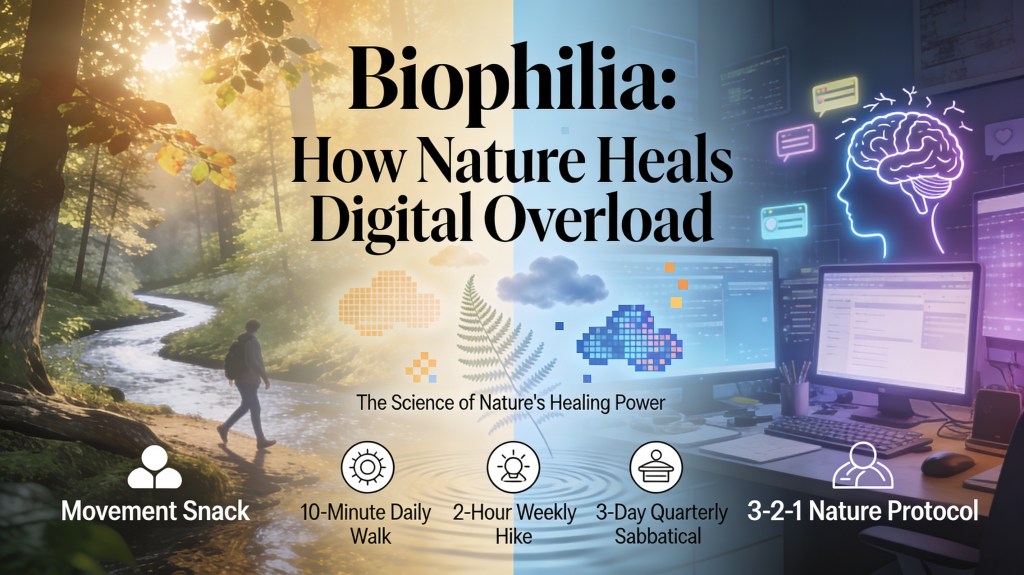
The 3-2-1 Nature Protocol for High Performers
If you are a nomad, a freelancer, or someone pursuing FIRE (Financial Independence, Retire Early), you treat your time and energy as assets. You wouldn’t ignore a 10% drop in your portfolio, so why ignore a 10% drop in your cognitive output?
To combat digital overload, I recommend a tiered Nature Protocol.
1. The Daily “Movement Snack” (10 Minutes)
You don’t need a national park to benefit from Biophilia. The “Lindy Effect” of nature suggests that even small, consistent exposures have compounding benefits.
- The Action: Every morning, within 30 minutes of waking, get outside. The combination of “Morning Light” (for your circadian rhythm) and natural movement resets your nervous system for the workday ahead.
2. The Weekly “Non-Digital Deep Dive” (2 Hours)
Once a week, you need to reach the “threshold of immersion.” Research suggests that 120 minutes a week in nature is the “minimum effective dose” for significant health gains.
- The Action: A two-hour hike, a visit to a botanical garden, or sitting by a body of water—phone-free. The “phone-free” part is non-negotiable. If you are documenting the nature on Instagram, you are still in the digital infosphere.
3. The Quarterly “Digital Sabbatical” (3 Days)
This is what I call the “Three-Day Effect”. It takes roughly 72 hours in the wild for the brain to fully shed the “digital skin” of modern life. By the third day, alpha waves in the brain increase, and your creative problem-solving capacity can jump by as much as 50%.
- The Action: Once a quarter, go off-grid. No Wi-Fi, no pings, no “quick check” of the markets.
Biophilic Design: Fixing Your Nomad Base
As digital nomads, we often have little control over our environments. We move from Airbnbs to co-working spaces. However, you can “hack” your immediate surroundings to reduce digital friction.
- The Green Wall: If you are staying in one place for more than a month, buy three indoor plants. The mere visual presence of greenery has been shown to reduce heart rate and improve task performance.
- Fractal Art: If you can’t see nature, look at pictures of it. Research shows that looking at high-definition photos of natural fractals (like snowflakes or fern leaves) can trigger the same parasympathetic response as the real thing.
- Open the Window: Natural airflow and the “soundscape” of the outdoors—even if it’s just the wind—prevent the sensory deprivation that leads to burnout.
Nature as a Force Multiplier for FIRE
You might wonder why a blog about Financial Independence is discussing trees. The answer is Efficiency.
The path to FIRE is a marathon, not a sprint. The “Boring Middle” of the FIRE journey is where most people fail because they burn out. They overwork, ignore their health, and spend money on “retail therapy” to compensate for their misery.
Nature is the ultimate Low-Cost, High-ROI health intervention. It costs nothing to walk in a forest, but the “Longevity Dividend” it pays is massive. If you arrive at Financial Independence with a broken nervous system and a sedentary body, you haven’t actually won the game. You’ve just traded your health for a number on a screen.
Conclusion: Reclaiming the Human Baseline
Digital overload is not a personal failure; it is an environmental reality. We are the first generation of humans to live entirely inside a simulated world of pixels and light.
By embracing Biophilia, we aren’t “going back to the caves.” We are simply acknowledging our biological requirements. We are “Intellectual Nomads” who use the best of technology to build wealth, but we must use the best of nature to keep our sanity.
Tomorrow morning, leave the phone on the charger. Walk outside. Look at the trees. Reconnect with the original operating system. Your brain—and your portfolio—will thank you.
Related Reading
If you enjoyed this deep dive into the intersection of health, environment, and performance, you may find these previous posts valuable:
- Digital Minimalism for Nomads: How to Unplug and Work
- How to Optimize Your Nervous System for Better Focus, Performance, and Health
- How to Fix Your Circadian Rhythm as a Remote Worker: Screen Time & Sleep Tips
- The Cost of Being “On” All Day: How Modern Work Overloads Your Nervous System
- Morning Light: The Ultimate Performance Hack for Remote Workers
- Why Some Cities Recharge You (and Others Drain You): The Hidden Energy Cost of Urban Living
- Biohacking Simplicity: Small Habits, Big Health Gains
- Designing a Body That Tolerates Modern Life: How to Stay Healthy in a Sedentary, Screen-Based World
 VD
VD 
Leave a comment